An Unexpected Journey into Kent’s Past
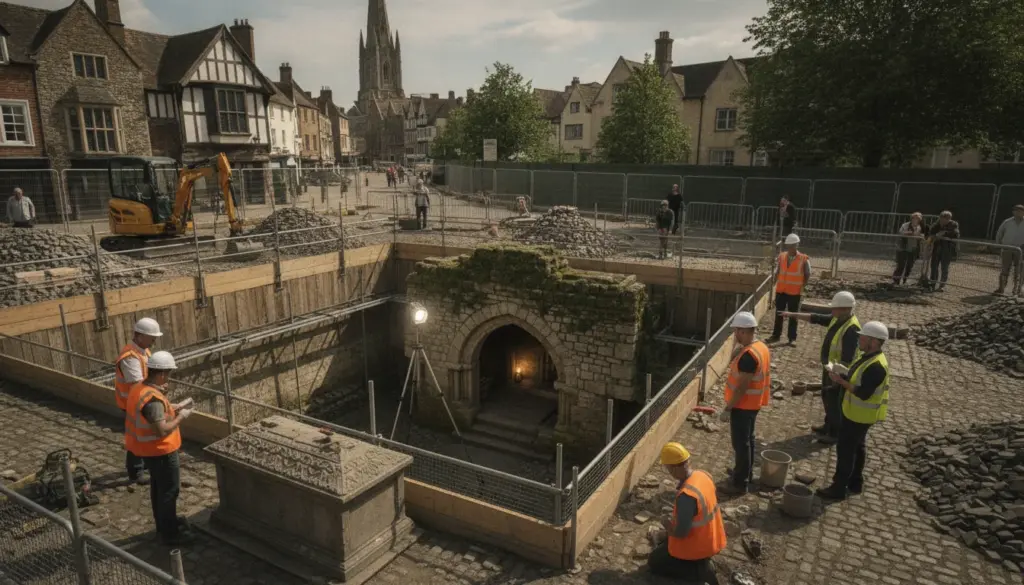
What began as a routine urban renewal project quickly morphed into a captivating historical investigation. While preparing ground for modern seating and fresh paving in Canterbury, construction crews unearthed a mysterious 18th-century crypt.
Resting silently beneath a bustling pedestrian walkway for well over a century, the forgotten tomb has suddenly re-emerged. This remarkable subterranean discovery offers a unique window into the regional history of Kent, bringing the legacy of an overlooked poet and vicar back into the public eye.
The St. Mary Bredman Surprise
The municipal groundwork was taking place at the historic St. Mary Bredman square. Initially, the local council’s only goal was to revitalize the neighborhood by introducing a tranquil, green relaxation zone for residents.
The situation changed dramatically the moment crews lifted the original stone paving slabs. Hidden safely below the surface was an intact brick structure that had not been seen since the overlying church was systematically demolished in 1900.
Calling in the Heritage Experts
Recognizing the significance of the subterranean architecture, city officials immediately halted work and brought in specialists from the Canterbury Archaeological Trust. These seasoned heritage professionals quickly mapped the underground chamber, locating it in the eastern quadrant of the vanished church—exactly where the sacred altar once stood.
Initial historical deep-dives link this specific burial vault to the Reverend John Duncombe, a prominent figure who passed away in January 1786. Lead archaeologist Jess Twyman advises that while absolute certainty requires further proof, securing a resting place directly beneath an altar strongly indicates an individual of immense community importance.
Memento Mori: Uncovering Funerary Art
Survey teams carefully recorded the vault’s dimensions, confirming the crypt spans precisely 2.5 meters in length and roughly a meter in width. As researchers meticulously sifted through the century-old rubble, they encountered a collection of elaborately carved grave markers.
One striking stone showcases a traditional “memento mori” aesthetic, prominently featuring a sculpted skull and laurel wreath. For historians studying period burial customs, these intricate details represent both standard and deeply mesmerizing examples of 18th-century sepulchral art.
Public Fascination and a Revised Vision
Conducting a sensitive excavation along one of Canterbury’s most heavily trafficked thoroughfares naturally drew a captivated audience. As Twyman humorously pointed out, whenever a mysterious opening appears in the pavement, passing pedestrians simply cannot resist taking a peek into the past.
The square’s revitalization blueprint is still moving forward, though the final design has been thoughtfully adapted to honor the discovery. A custom mural will now be installed to celebrate the site’s rich ecclesiastical roots, while the newly recovered headstones will be permanently displayed for public viewing. Local councilor Charlotte Cornell expressed immense enthusiasm for the adjusted plans, noting how incredibly exciting it is to weave forgotten heritage back into crucial civic spaces.