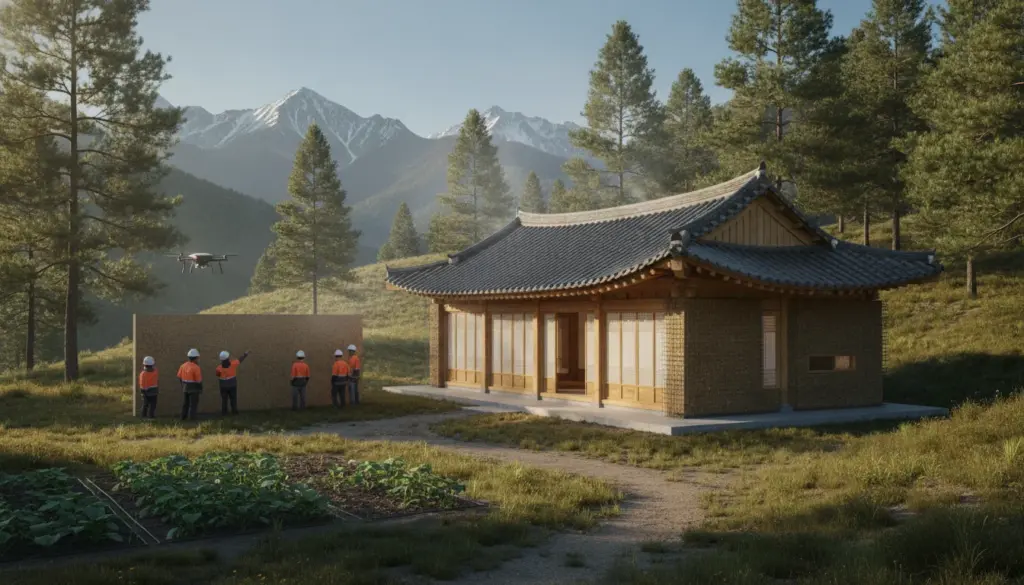
Reimagining Modern Living Through Ancient Wisdom
Today’s residential construction frequently overlooks a crucial element: blending seamlessly with the environment while providing organic comfort. Yet, picture a residence designed to last for generations, breathing naturally alongside its surroundings and delivering ultimate resilience against harsh weather. This exact vision comes to life through the Korean hanok architectural style, which recently made its way to Argentina by merging millennial traditions with cutting-edge technology.
Nestled among aromatic pine trees and the calming sounds of the sea in beautiful Costa Esmeralda, the very first hanok-inspired dwelling has emerged. This unique project stems from the shared vision of two architects, Félix Raspall and Jennifer Lee. Their professional paths crossed during their time at Harvard, where both developed a deep fascination for traditional South Korean building techniques. They were captivated by how these structures prioritize ecological unity and visual appeal over rigid, everyday functionality.
The Foundations of Millennial Design
Dating all the way back to the 14th-century Joseon era, the hanok philosophy relies heavily on raw, unprocessed materials like timber, stone, and natural earth. At the core of this design is the concept of baesanimsu. This ancient principle dictates that the perfect dwelling should sit with a mountain protecting its rear and a body of water flowing at its front, a layout precisely crafted to capture natural energy and optimize sunlight exposure.
Bringing this Eastern philosophy to the South American coastline demanded careful thought and architectural finesse. Rather than strictly replicating historic designs, the creative team opted for a thoughtful reinterpretation. The home revolves around a madang—a traditional open courtyard serving as the vital core of the property. Additionally, the architects incorporated expansive roof overhangs that diffuse intense sunlight and expertly shield the primary framework from torrential downpours.
As an architectural specialist might note, integrating Korean-style extended eaves is a brilliant strategy for regions with unpredictable climates. Precisely calculated roof extensions allow the lower winter sun to warm the interior naturally, while completely blocking scorching summer rays. This creates an ingenious, electricity-free temperature regulation system that keeps the indoor climate comfortable year-round.
Inside the Argentine-Korean Architectural Marvel
The entire layout orbits the central open space and rests elevated on sturdy stilts. This raised foundation acts as an exceptional barrier against ground moisture. Stepping indoors reveals two comfortable bedrooms alongside a versatile tea room. Every material chosen for this build serves a singular, overarching purpose: to blur the boundaries between the indoor living spaces and the outside world.
Despite its historical roots, the property is fully equipped with contemporary innovations. While classic hanoks are renowned for their traditional ondol floor heating, this coastal adaptation introduces modern climate control, double-pane glazing, and advanced smart home automation. Consequently, the occupants experience premium convenience without sacrificing the structure’s rugged, original aesthetic charm.
Ultimately, this remarkable coastal retreat represents much more than a simple shelter. It acts as a fascinating cultural bridge, transplanting ancient design wisdom into an entirely new hemisphere defined by distinct coastal light and maritime conditions. Every angle of this property challenges us to rethink how we interact with our built environment, making it the perfect inspiration to keep in mind when designing your future dream home.