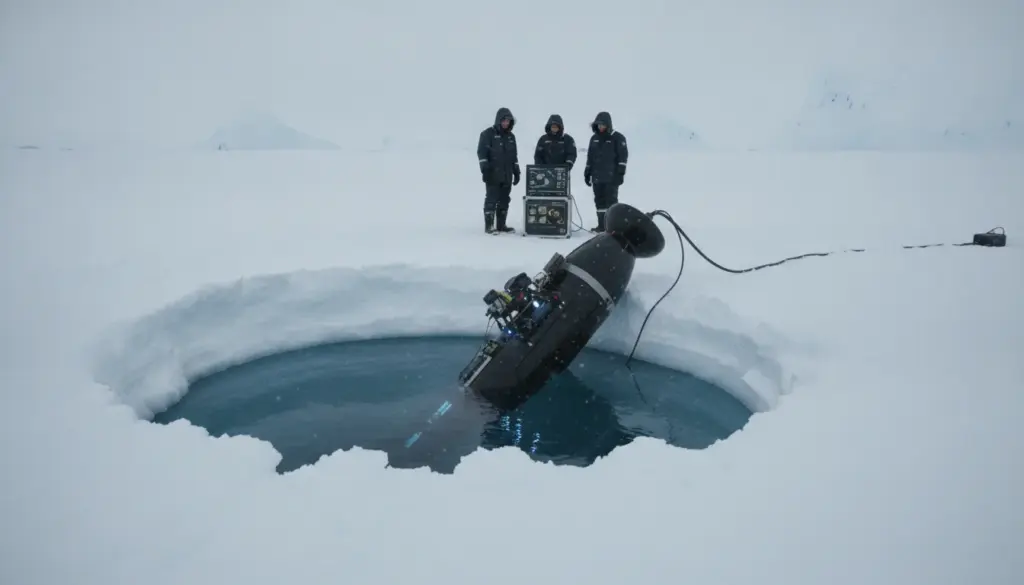
Picture launching a highly advanced aquatic drone into an environment untouched by human presence, only for it to vanish immediately after transmitting groundbreaking data. The vanishing of the autonomous underwater vehicle, known as Ran, beneath the Dotson Ice Shelf feels like a plot from a sci-fi thriller. However, this event actually represents a pivotal turning point in our understanding of global sea-level rise. Based on the preliminary information it managed to beam back, our current climate forecasting models could be entirely off base.
In early 2024, following two years of rigorous scientific investigation, the six-meter submersible was lost beneath the ice in West Antarctica. Researchers deployed the craft to investigate the glacial underside—a completely uncharted realm often compared to the dark side of the moon. Honestly, the scientific community was completely blindsided by this dramatic conclusion, leaving experts grappling with numerous unresolved questions.
Mapping the Unknown Ice
Exploring this subglacial cavity is remarkably similar to observing the hidden face of the moon, notes lead researcher and physical oceanography professor Anna Wåhlin from the University of Gothenburg. While previous glaciological surveys relied heavily on satellite imagery and traditional ice cores, this mission finally allowed experts to peer directly into the concealed gap separating the ocean floor from the glacial ceiling. By gathering exceptionally detailed high-resolution maps, the submersible unveiled geological formations entirely new to science.
The robotic explorer ventured more than 16 kilometers deep into the massive underwater cavern. Utilizing cutting-edge sonar technology, it documented highly unusual physical characteristics, including distinctive teardrop-shaped formations, sprawling icy plateaus, and intricate erosion patterns. In fact, these unprecedented observations are actively challenging our existing scientific paradigms. According to the research team, contemporary ice-melt models simply cannot account for the bizarre terrain the submersible encountered.
Unlocking Glacial Melting Mechanics
The primary objective behind deploying this advanced drone was to capture precise data regarding how glaciers melt, specifically looking at their interaction with deep ocean currents. Oceanographers desperately wanted to comprehend why the eastern section of the Dotson shelf remains significantly thicker and melts at a much slower rate compared to its western counterpart.
Recent published data confirms that this stark contrast is driven by the influence of deep circumpolar waters—a dynamic blending of currents from both the Pacific and Indian Oceans. This circulation acts as a primary catalyst. The warmer, highly turbulent water flows aggressively erode the glacier’s western edge, while the eastern side remains largely sheltered from this intense exposure.
During its operational lifespan, the craft successfully surveyed roughly 130 square kilometers of submerged ice. What it revealed was a structural complexity far exceeding any prior hypotheses. The research team openly admits that many long-held scientific assumptions are simply no longer valid, as traditional predictive models never anticipated the elaborate, chaotic patterns displayed on the newly generated subglacial maps.
An Unforgiving Environment
Operating equipment in such an extreme, hostile ecosystem makes real-time communication virtually impossible. Once submerged beneath massive layers of frozen freshwater, GPS and standard tracking systems become completely useless. Dive durations ranged anywhere from a few short hours to well over a full day, turning basic navigation into an incredibly daunting logistical challenge. Despite these massive hurdles, the drone flawlessly executed 14 successful underwater missions back in 2022.
Tragically, when the research initiative resumed two years later, the submersible vanished without a single trace during its very first deployment. The scientific team is left to endlessly speculate about its ultimate fate. Did it become trapped on an uncharted underwater ridge? Was it compromised by an unknown biological entity or a sudden mechanical failure? The only undeniable fact is that the machine never arrived at its designated recovery coordinates, and absolutely no wreckage has ever been recovered.
While the expedition secured truly invaluable environmental data, researchers acknowledge they missed out on capturing the complete picture. The team stresses that pushing forward with these subglacial investigations is absolutely vital for predicting the continent’s environmental future, and plans are already underway to commission a replacement vessel. Ultimately, this gripping loss serves as a powerful reminder of how much of our own planet remains completely shrouded in mystery.