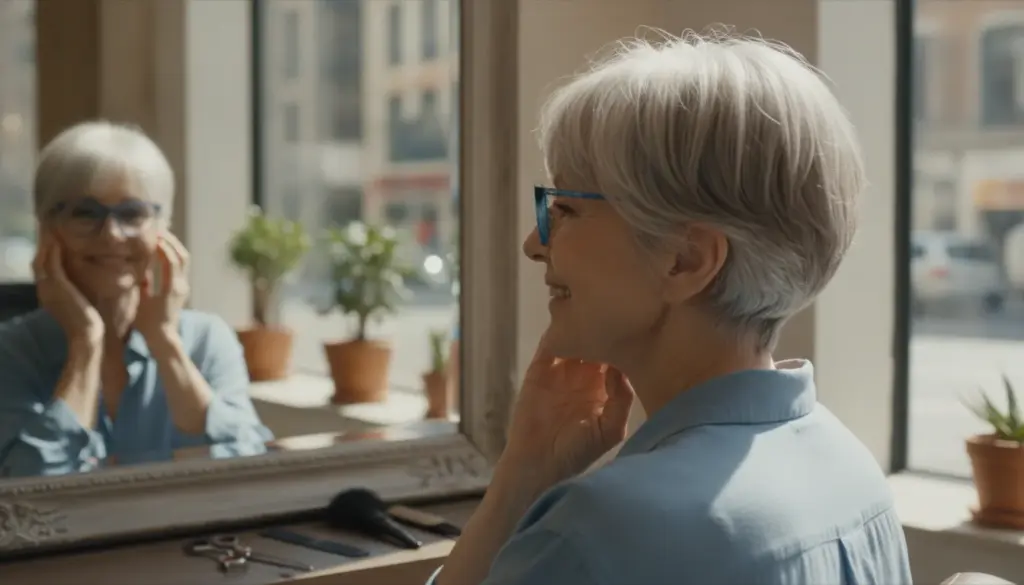
There is actually a highly specific short cut that offers a surprisingly soft aesthetic, draws attention away from wrinkles, and flawlessly complements both your optical frames and thinning hair. By making a few strategic requests in the salon chair, you can transform the pairing of your glasses and hair into a remarkably fresh, personalized style.
Why Cropped Styles Often Shine After 70
As we approach our seventies, our hair undergoes significant natural transformations. Strands generally become finer, overall volume diminishes, and noticeable thinning may occur in certain spots. Furthermore, silver and white strands tend to develop a coarser texture, often becoming a bit unruly. This prompts countless women to embrace shorter lengths for the sake of sheer convenience—less blow-drying, reduced styling time, and maximum comfort.
However, simply requesting a generic short chop doesn’t always yield the most flattering results. When you wear spectacles, an additional visual element comes into play, as your frames already create a bold border around your eyes. Opting for a severely cropped or ultra-sleek style can cause a few unintended styling hurdles.
- Accentuate fine lines around your delicate eye area and mouth.
- Expose your facial features too much, which can appear harsh if you possess a narrower jawline.
- Clash awkwardly with prominent, thick, or angular eyewear.
- Flatten the appearance of hair that is already experiencing thinning.
The objective isn’t to hide your features behind heavy layers. Instead, you want to introduce strategic, sweeping lines that bring both gentle softness and radiant clarity to your complexion.
The Magic of a Short, Layered Cut Paired with Glasses
For women over seventy who wear glasses, seasoned stylists consistently recommend one specific look: a short, softly layered cut. We aren’t talking about a rigid pixie or a severe boy-cut, but rather a fluid style featuring varying lengths. This specialized technique builds essential volume precisely where it’s needed while keeping the perimeter around the face beautifully soft.
So, what exactly does this dynamic layered approach entail?
- At the crown: Preserving slightly more length and incorporating textured layers creates crucial lift, offering an optical lifting effect for your entire face.
- Around the face: Leaving the front sections slightly longer prevents fine lines from taking center stage.
- At the nape: Tapering the back for a tighter, shorter finish ensures an effortlessly crisp and polished silhouette.
- Near the temples: This area is highly customized to your eyewear. Stylists will leave less bulk for wide frames, or keep it fuller for delicate wire-rimmed glasses.
Cleverly placed layers instantly breathe life and movement into even the finest hair textures. A skilled stylist will position the shortest pieces just above any sparse zones, allowing the longer layers to cascade gracefully over them for a noticeably thicker illusion. Ultimately, a masterfully layered cut acts as a gentle real-life filter, shifting the focus away from wrinkles and directly toward your vibrant eyes and smile.
Harmonizing Your Hairstyle with Your Frames
Because your spectacles are a permanent fixture on your face, they demand just as much consideration as your tresses. The specific silhouette, hue, and thickness of your glasses ultimately dictate which haircut lines will flatter your features the most.
Color dynamics play a surprisingly crucial role in this balance. Wearing a heavy, dark frame against snowy white or silver hair creates a striking, high-contrast aesthetic. In these instances, a serene, neatly layered cut often looks much more sophisticated than a wildly tousled style. Conversely, if you prefer translucent or softly colored frames, you have the perfect canvas to experiment with a much more playful, textured hairstyle.
Finding the Perfect Shape and Length
The true artistry lies in retaining enough length around your features without allowing the hair to look heavy or blocky. While achieving this perfect balance requires a customized approach, a few professional rules of thumb can expertly guide you.
Keep these specific details in mind during your salon consultation:
- Cheek-grazing pieces: Allowing front strands to fall right at or just below the cheekbones significantly softens deeper facial creases and creates a remarkably welcoming expression.
- A whisper-light fringe: Incorporating a wispy, side-swept bang breaks up a taller forehead and effectively diffuses the appearance of forehead lines without feeling oppressive.
- A clean neckline: Keeping the nape closely cropped instantly elevates your overall polish and completely stops annoying friction against your shirt collars.
- Amplified crown volume: Securing extra lift at the top of the head combats the dreaded “flattened” look that frequently plagues thinning textures.
While every unique bone structure demands its own specific length adjustments, practically everyone benefits immensely from embracing softer, sweeping lines around the eyes and cheekbones.
Communicating Effectively with Your Stylist
When pursuing a major hair transformation, a clear, honest conversation often proves far more valuable than a stack of inspiration photos. Always ensure you wear your everyday glasses to the salon, and critically, keep them on your face while the stylist visually maps out the haircut.
Try using these highly effective phrases while sitting in the styling chair:
- “My glasses are a daily staple, so the new shape absolutely needs to harmonize with these frames.”
- “I’m looking for a shorter, airier feel, but I don’t want my face to feel overly exposed.”
- “Is it possible to build some low-maintenance volume at the crown without requiring heavy styling?”
- “I’ve noticed some thinning in these specific areas, so I’d prefer to avoid any harsh, rigid partings.”
- “My ultimate goal is a style I can easily finger-tousle and finish in under five minutes.”
Additionally, establish a consistent maintenance schedule with your professional. For a beautifully layered short cut, booking a trim every six to eight weeks is the absolute sweet spot. Delaying appointments beyond this window causes the structural layers to droop, making fine hair appear limp and lifeless once again.
Expert Styling Tricks for Finer Textures
While a meticulously crafted haircut eliminates the vast majority of your daily styling struggles, a few insider techniques will truly elevate your final look.
- Opt for weightless lifters: Work a touch of airy mousse or a specialized volume powder directly into the roots—especially at the crown—to encourage effortless bounce and movement.
- Practice product restraint: Heavy pomades, thick waxes, or dense oils will immediately drag fine strands down, inadvertently spotlighting sparse patches on the scalp.
- Master the finger-dry method: Use your blow dryer to push the hair entirely against its natural growth pattern for maximum root lift, only utilizing a styling brush at the very end to smooth the tips.
- Protect your silver hues: Maintain your white or gray strands with an ultra-hydrating daily cleanser, weaving in a purple shampoo occasionally to expertly neutralize any unwanted brassy yellow tones.
At this stage in life, discovering a haircut that falls flawlessly into place with a mere shake of the hands feels incredibly luxurious compared to wrestling with a stiff, heavily manipulated style.
Why This Specific Hairstyle is Incredibly Forgiving
The sheer adaptability of the short, layered crop makes it universally flattering across diverse facial proportions and eyewear choices. If you possess a rounder facial structure, your stylist can preserve extra height in the uppermost layers while slightly tapering the sides for a visually slimming effect. Conversely, those with longer, narrower faces benefit greatly from added width and fullness near the temples. Simply tweaking the length of those delicate cheek-framing pieces instantly establishes a beautiful sense of symmetry.
This methodology is an absolute game-changer for anyone dealing with receding hairlines or a noticeably thinning crown. Expertly mapped layers can be strategically positioned to gently obscure those specific zones, offering graceful coverage without ever looking like you are intentionally trying to camouflage something.
Enhancing Your Natural Glow and Color
Fully embracing your natural silver or white transition doesn’t mean you have to automatically reach for traditional hair dye. The striking combination of an updated cut, contemporary eyewear, and a touch of soft makeup—such as a healthy pop of cream blush and a vibrant lipstick—projects incredible, youthful vitality. However, if your natural gray happens to feel slightly dull, a subtle, semi-permanent gloss or toner can brilliantly revive your overall complexion.
Finally, never underestimate the power of proper lighting during your salon visit. Don’t hesitate to ask your stylist if you can quickly check your new cut near a window in natural daylight. This allows you to accurately evaluate how the freshly snipped lines interact with your frames and skin tone in the real world. Doing so gives you the perfect opportunity to request minor, on-the-spot tweaks—like softening a front piece or taking the neckline up just a fraction more—ensuring your final look is absolutely flawless.