
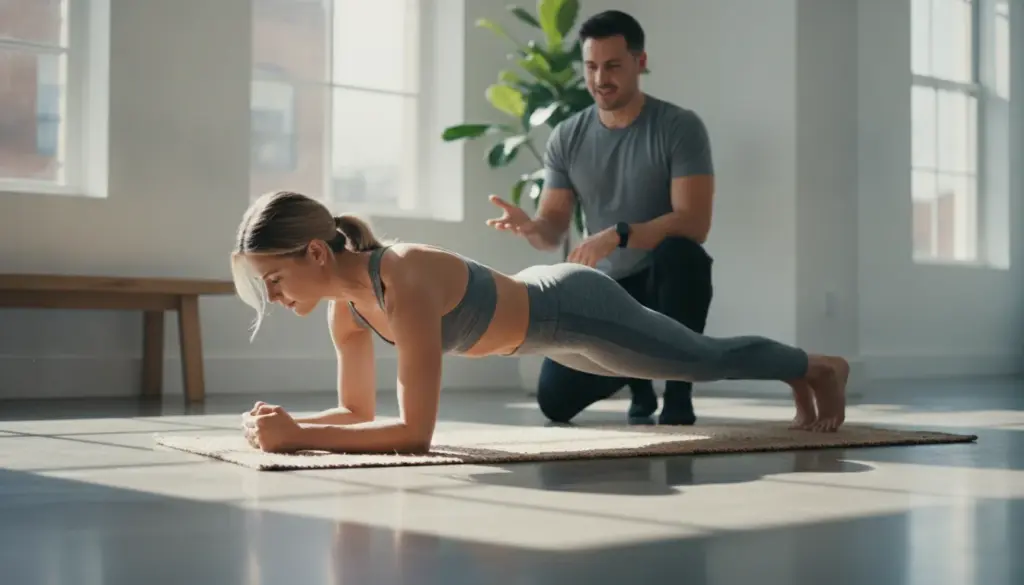
More and more fitness professionals are pointing their clients toward one surprisingly straightforward movement. Instead of handing out complicated workout spreadsheets and heavy, expensive weights, coaches frequently opt for a fundamental motion you can execute anywhere, taking just a few minutes a day. While this move might appear a bit dull from the outside, anyone who performs it with proper form quickly realizes how almost every single muscle has to pitch in.
Why so many trainers recommend the exact same movement
The go-to exercise that countless fitness experts rely on is the plank. At first glance, it looks incredibly easy, as you are simply holding your body perfectly still in a straight line. However, in reality, this static hold demands much more coordination, muscular endurance, and mental focus than most beginners anticipate.
Planking goes far beyond just targeting your abdominal region. Your entire physical structure has to work together as a synchronized unit. To keep your torso stable, your shoulders, back, glutes, hips, and legs all must contract simultaneously. Because of this full-body tension, a thirty-second hold often feels significantly more challenging for newcomers than cranking out a long set of traditional sit-ups.
Ultimately, this movement doesn’t isolate a single muscle group, but rather conditions an entire muscular network that actively supports your daily posture. Fitness coaches appreciate this exercise for three main reasons: it delivers results, it remains remarkably straightforward, and you can practice it virtually anywhere. You do not need dumbbells, resistance bands, or a bench—just a tiny patch of floor space and a few minutes of your time.
Exactly what a static hold does to your muscles
Building core strength without the crunches
This exercise heavily targets the trunk muscles, a group commonly referred to as your core. Keep in mind, core strength is about much more than achieving a visible six-pack. It encompasses all the muscular tissues wrapping around your midsection, including your abdominals, lower back, obliques, pelvic floor, and deep stabilizing muscles.
When you engage this network properly, you unlock several structural benefits:
- Your spine receives significantly better structural support
- Your upright posture improves whether you are sitting at a desk, standing, or walking
- The risk of strain in both your neck and lower back noticeably decreases
- Everyday physical tasks, such as lifting groceries, bending over, and climbing stairs, begin to feel much more fluid
Because you are holding completely still rather than moving up and down, exercise physiologists refer to this as an isometric contraction. The muscle fibers remain actively engaged without actually changing their physical length. This specific type of tension creates a deep, intense muscular fatigue, especially in the supportive muscles that tend to weaken when we spend too much time sitting down.
Activating the entire body in a fraction of the time
If you perform a plank correctly, you will immediately notice that practically everything is working hard. You have to push gently through your arms, stabilize your shoulder blades, pull your stomach inward, squeeze your glutes tightly, and lock your legs in place. Rather than cycling through a tedious list of isolated exercises, holding this posture acts as a highly efficient, all-in-one package.
Committing to just a few brief sets each day generally yields better long-term results than dreaming up an overly ambitious gym routine that you never actually start. Because the time commitment is so minimal, it fits seamlessly into even the most chaotic daily schedules.
Many certified trainers advise their clients to start with just a couple of minutes daily to gently build a sustainable fitness habit. The barrier to entry stays incredibly low, yet your body starts feeling notably stronger almost immediately.
How to master proper form right in your living room
Establishing the step-by-step foundation
To execute a classic forearm plank, you need to establish a solid structural base. You should feel the correct physical tension not just in your stomach, but radiating throughout your entire frame. While you shouldn’t be shaking uncontrollably from the effort, you also want to avoid settling into a relaxed, sagging position where gravity does the work.
Common technical errors to watch out for
Movement specialists constantly emphasize that technical precision matters far more than the number of seconds on a stopwatch. Someone who struggles through a full sixty seconds with a sagging lower back gets significantly less benefit than someone who holds a crisp, highly controlled posture for three sets of twenty seconds.
Progressing from novice to advanced holding times
Starting slowly when you are new
For absolute beginners, executing three sets of 15 to 20 seconds, with a brief rest in between, is usually more than enough. While that duration might sound minimal on paper, it feels surprisingly intense when you are down on the mat. Once you can maintain that specific time frame with rock-solid stability and zero trembling, you are ready to scale up.
Here is a very practical guideline many fitness coaches use to map out progression:
- Weeks 1 and 2: Aim for 3 sets of 15 to 20 seconds
- Weeks 3 and 4: Push up to 3 sets of 25 to 30 seconds
- Moving forward: Gradually increase your holding time, add more sets, or introduce challenging variations
Always tune in to what your body is telling you. Experiencing a mild, dull burning sensation in the working muscles is perfectly normal, but sharp, shooting pain in your lower back or shoulder joints is absolutely not. If you feel actual pain, simply drop the duration or opt for a modified version, like gently resting your knees on the floor.
Variations for those craving an extra challenge
Once you have completely mastered the foundational move, you can ramp up the intensity without buying any extra equipment. Try these highly effective variations:
- The straight-arm hold: Place your hands directly under your shoulders with your body in a perfectly straight line, placing more dynamic load on the chest and shoulder capsules.
- The side hold: Balance on a single forearm and the outer edge of your foot, a modification that intensely targets the oblique muscles along your sides.
- Arm or leg lifts: Alternately lift one leg or one arm off the ground. This deliberate instability forces your core to work incredibly hard to prevent rotation.
- The shoulder tap: From a high, straight-arm position, use one hand to tap the opposite shoulder while keeping your hips entirely frozen in place.
By introducing these tiny elements of instability, you teach your torso to react faster and more intelligently to unexpected shifts in movement.
Safety considerations and knowing when to modify
While this static hold is highly appropriate for the vast majority of people, certain individuals should proceed with extra caution. If you are dealing with chronic neck, shoulder, or severe spinal issues, it is always wise to consult with a physical therapist or a medical doctor first. These healthcare professionals can suggest safer alternatives or slightly adjusted angles.
Furthermore, anyone recovering from pregnancy or abdominal surgery should reintroduce this movement gradually as part of a structured rehabilitation plan. The deep abdominal wall often requires highly targeted, lighter activation exercises before diving back into prolonged, intense static holds.
Smart ways to blend this into your daily routine
This straightforward exercise serves as a fantastic anchor for a brief morning or evening mobility routine. Consider setting up a quick circuit where you alternate between the floor hold, some light bodyweight squats, and a few upper back stretches. This approach helps you construct a durable, stable physique without forcing you to commit to an hour-long gym session.
Athletes who regularly cycle, run, or play tennis will also reap immense benefits from consistent core conditioning. A sturdier trunk ensures that the power generated by your arms and legs transfers much more efficiently. Your athletic movements become highly coordinated, which naturally boosts your performance while lowering your vulnerability to sports injuries.
Finally, practicing this isometric hold builds profound mental resilience. You are simultaneously training your physical endurance, your breathing patterns, and your sheer willpower in one compact posture. Every single second you manage to maintain a pristine position provides a tangible sense of accomplishment—and that intrinsic motivation is exactly what gets you back on the floor the very next day.