The long-held belief that deep soil layers serve as an pristine, untouched archive of our past has just come crashing down. Scientists have detected contemporary plastic particles within sediment dating back to the Roman Empire—a troubling find that throws our entire understanding of how to read the planet’s history into question.
Polymer particles where they simply shouldn’t be
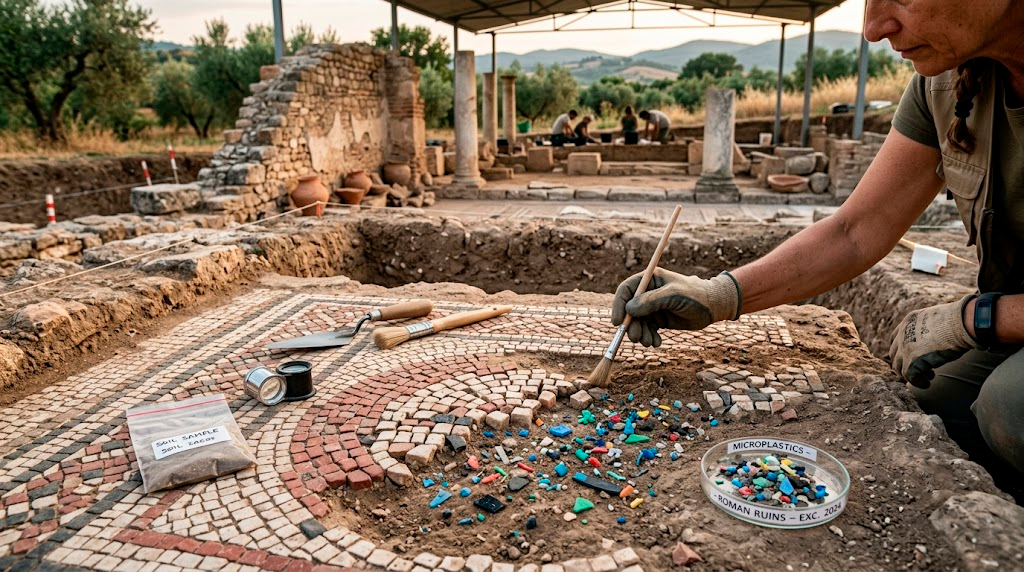
While analysing core samples in York, researchers stumbled across something that left them utterly shell-shocked. In strata reliably dated to the 1st and 2nd centuries AD, they uncovered the unmistakable presence of microplastics. To be brutally honest, this isn’t merely an environmental headache; it is a full-blown scientific disaster.
Here are the key facts regarding this discovery:
- Samples were extracted from depths of over 23 feet (7 metres).
- State-of-the-art $\mu\text{FTIR}$ spectroscopy was deployed to identify the polymers.
- A staggering 16 different types of microplastic were identified.
- The contamination was present in both freshly dug trenches and archived samples from the 1980s.
To put it bluntly: the Romans certainly weren’t using plastic. This is modern waste that has infiltrated archaeological layers we previously considered hermetically sealed time capsules.
Geoarchaeology Specialist:
“In 2026, we have to face the uncomfortable truth that microplastics act as a ‘chemical gatecrasher’, altering soil pH. This could trigger a rapid acceleration in the decay of delicate organic artefacts—like Roman leather or textiles—which have survived for millennia but could now vanish within decades.”
Why this find wrecks the ‘Anthropocene’ timeline
Until now, scientists—including the late chemist Paul Crutzen—suggested that plastic would serve as the textbook marker for the Anthropocene, the new epoch defined by dominant human impact on Earth. It was widely assumed that a distinct layer of plastic in the ground would neatly point to the mid-20th century. Now, there is a massive spanner in the works.
The catch is that the geological record isn’t an orderly library. Microplastics are highly mobile. These tiny particles migrate through the pores of the soil, carried downward by water movement and biological activity. Boom. Our “perfect marker” has effectively travelled two thousand years back in time, muddying the historical waters.
How modern rubbish ‘travels’ back in time
This isn’t magic; it is simple soil mechanics. Earth sediment isn’t a solid concrete block, but a complex, breathing network of mineral particles, moisture, and micro-organisms.
- Spherical particles find it easiest to slip down into the deepest subterranean layers.
- Synthetic fibres, by contrast, tend to get snagged higher up in the soil matrix.
- Groundwater fluctuations act like a lift, moving microscopic polymers up and down.
- The presence of plastic alters local chemistry, which threatens to skew radiocarbon dating results.
This discovery is a massive wake-up call. If we can no longer trust the purity of archaeological strata, reconstructing ancient landscapes and lifestyles is about to become an uphill struggle.
FAQ: What you need to know about plastic in archaeology
Did the Romans manufacture plastic?
No, absolutely not. The plastic found in these ancient layers is entirely modern contamination. It has filtered down through the earth from the surface or via groundwater into strata deposited 2,000 years ago.
How did scientists detect plastic in such old soil?
They utilised $\mu\text{FTIR}$ spectroscopy. This laser-based laboratory technique allows researchers to identify the exact chemical fingerprint of microscopic fragments with incredible precision, easily telling natural minerals apart from synthetic polymers.
Why does this discovery pose a threat to history?
Because microplastics change the chemical environment of the surrounding soil. This shift can degrade ancient DNA or fragile organic remains, both of which are absolutely vital for understanding the diet, health, and diseases of people in antiquity.