Traffic through the Strait of Hormuz has ground to a virtual standstill, and the few tankers daring to make the passage are paying astronomical protection fees in cryptocurrency. The world stands on the brink of an energy paralysis, but the United Arab Emirates and Saudi Arabia have just launched a “Plan B” to break Tehran’s stranglehold on oil prices.
The situation is critical. From the 86 tankers a day that used to cruise through this strategic chokepoint before the conflict flared up, barely five make the journey now. Sultan Al Jaber, head of the Adnoc group, has pulled no punches, calling Iran’s actions “economic terrorism.” To be perfectly honest, it is a battle not just over oil barrels, but over who will call the shots in the Middle East for the next decade.
Pipelines instead of tankers: Will it be enough?
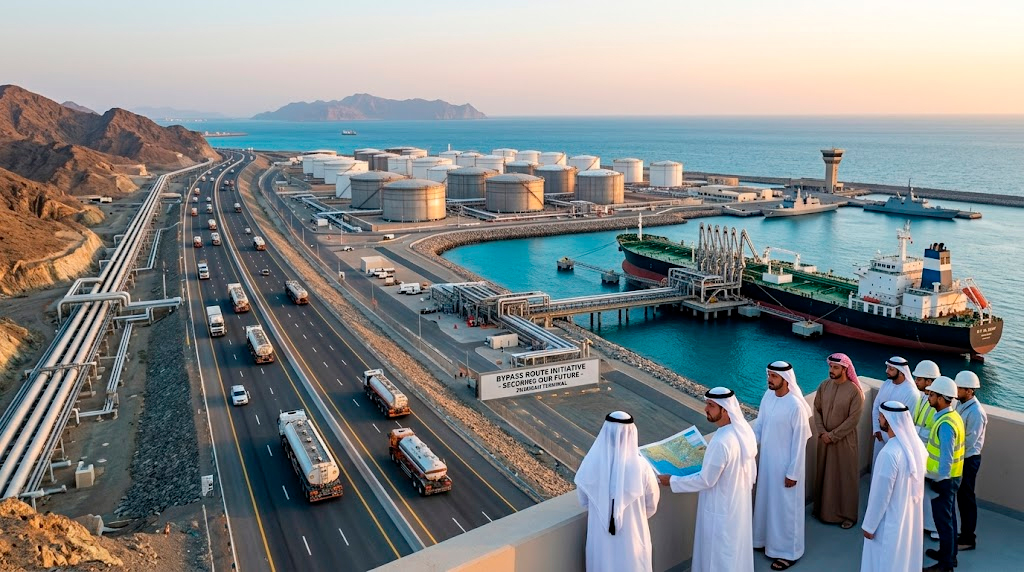
Gulf nations have spent years preparing for this exact nightmare scenario. While the pipelines bypassing Hormuz cannot fully replace historical export volumes, they currently offer the only genuine lifeline for the global economy. In short, without them, the world would grind to a halt.
The most vital alternatives include:
- The Emirati Pipeline (Adcop): Terminating at the port of Fujairah on the Indian Ocean, it can shift 1.7 million barrels a day.
- The Saudi East-West Line: Running to the Red Sea port of Yanbu, boasting a daily throughput capacity of up to 7 million barrels.
- Underground Storage: Adnoc has engineered a massive facility in Fujairah capable of holding 42 million barrels of crude for a rainy day.
- Etihad Rail: A state-of-the-art network connecting Abu Dhabi with Oman, specifically designed to transport fuels and chemical products.
The catch is that these very ports have become the new targets. Despite being far from Iran’s borders, both Fujairah and Yanbu have already been hit by drone and missile strikes. Any sense of security is purely an illusion.
Energy Geopolitics Expert:
“In 2026, relying on pipelines alone is simply no longer enough.”
The astronomical cost of ‘insurance’
The cash poured into this new infrastructure is staggering, but in the teeth of war, it pays off in a flash. The Habshan–Fujairah pipeline cost roughly £4.7 billion ($6 billion) to build. Sounds like a fortune? At current oil prices, an investment like that can pay for itself in just a single month of operating at full throttle. Boom.
The bleakest outlook faces those countries completely snookered by their own geography:
- Kuwait and Bahrain: They have no direct access to the open sea without passing right through Hormuz.
- Qatar: Completely reliant on maritime corridors that Iran holds in a vice.
- Iraq: Scrambling to revive older pipelines through Turkey (handling up to 1.5 million barrels a day) and Jordan to avoid Tehran’s blackmail.
Chinks in the grand strategy
Despite the billions pumped into concrete and steel, infrastructure has its limits. Pipes are relatively easy to patch up, but the pumping stations and loading terminals are the soft underbelly of the entire network. A single precision strike is all it takes to paralyse exports for weeks on end.
An additional headache is the logistics of handling different grades of crude. Blending light Saudi oil with heavy Basra crude is a logistical nightmare that drags down the market value of the cargo. That is the brutal truth you will rarely find in official press releases.