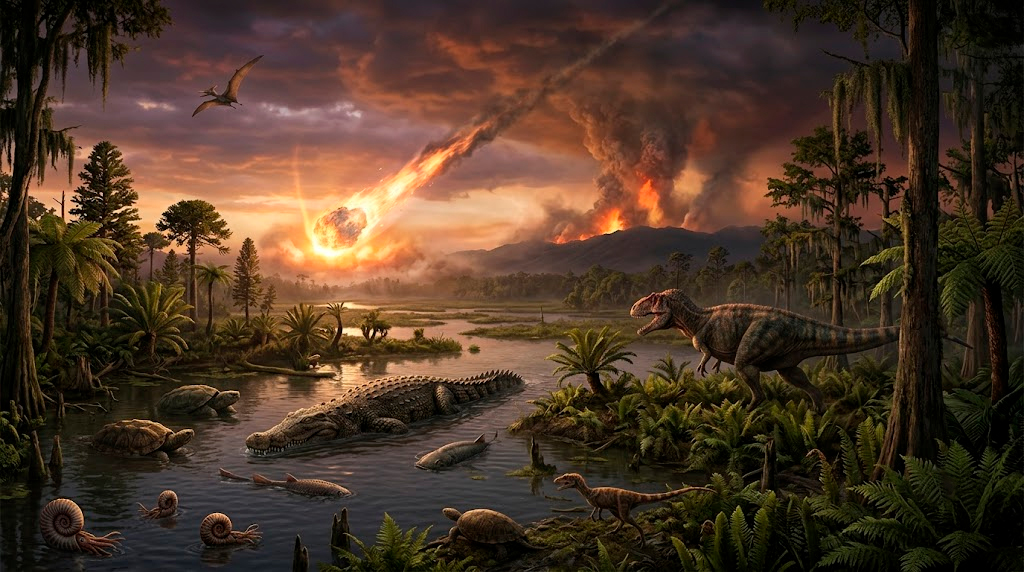
Imagine a warm, azure sea where predators larger than a double-decker bus lurk just beneath the surface. This isn’t a pitch for a sci-fi blockbuster, but the reality of what is now Louisiana 66 million years ago, which palaeontologists have just brought to light thanks to groundbreaking new research.
To be perfectly honest, while the region today conjures up images of bayous and jazz, it was once the arena for a brutal struggle for survival. Scientists from Louisiana State University, alongside international research teams, have reconstructed the ecosystem that existed right before the Chicxulub asteroid struck. The findings are as fascinating as they are terrifying.
Marine monsters dominated the Gulf
Before that cosmic rock slammed into the Yucatán Peninsula, Louisiana was completely submerged. It was a shallow, tropical basin that provided the perfect playground for giant reptiles. To put it bluntly: it was a predator’s paradise.
- Mosasaurs (Mosasaurus): Colossal marine reptiles of the genus Prognathodon, which grew to over 45 feet (14 metres) in length.
- Squalicorax: Scavenging sharks that never passed up the opportunity for a free meal.
- Dromaeosaurids: Dinosaurs whose remains suggest that the boundary between land and sea was incredibly fluid.
Traces of ‘ghost megawaves’ in the bedrock
When the asteroid struck Earth, it unleashed a cataclysm on a scale that defies human imagination. Louisiana bore the full, monstrous brunt of a megatsunami. Using seismic imaging, scientists have discovered what are known as “mega-ripples” buried deep underground.
These are gigantic, fossilised wave structures reaching up to 52 feet (16 metres) in height, spaced more than a third of a mile (half a kilometre) apart. They serve as physical proof of the unimaginable force of the water that swept across the continent. They are highly likely the largest “fossil waves” ever discovered on our planet. In short, it was the end of the old order. Boom.
A new dawn: How mammals took the baton
The demise of the great reptiles opened the door for our own ancestors. In Palaeocene sediments, researchers stumbled upon the remains of Anisonchus fortunatus—a primitive, hoofed mammal about the size of a small dog.
- The find comes from a deep-core sample drilled by an oil well.
- It is dated to between 62 and 63 million years ago.
- It documents the lightning-fast expansion of mammals across a shattered ecosystem.
- It shows how life manages to bounce back, even after total annihilation.
This tiny creature stands as a classic symbol of evolutionary success. Without the catastrophe that took out the mosasaurs, mammals would likely have never stepped out of the predators’ shadow.