We interact with mundane household objects daily, yet rarely pause to consider their specific design quirks. Your standard bath towel is a perfect example of this phenomenon. If you look closely, nearly every model features a distinct, textured band near the hem. While many assume this is just a touch of elegance, others wonder if there is a hidden, functional purpose behind it. It is definitely worth investigating if this is purely a matter of aesthetics.
What Is the Towel Stripe Called and What Does It Do?
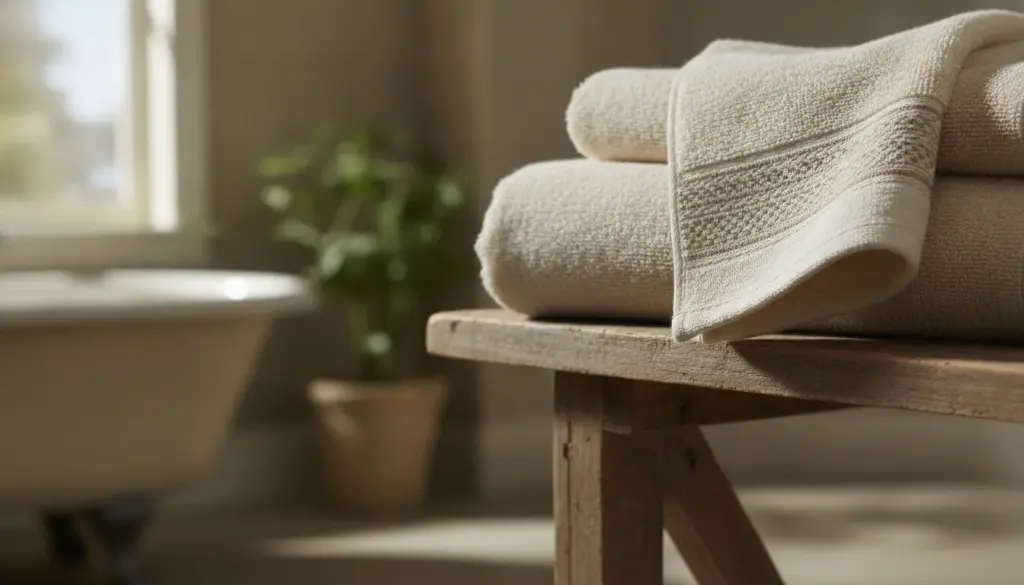
In the textile industry, this distinct woven fragment is officially known as a border—a decorative framing of the fabric. Manufacturers incorporate this element primarily to break up the visual monotony of plain terry cloth and help standard linens stand out on store shelves.
As anyone familiar with textile construction will tell you, this feature is almost entirely decorative. The stylized strip does absolutely nothing to boost the towel’s moisture-wicking capabilities, and it offers very little in terms of overall durability. Instead, it introduces a contrasting texture, a unique weave, or perhaps some delicate embroidery to give the piece a more premium character.
A widespread myth suggests that this solid band somehow reinforces the material. In reality, a towel’s overall toughness comes down to its cotton quality and fabric weight (grammage). That fancy trim simply won’t change how the fabric performs during daily use.
Washing Troubles Caused by Decorative Borders
Despite looking incredibly chic folded on a shelf, that stylish accent can become a massive headache when it comes to laundry care. Uneven shrinkage is incredibly common. Because the band features a different weave, it often shrinks at a faster rate than the surrounding fluffy fabric after a wash, leaving you with a strangely puckered or deformed towel.
Furthermore, you have to be careful with your drying methods. Certain models boasting embroidered trims cannot handle the high heat of a tumble dryer without sustaining damage to the intricate detailing. Additionally, the border naturally feels much stiffer than the rest of the plush material. If you have sensitive skin, accidentally dragging this rigid section across your body can cause mild discomfort.
To prevent permanent distortion, textile care enthusiasts recommend a simple trick: gently stretch and reshape the banded area by hand while the fabric is still damp straight from the washing machine.
Are Plain Towels Actually Inferior?
Skipping the embellished edges absolutely does not mean you are buying a lower-quality product. In fact, plain towels frequently prove to be far more practical for heavy, everyday rotation. Without the contrasting weaves, the entire piece of fabric wears uniformly and refuses to warp in random places over time.
Eliminating that ornamental zone simply means there are fewer weak points susceptible to damage. Ultimately, this minimalist design choice frequently translates to a much longer lifespan for your bath linens. When you are shopping for your next set of towels, focus your attention on these crucial factors instead:
- The exact material composition
- The overall density and grammage
- The tactile softness and fabric texture
- The durability of the edge finishing
Remember, that rigid strip running along the edge will never help dry you off any faster. It remains a purely visual detail engineered to elevate the towel’s appearance, rather than offering any true functional benefit.