Creatures of the Abyss That Melt on the Surface
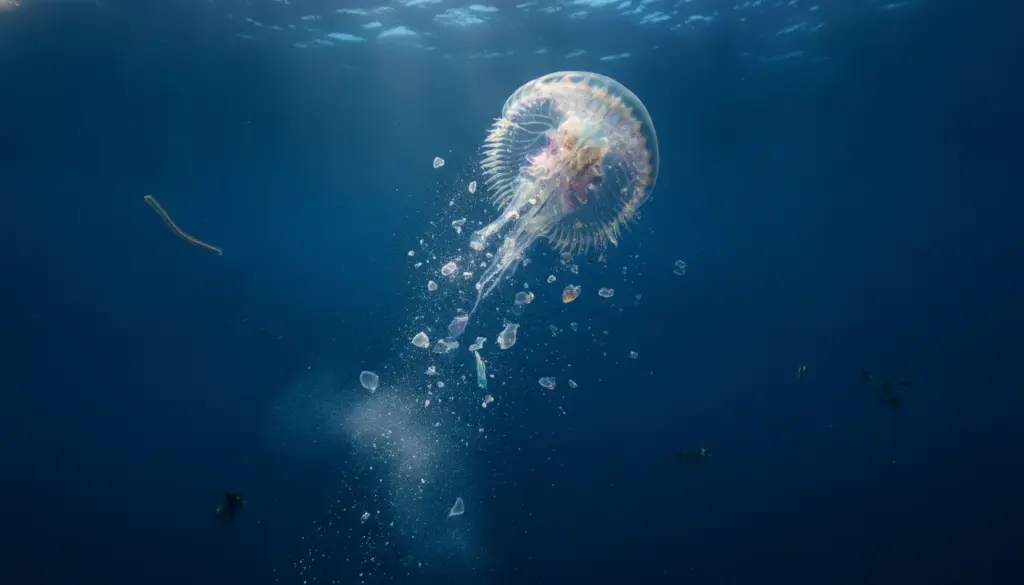
The ocean’s twilight and midnight zones are incredibly harsh environments. Without sunlight, and with pressure increasing by roughly one bar every ten meters, survival requires extraordinary biological engineering. At depths nearing four kilometers, the sheer weight of the water column would easily obliterate most familiar lifeforms. Yet, against all odds, unique gelatinous animals known as ctenophores—or comb jellies—flourish in this extreme darkness.
These graceful predators navigate the abyss using rows of shimmering, iridescent cilia. While they appear incredibly fragile, they are actually highly efficient hunters. The most fascinating mystery surrounding these deep-water species, however, reveals itself only when they are hauled up to sea level. Almost instantaneously, their bodies completely disintegrate.
As they breach the surface, their tissues lose all structural integrity. Cellular boundaries collapse entirely, reducing the elegant animal to a formless puddle. For decades, marine biologists assumed this bizarre melting effect was simply caused by physical trauma from collection nets or sudden temperature changes. Modern research has uncovered a much more complex, fascinating truth. It turns out that immense hydrostatic pressure acts as the literal glue maintaining their physical form.
The Delicate Chemistry of Cell Membranes
To understand this rapid disintegration, we have to look closely at microscopic membrane structures. Every living cell is wrapped in a protective envelope made of phospholipids, which must maintain a very precise physical state. This biological barrier needs to strike a perfect balance between rigidity and flexibility.
If the membrane is too stiff, essential proteins cannot move and function properly. If it becomes too loose, the cell completely loses its structural integrity. Surface-dwelling organisms achieve this vital equilibrium by mixing lipids with different microscopic geometries, typically blending cylindrical and cone-shaped molecules to create a stable, functional barrier.
A Surprising Biological Defense: Homeocurvature
Historically, scientists were primarily familiar with how animals adapted to freezing temperatures by altering membrane fluidity. To see if pressure adaptation functioned through a similar mechanism, an international research team analyzed comb jellies living in drastically different environments. They compared shallow, freezing Arctic waters with the crushing depths off the California coast.
The biochemical differences were staggering. The deep-sea specimens were packed with massive quantities of a specific phospholipid called plasmenyl-phosphatidylethanolamine (PPE). In the animals living at the greatest depths, this specific plasmalogen accounted for a staggering three-quarters of all their membrane lipids. This wasn’t merely a tweak in membrane fluidity; it was a fundamental architectural overhaul.
Experts have termed this unique phenomenon homeocurvature. The crucial factor isn’t just how fluid the lipids are, but their natural geometric curve. Plasmalogens possess a highly exaggerated cone shape. In the deep ocean, massive hydrostatic forces physically compress all molecular structures, effectively squeezing these wide cones into more cylindrical, stable shapes.
Deep beneath the waves, this intense environmental compression perfectly balances out the extreme cone shape of PPE molecules, keeping the animal’s cells entirely functional. As the comb jelly is brought up, that critical squeezing force disappears. The lipids aggressively spring back into their natural cone forms, causing the cellular boundaries to ripple, destabilize, and ultimately shatter. This sudden microscopic chaos is exactly why the creature appears to melt.
Testing the Pressure Hypothesis
To prove that these specific lipids were the actual mechanism for survival, researchers utilized synthetic biology techniques. They genetically engineered standard Escherichia coli bacteria to synthesize the exact same plasmalogens found in deep-sea comb jellies. These modified microbes were then placed inside specialized high-pressure simulation chambers.
The results provided definitive proof. While normal bacteria immediately stopped growing or died under forces mimicking depths of several kilometers, the modified strains thrived. By increasing the baseline geometric curvature of their membrane lipids, the engineered cells gained immediate resistance to extreme compression.
This breakthrough fundamentally shifts our understanding of deep-sea evolution. Adjusting to abyssal pressure is a completely separate biological pathway from cold-water adaptation, relying on entirely distinct biochemical modifications. Shallow-water species utilize different compounds that increase fluidity without altering cell geometry, whereas deep-ocean survivors rely on a highly specific molecular cocktail designed to withstand massive force.
Unexpected Links to the Human Brain
The implications of these deep-ocean discoveries stretch far beyond marine biology. Surprisingly, human brains are incredibly rich in these exact same plasmalogens. They serve as a critical structural component in our neuronal membranes, and their depletion has been closely linked to severe neurodegenerative conditions, including Alzheimer’s disease.
Unraveling exactly how these complex molecules influence cellular stability could unlock completely new pathways for biomedical research. Because these compounds possess such unique biophysical properties, deep-sea comb jellies have inadvertently become an extraordinary model for studying fundamental cellular mechanics. The biological adaptations occurring thousands of meters underwater might eventually help explain the intricate processes happening inside human neurons.
The Invisible Scaffolding of Life
These findings prompt a profound rethinking of marine ecology. Because these specialized creatures require a lipid composition that only remains stable under massive force, they are physically dependent on their harsh environment to exist. Extreme depth is no longer just a habitat preference; it is a strict physiological requirement.
In the darkest, most isolated corners of our oceans, life is far from fragile. It is remarkably inventive. Deep-sea comb jellies aren’t weak organisms destined to fall apart. Instead, they are so magnificently specialized that they require the ocean’s immense weight just to hold their physical bodies together. The crushing pressure that would easily destroy human biology serves as their invisible, life-sustaining scaffolding.