A Tiny Window into the Distant Past
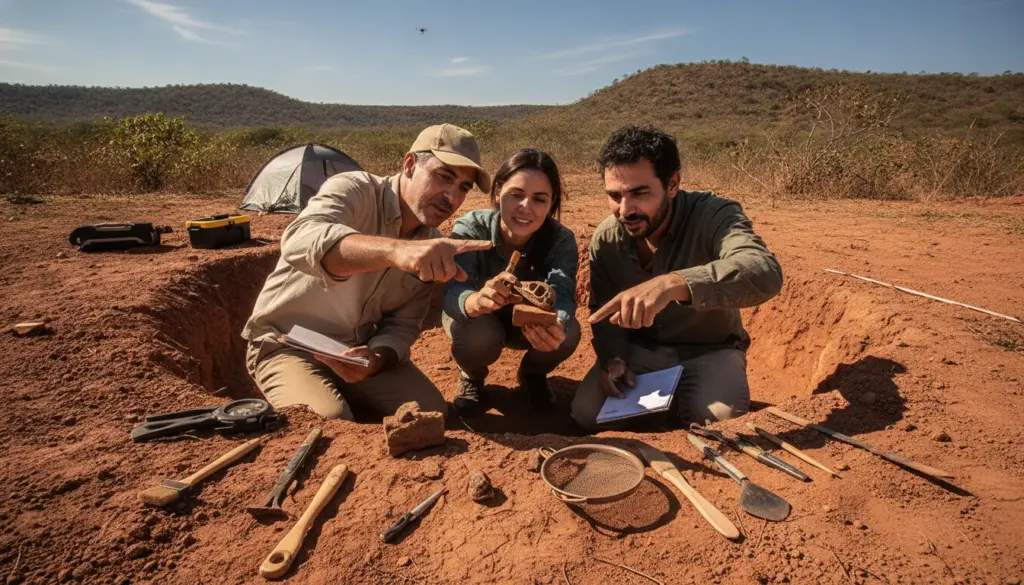
In the southern reaches of Brazil, a remarkable paleontological breakthrough is reshaping our understanding of ancient ecosystems. Researchers unearthed a diminutive rhynchosaur fossil at the Buriol site in Rio Grande do Sul. Recently detailed in the Journal of Systematic Palaeontology, these findings offer a fresh lens on prehistoric reptile diversity across South America.
Guided by Dr. Flávio Pretto and Jossano Rosso Morais, with backing from the Federal University of Santa Maria (UFSM), the investigative team identified the delicate remains. These fragments belonged to a newly hatched member of the Hyperodapedontinae subfamily, a fascinating lineage of extinct reptiles that roamed the region roughly 233 million years ago during the Late Triassic period.
Uncovering a Miniature Marvel
During their excavation efforts, experts recovered a pair of modest rock fragments concealing parts of the creature’s jaw and skull. Officially cataloged as CAPPA/UFSM 0295, this astonishingly small cranium measures a mere 2.5 centimeters in length. As the most compact skull ever recorded for this specific group, it has allowed scientists to examine evolutionary traits and structural intricacies that were previously completely unknown.
While the Buriol site yields an incredible array of ancient remains, the rock layers themselves lack direct chronological markers. To pinpoint the fossil’s age, specialists cross-referenced data from neighboring geological sites, ultimately tracing the specimen back to the Carnian stage of the Late Triassic.
This specific region in Brazil remains an absolute focal point for studying archosauromorphs like the rhynchosaurs. Although similar fossils appear worldwide, experts have only formally recognized five distinct species within Brazilian borders to date.
Digital Preservation and Unseen Details
What makes this cranial fossil truly spectacular is not just its minute scale, but its extraordinary state of preservation. Because the bone structures were incredibly delicate, the research team abandoned standard mechanical extraction methods. Instead, they utilized advanced micro-computed tomography (micro-CT) to safely peer inside the rock.
Dr. Flávio Pretto emphasized that any physical tampering would have likely resulted in permanent destruction of the fragile artifact. By opting for digital preparation, the team successfully analyzed internal anatomy and tooth implantation without causing a single scratch. These high-resolution scans provided an unparalleled glimpse into the physical development of juvenile rhynchosaurs.
Redrawing the Evolutionary Map
A meticulous review of the micro-CT data confirmed the specimen was a perinatal creature, essentially a newborn. Paleontologists deduced this developmental stage by observing pristine, unworn tooth plates. Interestingly, the infant already displayed muted versions of adult characteristics, such as an early-stage anguli oris crest and a combination of pyramidal and conical jaw teeth.
Currently, scientists tentatively link this tiny reptile to the species Macrocephalosaurus mariensis. This preliminary classification bolsters the theory that a minimum of two different Hyperodapedontinae species shared this Triassic landscape.
When researchers initially mapped the creature’s evolutionary lineage based strictly on the number of tooth rows, the newborn appeared far more primitive than anticipated. Recognizing that dental rows multiply as the animal ages, the team removed this growth-dependent variable from their calculations. Instantly, the fossil aligned perfectly within the expected branches of its family tree, a crucial adjustment that also permitted the re-evaluation of other previously dismissed species.
Rethinking Reptile Classification
This meticulous research highlights a major pitfall in ancient taxonomy: confusing age-related growth changes with permanent species markers. As the experts demonstrated, utilizing tooth row counts for classification is only accurate when an animal’s exact life stage is factored into the equation. Failing to do so can trigger significant misinterpretations of extinct family lineages.
Continuous exploration at the Buriol site keeps the door open for future breakthroughs. With its proven track record of yielding highly significant fossils, the location stands ready to further illuminate South America’s rich prehistoric fauna and refine our grasp of Triassic reptile evolution.