From a Master’s Vision to an Eternal Building Site
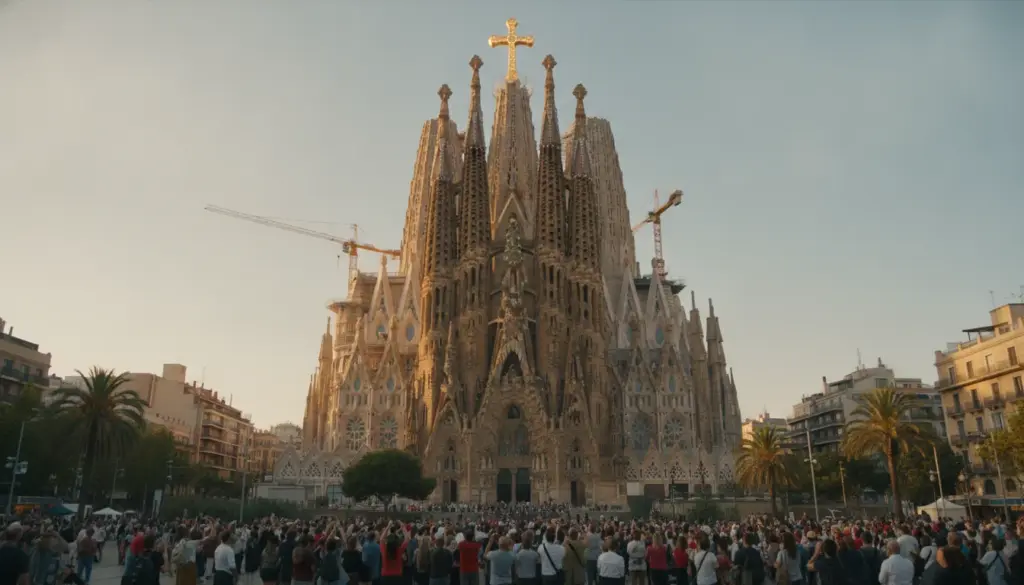
For more than a century, unfinished spires and towering construction cranes have dominated Barcelona’s horizon. Today, that very same skyline broadcasts a historic triumph: the Sagrada Familia has officially surpassed every other sanctuary on Earth. By finalizing the Jesus Tower—the majestic vertical centerpiece of the entire complex—it now proudly stands as the tallest church globally.
When Antoni Gaudí assumed control of the project in 1883, he completely transformed a standard neo-Gothic layout into a breathing, stone-crafted organism. He drew heavy inspiration from the natural world, utilizing parabolic arches, columns mimicking robust tree trunks, and surfaces that resemble organically grown crystals.
Initiated in 1882, this mammoth endeavor has weathered monarchies, republics, a brutal civil war, a dictatorship, and the eventual shift to democracy. Because Gaudí’s original plaster prototypes were severely damaged in 1936, the ongoing labor in the 20th and 21st centuries represents a masterful feat of historical reconstruction. Skilled artisans must piece together the architectural puzzle using surviving shards, vintage photographs, and scattered notes.
It is precisely this generational continuity—with successive waves of engineers and craftsmen interpreting Gaudí’s brilliance—that makes today’s milestone far more than a mere statistical victory.
The Record-Breaking Dimensions
News of this monumental achievement has echoed around the globe. The structure now boasts a towering height of 172.5 meters following the successful erection of the Jesus Tower. This remarkable elevation permanently dethrones Germany’s Ulm Minster, which had firmly held the 161.5-meter record since the late 19th century.
Interestingly, Gaudí instituted a very strict vertical boundary for the project. He insisted the sanctuary must never eclipse Barcelona’s Montjuïc hill, which rises roughly 173 meters above sea level. Believing that human creations should remain respectfully subordinate to a “divine creation,” the architect chose this precise, millimeter-perfect height.
This subtle constraint serves as a flawless balance of soaring architectural ambition and profound theological modesty.
Constructing a 172.5-Meter Spire in the 21st Century
While the architectural concept stems from the 1800s, the methodology used to execute it is purely cutting-edge. The newly finished Jesus Tower brilliantly demonstrates how heritage craftsmanship seamlessly blends with modern technology on a single job site.
The intricate shapes rigorously emulate Gaudí’s post-war reconstructed plaster models. However, transforming those visions into solid stone and reinforced concrete required a combination of groundbreaking techniques:
- Highly accurate 3D digital modeling to simulate heavy wind loads, internal forces, and subtle vibrations.
- Computer-guided precision cutting of massive stone blocks, which are then hoisted and assembled in the sky like a colossal jigsaw puzzle.
- Advanced structural calculations to guarantee absolute resilience against temperature fluctuations and micro-seismic activity.
Consequently, the spire looks ethereal and beautifully organic, yet it performs with the robust safety mechanics of a contemporary skyscraper.
A Forest of Spires: Meaning and Vertical Theology
From a distance, the basilica resembles a dense cluster of reaching pinnacles, yet every single element holds a deeply specific intent. Gaudí originally mapped out exactly 18 towers. These structurally represent the 12 Apostles, the 4 Evangelists, the Virgin Mary, and ultimately, Jesus.
Just beneath the central peak sit the towers of the Evangelists. Capped with their traditional symbolic figures—an angel, lion, ox, and eagle—these are now highly visible across the Catalan sky. The 138-meter Virgin Mary spire, finalized earlier, features a brilliant illuminated star that appears to hover magically over the Eixample district at night.
This carefully tiered elevation translates a complex concept into masonry. It represents a “vertical theology” where climbing higher physically brings the structure closer to the core of the Christian narrative.
Fascinating Hidden Details
Beyond the sheer scale of the building, several lesser-known elements highlight the temple’s unparalleled nature within the architectural world.
During his final years, Gaudí lived almost exclusively on the construction site, earning the affectionate moniker of “God’s Architect.” Tragically, a tram struck and killed him in 1926 before he could witness even one fully completed facade. Today, his remains rest quietly in the crypt of the very basilica that continues to ascend directly above his tomb.
Financially, the endeavor relies entirely on private donations and visitor ticket sales. This is absolutely not a state-funded initiative. Every fresh stone placed signifies the direct contribution of millions of curious tourists. Furthermore, while Pope Benedict XVI consecrated it as a minor basilica in 2010, it is technically not the city’s cathedral—that prestigious title still belongs to Barcelona’s Cathedral of Saint Eulalia.
Acoustically, the interior is an engineering marvel designed specifically to enhance sacred choral music. The towering naves and unique column arrangements cultivate meticulously controlled reverberations. Many professional musicians affectionately refer to this acoustic environment as a breathtaking “cave of light.”
Transforming the Modern Visitor Experience
For travelers exploring the sanctuary today, this height milestone is far more than a simple statistic to share with friends back home. The presence of the fully realized central spire fundamentally alters how visitors experience both the surrounding urban landscape and the sweeping interior space.
Ascending the completed towers provides an entirely renewed perspective of Barcelona. From these lofty viewing platforms, the strict, rational grid of the Eixample neighborhood is starkly visible. At the same time, observers can easily feel how the basilica’s flowing architecture completely disrupts that rigid urban planning. This dynamic contrast between a hyper-modern metropolis and Gaudí’s whimsical vision has never been more striking.
For Catalonia’s capital, this triumph reinforces an already potent cultural identity. The Sagrada Familia utterly transcends its role as a mere tourist hotspot. It has evolved into the ultimate global benchmark for religious architecture, seamlessly marrying faith, tourism, traditional masonry, and futuristic engineering.
Anyone visiting the city right now witnesses a truly rare phenomenon. After more than 140 years of relentless labor, this masterpiece hasn’t lost a fraction of its cultural power. Instead, it has successfully morphed from an “endless” building site into a vibrant, living monument, still managing to astound the world with its final, dizzying leap toward the heavens.