
The Mystery of Feline Vocalizations
Do you often find yourself puzzled by your feline friend’s sudden, seemingly unprovoked vocalizations? Deciphering these auditory clues does much more than just restore quiet to your living space. It is actually a vital step in checking on your pet’s well-being and forging a truly meaningful connection.
By blending everyday observation with modern technological tools, you can finally figure out exactly what your furry companion is trying to say.
Why Do House Cats Speak to Us?
Interestingly, feral and wild felines almost never use vocal sounds to converse with one another. Instead, they rely heavily on scent markers and physical postures. The indoor environment, however, changes everything.
Behavioral research reveals that fully grown domestic cats utilize their voices almost entirely for the purpose of grabbing human attention. It is a remarkable evolutionary adaptation, showing how cleverly these pets have modified their behavior to pull at our heartstrings and fulfill their desires.
A Customized Vocabulary
Over the years you spend together, your pet carefully crafts a specialized repertoire of pitches and tones. This personalized auditory toolset allows them to distinctly communicate hunger, a desire for affection, or growing irritation.
From an animal behavior standpoint, this represents an incredible leap in cross-species communication, proving just how highly adaptable felines are to their specific caretakers.
The Tail Tells the Tale
Before you immediately reach for the treat jar, take a moment to evaluate your pet’s posture. When a kitty approaches with their tail held tall and sporting a slight curl at the tip—much like a question mark—they are radiating friendliness.
This specific physical cue usually signifies a craving for companionship and playtime, rather than an empty stomach.
Bridging the Translation Gap with Technology
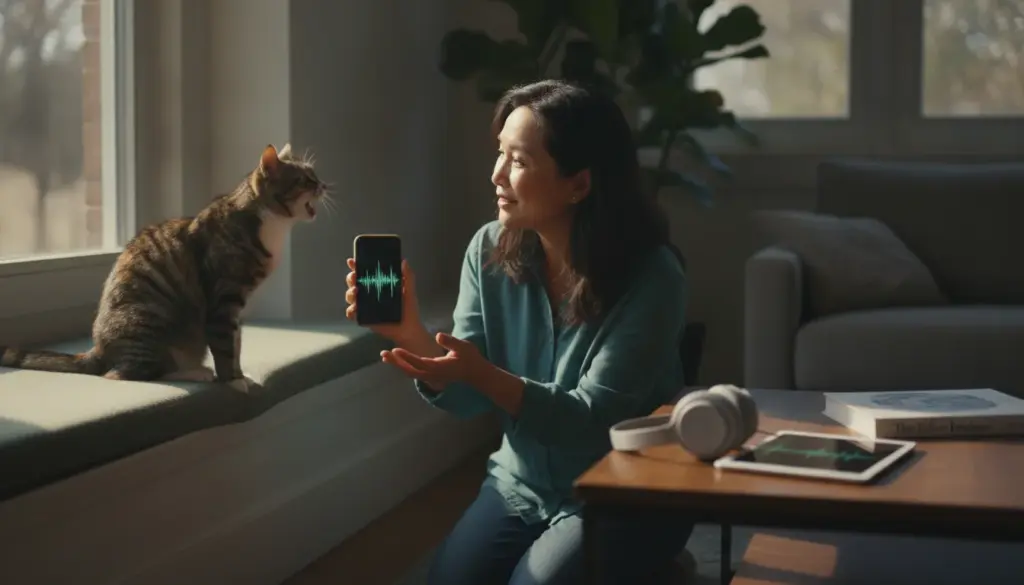
Even with physical clues, humans notoriously struggle to accurately read feline moods, a fact backed by extensive animal cognition studies. To bridge this communication gap, digital solutions like MeowTalk have emerged, serving as a pocket-sized interpreter.
Launched in 2020 by tech developers, this application relies on sophisticated machine learning algorithms to decode specific auditory patterns. By recording a quick vocalization and cross-referencing it against a massive sound database, the system provides instant translations such as “feed me” or “give me space.”
For numerous pet parents, this innovation has illuminated previously unnoticed emotional states in their beloved companions.
The Limitations of Digital Interpreters
Despite these technological advancements, relying solely on an app has its drawbacks. Feline expression is profoundly intricate, making vocalizations highly individualistic.
A chirp that signals pure joy in one household might indicate distress in another. Furthermore, digital tools completely miss the surrounding context and crucial physical movements that form the bedrock of animal interactions.
Mastering the Art of Observation
Because of these digital blind spots, animal specialists maintain that your own consistency and attentive watching remain the most effective translation tools available. Make it a habit to monitor how their ears pivot and the shape of their eyes.
Keep this fundamental guideline in mind: higher-pitched chirps generally convey excitement or a polite request, while deep, rumbling growls point to annoyance.
When you respond to these auditory hints with a calm, measured demeanor, you cultivate a profound level of mutual trust that a smartphone application could never replicate. Be sure to bookmark this guide for your next chat with your feline friend.