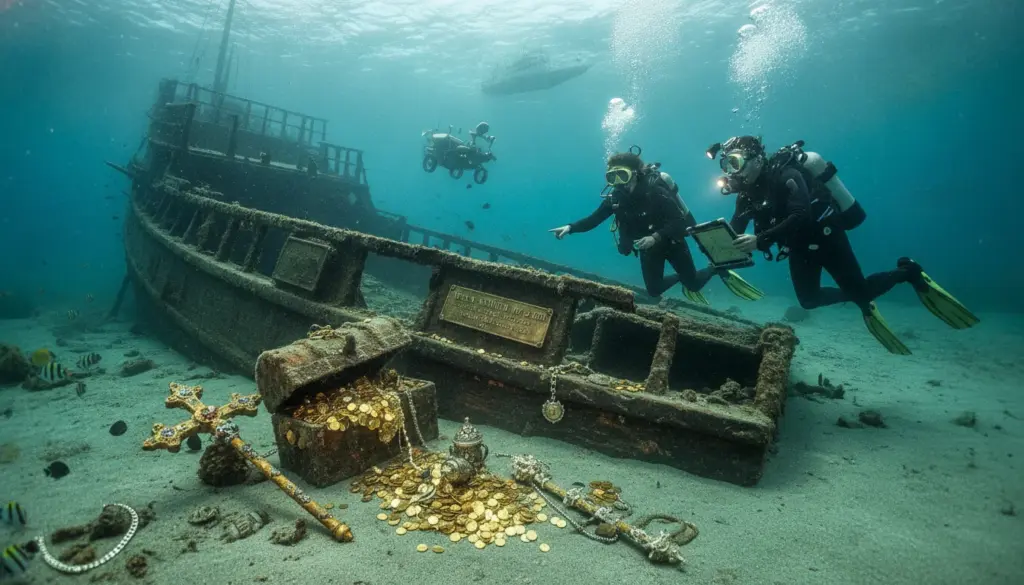
The depths off the coast of Madagascar have finally surrendered a staggering maritime mystery. Following 16 grueling years of underwater exploration, two maritime archaeologists from the United States have officially pinpointed the resting place of the fabled Nossa Senhora do Cabo. Rather than a mere seafaring myth, experts now have concrete evidence of a colossal fortune that vanished without a trace back in 1721.
Professionals at the Center for Historic Shipwreck Preservation successfully identified the Portuguese vessel’s remains. The doomed ship fell victim to pirates operating in a notorious hotspot, losing a cargo hold absolutely bursting with gold, diamonds, and emeralds.
A Forgotten Fortune Claimed by the Sea
This heavily burdened Portuguese galleon initially set sail from India carrying an extraordinarily valuable payload. Among its passengers were the Viceroy of Portugal, the Archbishop of Goa, and 200 enslaved individuals, alongside mountains of precious cargo. From an historical perspective, the heavily laden vessel was essentially a floating gold mine, making it an irresistible prize for maritime marauders.
How a Ruthless Pirate Ambushed the Portuguese Fleet
The devastating ambush was orchestrated by the infamous Olivier Levasseur, historically feared under the moniker “The Buzzard.” He cunningly struck when the Portuguese ship was severely battered by a violent storm near Réunion island. Resistance was remarkably brief, allowing the buccaneers to easily seize the battered vessel and its phenomenal wealth. The outlaws then navigated 400 miles westward, ultimately abandoning the stripped wreckage in the waters surrounding modern-day Nosy Boraha.
Decades of Determination Yield a Historic Breakthrough
Dedicated researchers Brandon Clifford and Mark Agostini committed 16 years to meticulously surveying Madagascar’s northeastern shoreline. Their incredible find wasn’t the result of sheer luck, but rather stemmed from relentless perseverance and meticulous sonar operations. The team ultimately detailed their triumph in Wreckwatch magazine, confirming the discovery of the lost hull alongside over 3,300 distinct historical artifacts. It is truly remarkable how long the ocean floor can conceal such massive secrets.
A Mind-Boggling Haul of Gold, Emeralds, and Relics
The recovered treasure, described by the excavation team as astonishing even by Golden Age pirate metrics, holds an estimated baseline value of $138 million. Surviving historical manifests detail an inventory brimming with silver and gold bullion, fine silks, and upwards of 400 precious gemstones.
- 110 exquisite diamonds and 250 emeralds
- Rare gold coinage featuring Arabic engravings
- Sacred religious statuary and artifacts originating from Goa
- Multiple heavy chests overflowing with pearls
However, the harsh reality of marine archaeology reveals that the bulk of this vast fortune never actually sank. “The Buzzard” and his crew meticulously looted the most portable, high-value items before ransoming the Portuguese Viceroy. Tragically, the ultimate fate of the Archbishop and the 200 captive slaves remains a chilling historical mystery.
An Island Haven for Historic Outlaws
During the early 18th century, Île Sainte-Marie (now known as Nosy Boraha) served as an infamous stronghold for high-seas criminals. Its incredibly sheltered harbors and complete lack of colonial authority transformed it into the perfect operational hub for dozens of heavily armed pirate fleets. From this isolated sanctuary, notorious captains coordinated devastating raids on the era’s most lucrative maritime trade routes.
Why This Shipwreck is Just the Tip of the Iceberg
Clifford strongly hypothesizes that the surrounding coastal waters might conceal up to ten additional sunken vessels. Remarkably, he believes at least four of these unidentified wrecks are submerged in the exact same harbor as the Nossa Senhora do Cabo. The underwater exploration team remains highly optimistic that upcoming field expeditions will facilitate a much more rigorous scientific analysis of this aquatic graveyard. For decades, the academic community largely ignored this specific geographic zone, a significant oversight that nearly cost us irreplaceable insights into our maritime past.
A substantial portion of this legendary bounty likely remains deeply buried beneath centuries of accumulated silt and shifting oceanic sands. Do you believe these extraordinary historical artifacts should be preserved in public museums, or do private explorers deserve to claim the spoils of their arduous labor?