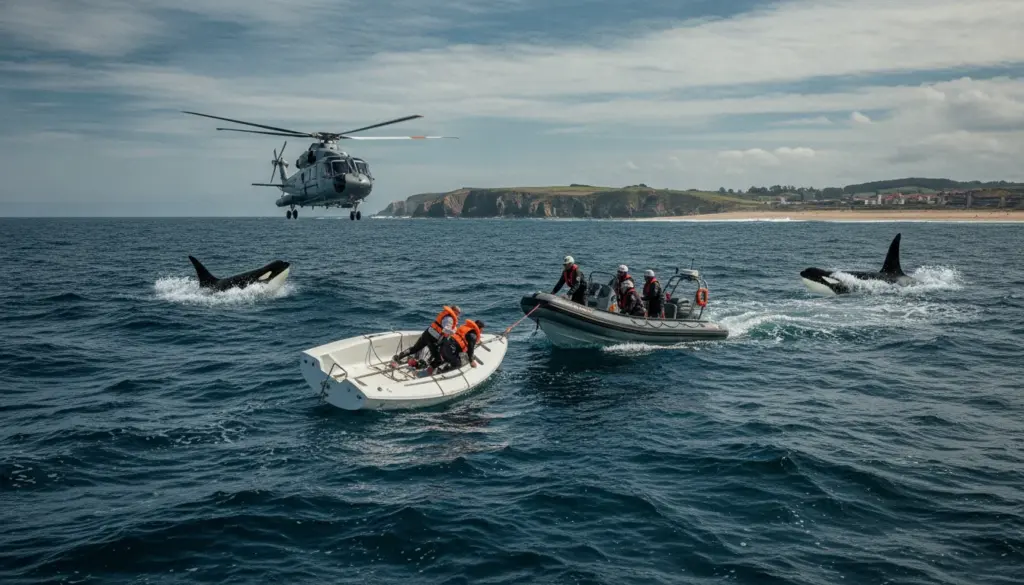
The sheer force of the impact against the hull instantly signaled to the French sailing crew that their maritime journey had morphed into a desperate survival situation. Rather than a simple navigational error or a rogue wave, a pod of killer whales deliberately ambushed the vessel just 3.7 kilometers from the coastline. Two individuals found themselves stranded amidst the turbulent waters of Gipuzkoa, holding out hope for marine rescuers to arrive.
Around 2:00 PM on Monday, the maritime coordination center in Bilbao received an urgent distress call. The French sailors reported a group of cetaceans aggressively ramming their boat, causing critical damage to the steering mechanism and leaving the vessel completely dead in the water. From a nautical safety perspective, losing steering capabilities in open water turns a vessel into little more than a helpless piece of debris at the ocean’s mercy. Fortunately, the 20-meter rescue cruiser Salvamar Orión was rapidly dispatched from its base in Pasaia to assist.
An Unprecedented Phenomenon in Northern Spain
Historically, mariners have associated these intense killer whale encounters primarily with the Strait of Gibraltar or the Tarifa coastline, where the mammals hunt tuna between April and August. Suddenly, the Basque Country has emerged as a new hotspot for these harrowing maritime incidents. Ignoring these shifting migration patterns is a grave navigational risk. While marine mammals have always frequented this region, their recent level of physical aggression toward watercraft is highly unusual.
Marine experts have tracked this escalating behavior as it spreads steadily up the coast toward Galicia. The situation became so pressing that both Spanish and Portuguese authorities commissioned specialized behavioral studies to understand the driving force behind these colossal creatures. As marine biologists have discovered, this isn’t an act of ecological revenge; rather, it appears to be a new recreational behavior adopted by juvenile whales. Essentially, these young animals are treating boat rudders as interactive aquatic toys.
The Undisputed Apex Predator of the Ocean
The Iberian orca is a masterful hunter that confidently commands the very top of the marine food web. Growing up to 6 meters in length, these highly intelligent mammals possess extraordinary hydrodynamic capabilities. As marine biology specialists, like Naomi Rose from the Animal Welfare Institute, bluntly point out: if these massive animals genuinely harbored intentions to sink human vessels, they possess the sheer physical power to accomplish it in mere seconds.
Data from recent years highlights the scale of this phenomenon, recording over 637 interactions since 2020. Interestingly, only 20% of these encounters result in disabling structural damage to the boats. The whales’ primary objective almost always remains the same: striking the rudder, an activity that clearly provides them with a form of entertainment.
Crucial Survival Protocols for Sailors
Crossing paths with a multi-ton apex predator undoubtedly triggers a massive adrenaline rush, but yielding to panic is the most dangerous response for any crew. The Spanish Ministry of Transport has formulated specific safety protocols to mitigate these encounters, and ignoring them invites potential disaster. Once a pod locks its attention on a vessel, mariners must remember that the ocean belongs to the whales.
- Keep moving: Never bring the vessel to a halt, whether you are relying on engine power or sailing.
- Head for the shallows: Immediately navigate toward the shoreline, as these predators generally avoid shallow waters.
- Secure your stance: Move away from the gunwales and rails to ensure sudden impacts don’t launch anyone overboard.
- Stow loose gear: Lock down all unattached equipment on deck to prevent items from becoming dangerous projectiles during hull strikes.
The intense recovery operation in Deba officially concluded at 5:37 PM, when a tugboat successfully navigated the battered yacht into the port of Getaria. Fortunately, the sailors escaped without physical injuries, though their boat now faces extensive and costly repairs. The Cantabrian Sea is proving to be increasingly unpredictable, making it vital for captains to integrate these wildlife risks into their summer sailing itineraries. Does restricting certain maritime zones seem like a viable solution for protecting both mariners and marine life? Consider how these changing ocean dynamics might impact the future of recreational sailing.