How a hairstyle can visually lift your face after 50
You might notice your face looking a bit more tired and your jawline losing its natural firmness, but you aren’t quite ready for cosmetic injections. Surprisingly, your hair holds incredible transformative power. Top stylists frequently rely on straightforward updos that visually elevate your facial features. By strategically pulling your strands upward and backward, your skin appears smoother, your eyes look brighter, and your jawline seems much more defined. This isn’t a digital filter or a complex illusion; it’s a quick, everyday mini-lift you can achieve in mere minutes each morning.
Around your 50th birthday, your facial dynamics naturally start to shift. Skin elasticity decreases, cheeks may drop slightly, and the once-sharp jawline softens. While a solid skincare and makeup routine helps immensely, the way you style your hair carries just as much visual weight.
The mechanics behind a “lifting” updo are wonderfully straightforward. You utilize the natural tension of your gathered hair to gently pull the skin upward. When you secure your strands tightly toward the crown, the skin around your temples and the outer edges of your eyebrows moves along with it. This creates a beautifully open gaze and softens the appearance of fine lines around the delicate eye area.
Shifting volume and tension toward the top of the head makes the face appear longer, slimmer, and noticeably refreshed.
Keeping your forehead clear allows natural light to illuminate the upper half of your face. Consequently, under-eye shadows lose their depth, shifting the viewer’s focus away from the neck and chin, straight toward your eyes and cheekbones. This technique is incredibly flattering, especially if you’re dealing with mild sagging along the jaw.
The trend behind the sleek, structured updo
Runways and red carpets have championed this technique for years, showcasing ultra-sleek ponytails and buns that sharpen facial contours. This signature aesthetic relies on flawlessly combed-back roots to create a clearly elevated eye area.
The secret lies not just in where you place your hair tie, but in achieving a perfectly smooth hairline. Professional stylists typically reach for a few essential tools to perfect the look:
- A fine boar-bristle brush to lay the roots completely flat and smooth.
- A lightweight wax or gel to tame any stubborn, frizzy flyaways near the temples.
- Flexible hairspray to lock the style in place without leaving a heavy, greasy finish.
However, there is a crucial caveat. Wearing your hair too tightly for extended periods can trigger headaches or even lead to traction alopecia along the hairline over time. Moderation is essential here. Frequently change the position of your hair tie, let your locks flow freely on occasion, and always treat yourself to a gentle scalp massage after taking down a tight style.
Three hairstyles with a lifting effect for mature women
1. High ponytail for a firmer jawline
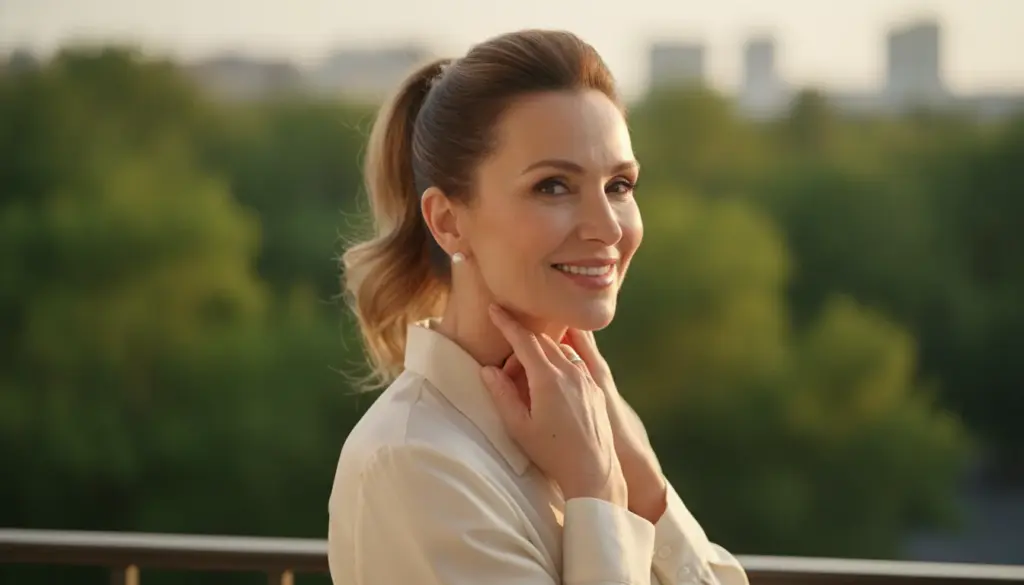
The classic high ponytail remains the quickest strategy to visually pull your features upward. Finding the perfect placement for your elastic is the most critical step. Hair experts suggest following an imaginary diagonal line starting from your chin, passing through the outer corner of your eye, and ending at your crown. Securing your ponytail at this exact intersection creates an upward trajectory that literally seems to lift your face.
By brushing the hair at your temples firmly toward the base of the pony, you visually smooth out crow’s feet and grant your eyes a subtle, fox-eye flare. This particular style works wonderfully for oval or round face shapes with medium to long hair lengths.
Beware of tying the ponytail too low, as this drags the visual focus downward and emphasizes a heavier jawline.
If your hair leans on the finer side, try working some volumizing powder or dry shampoo into the lengths to build extra body. For pin-straight locks, adding a soft curl to the ends creates a much softer, more youthful bounce.
2. High twisted bun to refine the cheeks
Taking the high ponytail one step further, a twisted bun provides even more architectural structure. Start by securing an extra-high ponytail, twist the length tightly, and coil it closely around the base to form a dense bun.
Because this compact knot acts as a sturdy anchor right on top of the head, it maintains steady tension along the hairline for hours. The volume remains concentrated up top, which creates the illusion of narrower cheeks and a crisper jawline. It also completely exposes the neck, making it a fantastic choice if you want to elongate and refine that area.
This elegant look is perfect for those who:
- Want to subtly slim down fuller cheeks.
- Wish to create the optical illusion of a longer, more graceful neck.
- Need a sophisticated, polished style for a dinner or special event.
Always opt for a fabric-covered scrunchie or a spiral hair tie to distribute the pressure evenly. When pinning the bun, use bobby pins that don’t pinch; if your scalp starts to sting or pull, the style is simply too tight.
3. High half-up for a soft, rejuvenating balance
If you have a sensitive scalp, the third option offers a much gentler approach: the high half-up style. Simply gather the top section of your hair, from ear to ear, and secure it high on your crown. Let the remaining bottom layers cascade loosely around your face and neck.
This method successfully lifts the upper portion of the face—making eyebrows and eyelids appear slightly raised—while maintaining a soft, romantic frame around your jaw and neck. Those free-flowing lengths do an excellent job of gently camouflaging a softening neckline or mild sagging.
The half-updo perfectly balances a gentle eye-lift with a highly approachable, less severe aesthetic.
This versatile option flatters almost all hair textures, from stick-straight to gently wavy or curly. If you struggle with very fine hair, try lightly teasing the roots of the top section before smoothing it back. This creates a subtle volume bump that amplifies the overall lifting effect.
How to prevent damage and tension headaches
While a lifting hairstyle needs to be secure, it should never cause pain. You definitely shouldn’t wear it in the exact same spot every single day. To protect your roots from breakage and relieve scalp tension, stick to these straightforward guidelines:
- Always use gentle, fabric-wrapped elastics or snag-free spiral ties.
- Alternate the height and placement of your ponytail or bun daily.
- Release your hair in the evening and gently massage the scalp to stimulate circulation.
- Never tie up wet hair tightly, as damp strands are incredibly fragile and prone to snapping.
- Schedule a few tension-free, loose hair days throughout your week.
If you frequently experience tension headaches or notice thinning near your temples, switch to a looser style or the half-up method more often. Applying a nourishing hair serum along the hairline can also fortify vulnerable roots, which is especially helpful for fragile, post-menopausal hair.
Extra styling tips to amplify the lifting effect
You can maximize the impact of these hairstyles with a few minor cosmetic tweaks. Dabbing a little highlighter on the highest points of your cheekbones and just beneath the brow bone dramatically enhances the upward visual pull. Adding a touch of slightly darker contour powder just under the jawline will further emphasize the sharp silhouette your new hairstyle creates.
If you wear glasses, pay close attention to your frame shape. Frames with a slight upward tilt at the outer corners work in perfect harmony with a high bun or ponytail, naturally drawing the viewer’s gaze upward. Jewelry plays a vital role too; long, slender drop earrings visually stretch the neck and pair flawlessly with swept-up locks.
Many women find it incredibly helpful to practice these styles at home before debuting them at the office or a social gathering. Experiment with different elastic placements, try an ultra-sleek finish one day, and leave a few wispy, face-framing pieces out the next. You’ll quickly discover which variation makes you feel the most confident—using nothing more than a brush and a hair tie, with absolutely no clinical procedures required.