Imagine walking across an ordinary agricultural landscape, completely unaware that a history-altering fortune rests right beneath your boots. The recent unearthing of a massive Celtic hoard near Pilsen offers far more than just excitement for historians. It serves as a striking reminder of the extraordinary wealth still hidden beneath the soil, providing researchers with invaluable insights into ancient commercial networks.
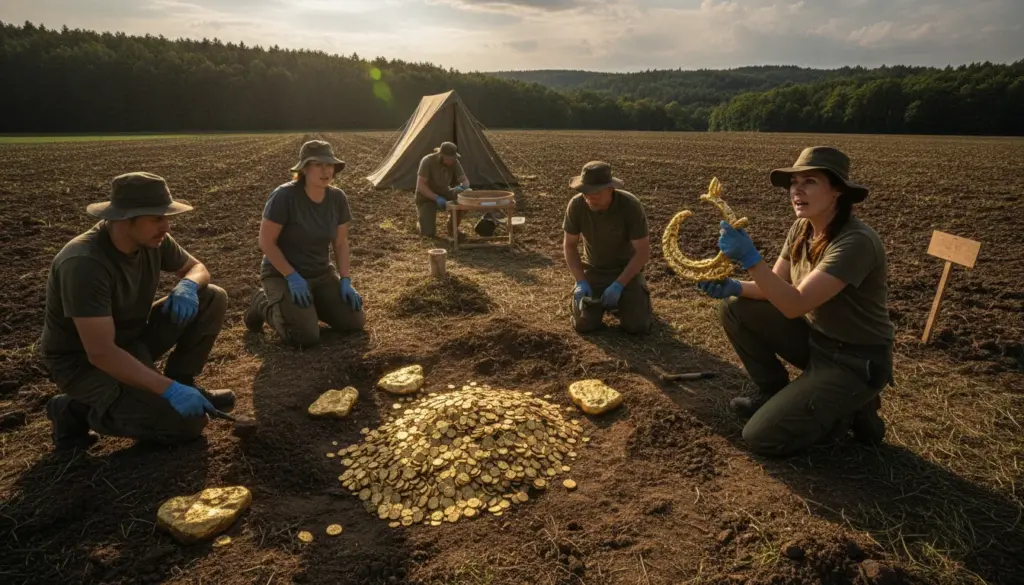
Specialists in European antiquity successfully pinpointed an age-old cache of golden artifacts hidden away in the rural outskirts of Pilsen, Czechia. This remarkable collection features coins and miniature ingots that remained undisturbed for hundreds of years. Regional museum authorities note that recovering these materials delivers crucial evidence regarding early Celtic settlement and activity throughout the area.
This assemblage holds immense historical significance, driven not only by its sheer age but also by its exceptionally pristine condition. Scholars from the Czech Academy of Sciences explain that advanced isotope testing will determine the exact origins of the precious metals. These scientific analyses will reveal whether the gold was mined locally or transported from distant territories across vast ancient trade routes.
How the Czech Gold Hoard Was Discovered
Truthfully, this remarkable narrative began rather quietly, long before making international headlines. Back in 2021, a hobbyist sweeping the area with a metal detector stumbled upon a tiny fragment of an ancient coin dating to the second century BCE. That single beep triggered rigorous, systematic excavations across the active farmland, which had to be carefully coordinated around seasonal planting and harvesting cycles.
Professionals suggest these precious items were either deposited as a form of economic exchange or intentionally buried for spiritual reasons. During the digging process, teams also uncovered horse remains alongside various metal implements. These accompanying finds strongly hint that the location served specific ceremonial functions or operated as a bustling hub for early barter systems.
Uncovering Unique Golden Artifacts in Pilsen
Project director Pavel Kodera confirmed that the site yielded a vast array of small yet extraordinary metallic objects. While coins make up the bulk of the discovery, the excavation also produced raw gold flakes, ingots, earrings, and segments of ancient bracelets. Uncovering these personal adornments sheds fascinating new light on the sophisticated craftsmanship possessed by early European populations.
Key Highlights of the Astonishing Excavation
- More than 500 gold and silver coins, many featuring distinct Celtic iconography.
- Solid ingots, raw precious metal chunks, and delicate jewelry pieces.
- Intricate engravings depicting horses, wild boars, solar patterns, and ancient deities.
- Noticeable Hellenistic artistic influences, showcasing motifs with distinct Greek origins.
These remarkable currencies range in size from a mere 7 millimeters up to 1.5 centimeters. Each piece showcases unique designs that beautifully capture the mythological beliefs and cultural mindset of the Celtic people, with Kodera describing the intricate imagery as genuine works of art. Analysts conclude that this specific geographic area likely functioned as a seasonal gathering space for regional communities, ultimately leaving behind one of Central Europe’s most significant archaeological legacies.