
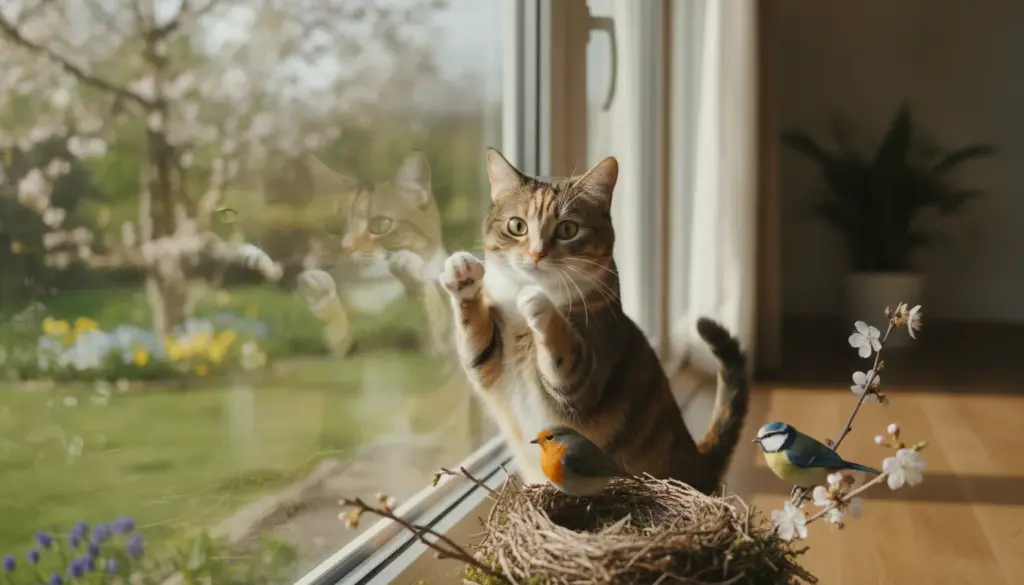
Springtime Activity: High Stress for Garden Birds
Early spring means veterinary professionals start issuing a familiar warning about letting our beloved felines roam outside. As March and April roll around, the breeding season kicks into high gear, transforming ordinary backyards into delicate wildlife nurseries. Because of this vulnerable period, animal health experts strongly suggest restricting your pet’s outdoor access, no matter how desperately they paw at the back door.
Between March and April, countless small mammals and bird species begin their reproductive cycles. Wrens, robins, titmice, and blackbirds construct their nests in shrubs, thick hedges, or even balcony planters. These nesting sites quickly fill with fragile eggs or newly hatched fledglings that haven’t yet mastered flight.
For a domestic feline, these young creatures offer an irresistible mix of erratic movement and high-pitched sounds. A clumsy fluttering wing or a faint chirp in the bushes immediately activates their predatory drive. Feeding your cat a premium diet won’t switch off this urge, as their brain automatically enters hunting mode whenever small things dart or squeak nearby, regardless of hunger levels.
Ecological tracking across Europe highlights a deeply concerning downward trend for many avian species in both rural and suburban zones. Certain bird populations have plummeted by more than a third over the last three decades. While traffic, habitat destruction, and pesticide use are major drivers, the added predatory pressure from domestic cats certainly exacerbates the crisis.
Keeping your furry companion indoors during these critical breeding weeks helps relieve some of that ecological stress. A single roaming pet might seem harmless, but dozens often patrol a standard residential neighborhood. Collectively, they can wipe out numerous nests and young birds in a matter of weeks.
The Unstoppable Feline Hunting Instinct
Many owners mistakenly believe their pet rarely catches anything simply because they never bring trophies inside. This assumption drastically underestimates their true outdoor behavior. In reality, many cats simply abandon their catch in the garden rather than proudly displaying it on the welcome mat.
Evolution engineered felines as solitary, silent stalkers. Their anatomy is perfectly optimized for stealth, featuring excellent night vision, a highly flexible spine, retractable claws, and ears tuned to the faintest rustle. Moving into a modern suburban home does absolutely nothing to erase thousands of years of biological programming.
Even the most lethargic couch potato can suddenly transform into a fierce predator once they step into the fresh air. The local park or backyard acts as a living playground where every rustling leaf represents potential prey. Low-hanging suet balls, seed dispensers, and scattered bird food naturally draw birds closer to the ground, creating a perfect ambush zone for patrolling cats.
- Bird feeders artificially gather potential prey into small, predictable areas.
- Thick hedges and garden shrubs offer perfect camouflage for a sudden ambush.
- Juvenile or unwell animals have slower reaction times, making them incredibly easy targets.
- Just one active cat can injure or kill dozens of small animals throughout the spring.
Furthermore, even if a bird manages to escape an initial attack, the resulting injuries or extreme exhaustion often lead to a delayed death. While owners rarely witness this aftermath, it leaves a significant mark on the broader ecosystem.
Spring Dangers for Roaming Cats
Restricting outdoor time in March and April doesn’t just protect local wildlife; it also shields your feline from seasonal hazards. As the weather warms up, neighborhoods see a surge in street traffic, noisy garden renovations, and overall outdoor human activity.
These environmental changes bring a sharp increase in physical risks. Veterinary clinics routinely treat a spike in spring-related injuries, including bite abscesses from territorial fights, severe eye trauma, and bone fractures from vehicle collisions. Keeping your pet safely indoors for a few extra weeks can prevent immense suffering while saving owners from unexpected, hefty medical bills.
How to Keep an Indoor Cat Perfectly Content
Owners often worry their furry friend will become deeply depressed if denied their daily garden patrol. However, indoor life can be incredibly fulfilling as long as you provide the right mental and physical stimulation. The secret lies in offering varied activities, interactive play, and a little bit of environmental creativity.
- Install a tall climbing tree or scratching post near a secure window to provide elevated bird-watching opportunities.
- Utilize wand toys, mechanical mice, and soft balls to simulate high-energy, short-burst hunting sequences.
- Hide daily kibble portions inside puzzle feeders or treat balls so your pet has to mentally work for their meals.
- Leave empty cardboard boxes, paper delivery bags, and fabric tunnels around the living room as temporary hiding spots.
Felines don’t require exhausting, hour-long play sessions. Engaging them in a few short, five-to-ten-minute bursts of activity throughout the day dramatically improves their mood and overall behavior.
Smoothing the Transition for Outdoor Veterans
Cats accustomed to unrestricted roaming might initially protest by pacing, vocalizing loudly, or persistently scratching at the door. Fortunately, you can make this seasonal adjustment much smoother by following a few strategic steps.
- Begin gradually reducing their outdoor hours a week or two before March arrives.
- Schedule your most engaging indoor play sessions precisely when they usually ask to go outside.
- Consider training them to wear a comfortable harness for supervised, brief walks in the yard.
- Establish strict feeding routines to provide a comforting, predictable daily structure.
When a feline understands exactly what to expect from their daily schedule, they adapt to new boundaries much faster and with significantly less frustration.
Finding Harmony Between Pet Care and Conservation
Finding the middle ground between spoiling your pet and protecting backyard biodiversity can feel like a difficult balancing act, especially during the spring bloom. Yet, making a few practical adjustments can drastically minimize ecological damage without permanently locking your cat away.
If completely banning outdoor time isn’t feasible, consider implementing strict curfews. Avoid letting your cat out during dawn and dusk, as these are the peak activity hours for foraging birds. Alternatively, investing in a secure enclosed patio or installing specialized netting around your fencing allows them to enjoy the fresh air safely.
Internationally, researchers are even testing brightly colored, bird-safe collars designed to visually warn wildlife of approaching predators. While their absolute effectiveness is still being debated by behavioral experts, these innovations highlight how seriously the conservation community treats this ongoing issue.
For hesitant owners, looking at the bigger environmental picture often provides reassurance. A brief indoor confinement paired with extra affection causes minimal stress for most pets. Meanwhile, that same short window can mean the difference between a thriving local bird population and another year of devastating breeding losses.