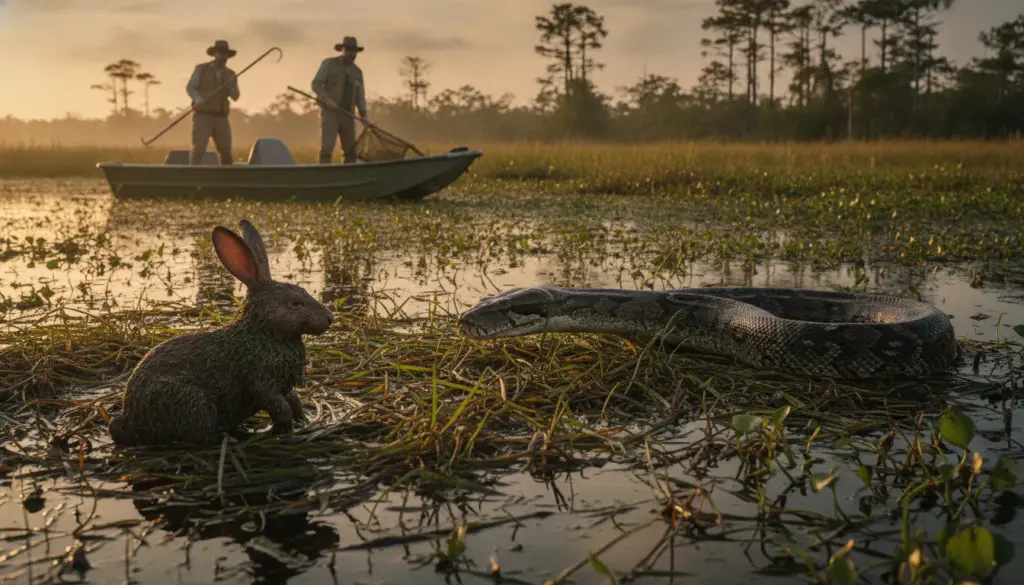
Florida’s marshlands have transformed into a landscape straight out of a science fiction movie. Rather than relying solely on human trackers to battle an ongoing ecological crisis, wildlife experts have deployed high-tech robotic rabbits directly into the wilderness. These incredibly lifelike gadgets serve one distinct purpose: luring deadly pythons right into the waiting arms of professional catchers by perfectly mimicking the habits of living prey.
Machines in Disguise: Tricking Apex Predators
The current situation across the Everglades is nothing short of heartbreaking, as Burmese pythons have turned this lush sanctuary into a dead zone. These relentless invasive reptiles are responsible for wiping out an estimated 95% of the small mammal population within the national park boundaries. This staggering loss severely disrupts the native biodiversity and completely shatters the natural food web. Because these massive serpents lack any natural predators in this habitat, their population has exploded entirely unchecked.
A Battery-Powered Heart
The engineering behind these artificial baits is absolutely brilliant. These mechanical hares do not just mimic the visual appearance of a fluffy woodland creature; they actually replicate the exact movements and scent of a real animal. Most importantly, built-in thermal modifications allow them to radiate body heat, which acts as the ultimate biological trigger for a hungry python. Researchers place these sophisticated machines inside specialized, camera-monitored enclosures. The moment a slithering giant approaches, the system immediately sends a critical alert to the trapping team.
An Ecological Armageddon in the Swamps
Eliminating these predators is actually the easy part—the true challenge lies in spotting them at all. As invasive species biologist Mike Kirkland points out, these giant snakes have mastered the art of natural concealment. A person could easily be standing just three feet away from a massive reptile and remain completely unaware of its presence. Because their stealthy nature renders traditional hunting tactics largely ineffective, cutting-edge technology must step in where human eyesight simply fails.
A Pricey Experiment That Actually Works
Conservation authorities eventually pivoted to robotics because using live animals as bait was both highly inefficient and morally problematic. Constructing a single mechanical decoy costs approximately $4,000. During their most recent large-scale field test, teams dropped 120 of these high-tech units directly into the wetlands. While the initial financial outlay is substantial, the terrifying speed at which these predators are consuming the environment makes every single dollar spent a vital investment toward saving native wildlife.
From Exotic Pets to Ecosystem Killers
This entire biological disaster stems from human carelessness within the exotic pet trade. Owners who were overwhelmed by the massive size of their captive snakes either deliberately released them into the wild, or the animals managed to escape their enclosures. Today, they operate as a formidable army of ecosystem destroyers. A single female python can easily lay anywhere from 50 to 100 eggs in just one reproductive cycle, and the resulting hatchlings mature at an astonishing rate. Experts now estimate that the current regional population ranges anywhere from tens of thousands to a staggering 300,000 individuals. Although wildlife management teams have successfully extracted over 23,000 snakes from the swamps so far, it barely scratches the surface of the infestation.
Python Hunting Becomes a National Sport
Authorities are fighting this relentless plague from multiple angles. Beyond deploying expensive droids, the state of Florida hosts an annual “Python Challenge” to rally public support. Enthusiasts travel from all corners of the country to wade through the murky waters, hoping to secure lucrative cash bounties for capturing the highest number of invasive reptiles. During the most recent competition, the ultimate champion managed to bag 60 snakes, walking away with an impressive $10,000 prize. Ultimately, every single snake pulled from the marsh represents a massive victory for local conservation efforts.
This mechanical bunny initiative is still navigating its early stages. While scientists caution that comprehensive data is pending before claiming total victory, the initial field trials have sparked genuine optimism within the conservation community. The battle for the wetlands is far from over, but advanced engineering currently looks like the most promising strategy for taking back the Everglades.
Have you ever seen such a fascinating, outside-the-box application of technology used to protect nature? Let us know your thoughts below!