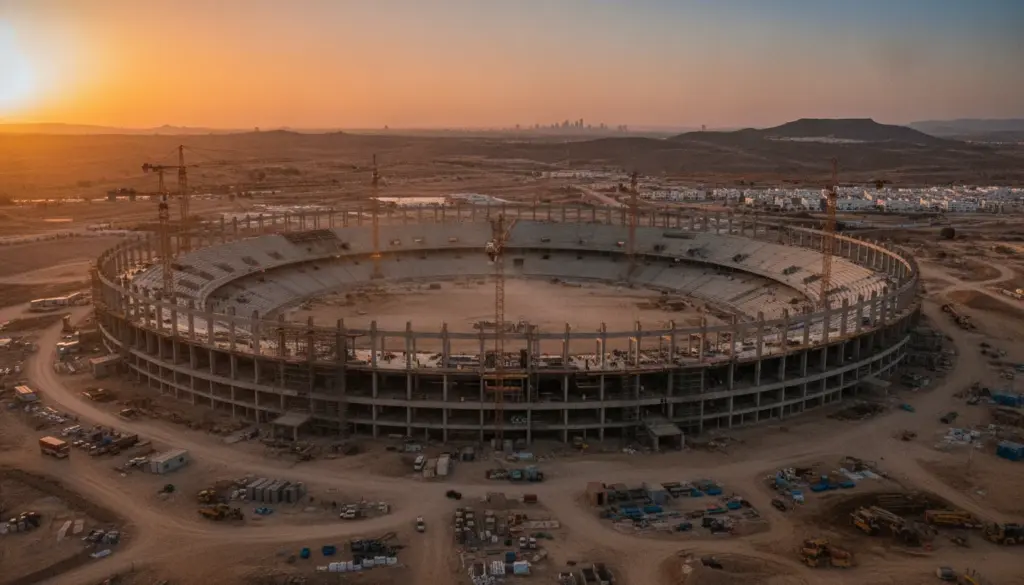
Just outside Casablanca, a spectacular new football venue is taking shape, aiming to dwarf the most iconic arenas across Europe and South America. Morocco is making a massive statement ahead of the 2030 World Cup. Instead of merely constructing a standard pitch, the country is developing a sprawling sports district anchored by an architectural marvel: the future Hassan II Stadium, engineered to become the largest football arena on the planet.
A stadium designed to shatter records
Situated in El Mansouria, roughly thirty kilometers north of Casablanca, this cutting-edge facility will rise over the coming years, leaving current venue sizes in the dust. The groundbreaking design features a projected seating capacity of 115,000, securing its spot as the world’s most massive football stadium.
To put this into perspective, even Barcelona’s renowned Camp Nou will only hold around 105,000 spectators following its current renovations. Meanwhile, Madrid’s Santiago Bernabéu remains under the 90,000 mark. The upcoming Moroccan colosseum will comfortably eclipse both of these historic giants.
Financially, the project carries an estimated price tag of 5 billion Moroccan dirham, which translates to roughly 466 million euros. This budget is remarkably competitive for a build of such colossal scale, though the final figure will undoubtedly depend on material costs, inflation, and any unforeseen construction hurdles.
Transforming El Mansouria into a sprawling sports metropolis
The ambitious vision extends far beyond a single football pitch. Government officials and real estate developers are collaborating to construct an entire “sports city” sprawling across approximately 140 hectares of land.
The comprehensive blueprint includes several major additions:
- an athletics arena capable of hosting roughly 24,000 spectators
- a massive indoor arena dedicated to court sports
- a specialized facility exclusively for gymnastics
- a sprawling convention and exhibition hub
- a dedicated sports campus equipped with elite training grounds
- lush public parks and expansive recreational spaces
- a hotel complex and entertainment district catering to fans and tourists
This vast precinct is engineered to serve as a vital economic and athletic powerhouse, both during the 2030 World Cup and for generations to follow. Organizers envision a bustling hub hosting international championships, massive concert tours, corporate summits, and commercial gatherings drawing thousands of attendees simultaneously.
The 2030 World Cup as a springboard for national ambition
Morocco will co-host the highly anticipated 2030 World Cup alongside Spain and Portugal. This marks a historic milestone for the North African nation, finally securing hosting rights after several unsuccessful bids in previous decades.
By erecting the massive venue in El Mansouria, the country intends to send a clear message: Morocco plans to remain a permanent fixture at the pinnacle of global football.
Constructing this gigantic arena aligns perfectly with a much wider national strategy. For years, the nation has poured resources into modernizing its infrastructure, rolling out high-speed rail networks, expanding highways, upgrading airports, and revitalizing urban centers. The upcoming tournament serves as a catalyst to accelerate this progress, cementing their reputation as a forward-thinking, secure footballing nation.
Current construction progress and crucial timelines
While ground has already been broken, the massive undertaking remains in its preliminary phases. Foundation work is advancing steadily, bringing the massive complex to life piece by piece.
During recent inspections of proposed Moroccan host cities, global football authorities evaluated the stadium plans and surrounding transit networks, awarding the project an impressive score of 4.3 out of 5. This represents a remarkably strong endorsement for an initiative still in its developmental infancy.
With an official completion target set for 2028, builders have a slight buffer before the global tournament kicks off in 2030. However, the margin for error remains slim. Colossal infrastructure endeavors frequently encounter unexpected delays, making the next few construction cycles absolutely critical.
The fierce rivalry for the ultimate World Cup final
Naturally, the ultimate prize for a venue of this magnitude is securing the 2030 World Cup final. Commercially and historically, it is the most prestigious match of the tournament. On paper, the Hassan II arena presents a flawless stage: a massive, brand-new structure explicitly designed for the world’s biggest sporting spectacle.
Yet, capturing that marquee fixture might prove difficult. Current indications suggest that tournament organizers lean heavily toward Madrid’s recently modernized Santiago Bernabéu for the closing ceremony.
Should the Spanish capital secure the closing match, the Bernabéu would become only the third stadium in history to host two World Cup finals. Currently, only Mexico City’s legendary Azteca and Rio de Janeiro’s iconic Maracanã claim that rare distinction. Spain clearly views this as an opportunity to further enrich its illustrious football heritage, potentially sidelining Morocco’s ultimate dream.
The strategic drive behind building record-breaking arenas
Constructing a venue that seats over 100,000 fans is about much more than concrete and steel. It functions as a towering national billboard. Governments utilize these architectural marvels to project technological prowess, economic resilience, and a grand cultural vision.
For Morocco, an additional strategic motive is at play: establishing the nation as the premier destination for major sporting events across Africa and the Mediterranean. A venue of this caliber instantly positions the country as a top contender to host Champions League finals, African Cup of Nations deciders, and global music festivals.
Simultaneously, massive developments inevitably spark logistical questions. Filling 115,000 seats outside of a global tournament is a monumental task. Planners must determine which domestic clubs might utilize the pitch regularly, or if the grounds will strictly operate as an elite event space. The primary challenge lies in preventing the structure from becoming a “white elephant” that sits dormant once the global crowds depart.
What fans can anticipate inside the Hassan II Stadium
While exact engineering specifications remain under wraps, preliminary blueprints highlight several core priorities designed to elevate the fan experience:
- flawless sightlines, guaranteeing that even the highest upper tiers offer an unobstructed view of the pitch
- ultra-modern amenities, featuring expansive hospitality sectors, premium business lounges, and vibrant fan plazas
- cutting-edge acoustics and illumination setups tailored for spectacular halftime shows and evening concerts
- a seamlessly integrated transit strategy designed to safely manage the massive influx of departing spectators
In today’s construction landscape, energy efficiency and environmental impact dictate the design process. Future visitors will likely see massive solar arrays blanketing the roof, advanced rainwater harvesting systems, and intelligent cooling technology engineered to keep the climate comfortable during blistering afternoon matches.
Navigating global standards and lasting local impact
International football governing bodies enforce incredibly strict guidelines for host venues. Seating capacity, crowd safety protocols, transit accessibility, broadcasting infrastructure, and VIP accommodations are heavily scrutinized. Because these demands escalate with every tournament—especially for semi-finals and finals—the El Mansouria project is born out of strict industry necessity, rather than just national pride.
Locally, the ripple effects radiating through the Casablanca region will be profound. Fresh transit lines, newly paved highways, and booming hotel construction will generate thousands of jobs, while simultaneously driving up regional land values. This creates a complex dynamic for local residents, who may benefit from new economic avenues while facing inflated housing costs. Historically, cities inheriting massive sports complexes experience a sharp blend of financial opportunity and socioeconomic friction.
Evaluating the true success of this mega-project requires looking far beyond seating charts or final match assignments. The ultimate verdict hinges on the legacy left behind after 2030. Whether the Hassan II Stadium evolves into a thriving, self-sustaining civic hub or struggles to fill its massive grandstands will be the true test of Morocco’s grand architectural gamble.