The Hidden Physical Toll of Weightlessness
We always assumed our gray matter was perfectly secure inside our skulls, but floating in microgravity tells a wildly different story. Figuring out exactly how the cosmos physically warps your most vital organ is absolutely essential before we can safely launch humans toward Mars. For decades, aerospace medical experts mostly worried about shrinking muscles and brittle bones. Meanwhile, they largely overlooked a startling reality: without gravity acting as a stabilizing anchor, the human mind literally begins to drift and deform.
When Gravity Drops the Anchor
Down here on Earth, gravity functions like an invisible scaffolding. It maintains a delicate, highly calibrated balance between brain tissue, cerebrospinal fluid, and the surrounding structures. As a clinical specialist in human anatomy would note, this constant downward pull dictates exactly how your cerebrum rests securely within the cranial cavity.
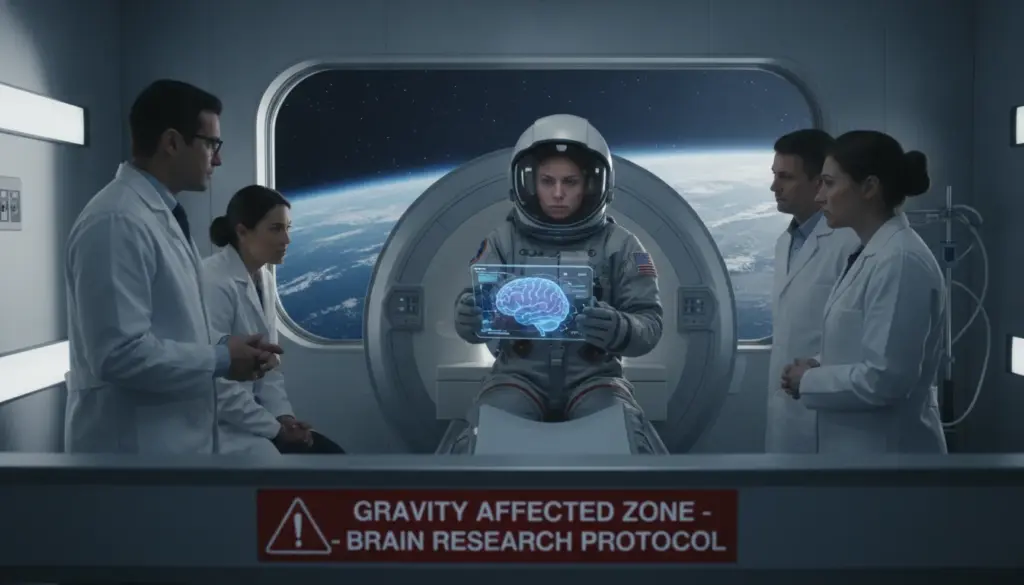
Once that gravitational force disappears, bodily fluids immediately rush upward toward the head, triggering a massive shift in internal pressure. Without its usual mechanical tether, the brain loses its spatial footing. Clinical imaging reveals a gradual, systemic upward and backward displacement of the brain. This isn’t a sudden jolt, but rather a slow, compounding physical adjustment to an extreme environment that worsens the longer an orbital mission lasts.
Clinical Insight: SANS and Astronaut Vision
If you’re fascinated by the biological hurdles of spaceflight, you need to understand Spaceflight Associated Neuro-ocular Syndrome (SANS). These exact shifts in cranial placement and fluid pressure are the direct culprits behind the flattened eyeballs and blurry vision that many returning astronauts experience after long deployments.
Why Millimeters Matter in Orbit
A shift of just a few millimeters might sound entirely trivial, but inside the cramped quarters of the human skull, the margin for error is essentially zero. Because the brain packs almost every available square inch of cranial volume, the slightest repositioning drastically alters the natural flow of cerebrospinal fluid.
Advanced anatomical mapping shows that this internal migration doesn’t happen evenly across the board. The regions governing motor control and sensory integration prove exceptionally vulnerable to this spatial reorganization. While the majority of these physical alterations naturally reverse once an astronaut is back under Earth’s familiar gravitational pull, the recovery rates vary wildly. The fact that some cranial modifications linger indefinitely raises serious red flags for lengthy interplanetary assignments.
The Biomechanical Mind
People usually picture the central nervous system as just a highly complex electro-chemical computer. However, aerospace biology serves as a stark reminder that the brain is also a heavy physical object that interacts mechanically with its immediate surroundings. Altering the local gravitational field fundamentally changes the operating environment for our biological processor.
While we haven’t yet seen definitive proof that this cranial shifting triggers direct neurological damage, it certainly complicates our extraterrestrial ambitions. In a zero-gravity vacuum, an astronaut’s brain doesn’t just have to figure out how to process unfamiliar sensory inputs. It is quite literally forced to physically settle into a brand-new shape within its bone casing.
The Mars Dilemma and Artificial Gravity
Current expeditions aboard the International Space Station act as crucial biological testing grounds, yet targeting Mars introduces an entirely unprecedented set of physiological hurdles. A Martian voyage means enduring many consecutive months in total microgravity, followed by a prolonged surface stay under partial gravity, and finally another grueling trip home.
Under those extreme parameters, even microscopic permanent shifts become massive medical liabilities. Global space agencies are already busy engineering potential countermeasures. Right now, engineers are heavily evaluating rotating habitats designed to generate artificial gravity. This centrifugal force would theoretically push body fluids back into their natural downward distribution and stop the brain from wandering inside the skull.
Biological Limits on the Final Frontier
The human body is remarkably resilient, easily adapting to disrupted sleep cycles and weightless environments. However, clinical adaptation shouldn’t be confused with actual biological immunity. Every environmental adjustment demands a steep physiological toll, and certain health consequences might remain hidden for decades.
A drifting brain won’t necessarily halt our journey into the cosmos, but it highlights exactly how little we understand about our biology outside our home planet. Venturing across the solar system is essentially one colossal experiment on an organism that evolved strictly under terrestrial conditions over millions of years.
Every fresh discovery about space-induced physiological changes completely redefines what constitutes a safe expedition. A brain that moves mere millimeters is a powerful reminder that our most shielded organs are intimately tied to Earth’s specific physics. Pushing toward interplanetary colonization means fully accepting the strict boundaries of our earthly vessels.
These quiet, highly technical biological discoveries will ultimately determine if a multi-month interplanetary transit can safely evolve into a permanent human presence in the cosmos.
Bookmark these aerospace medical insights to stay informed on how human biology is adapting to the future of deep space exploration.