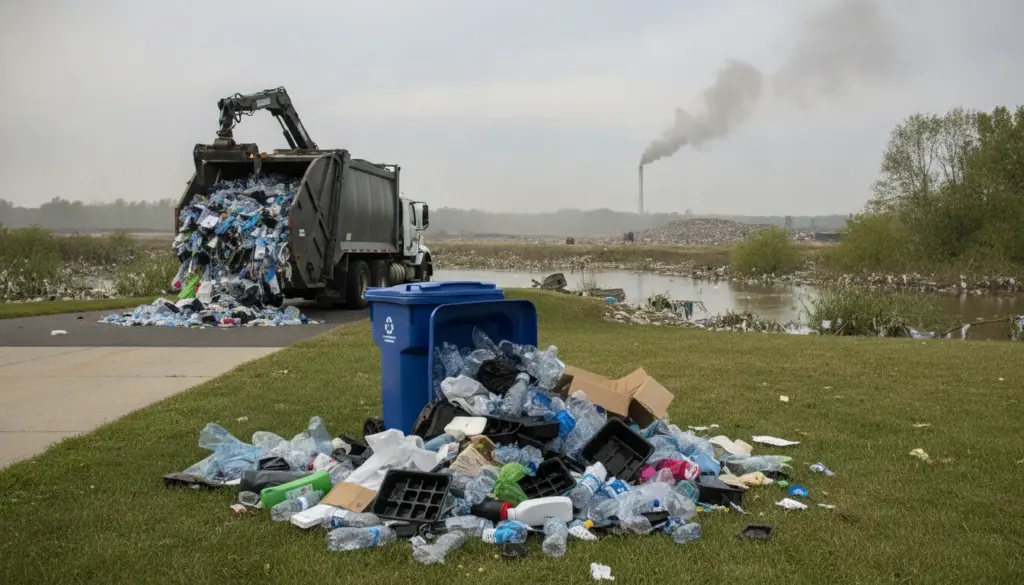
We dutifully toss our bottles, trays, and wrappers into the recycling bin every week. As that container fills up, a nagging thought inevitably crosses our minds: does this daily effort actually make a difference? For many households, a mix of skepticism and resignation leads to a quiet “probably not.”
Unfortunately, industry data confirms these widespread suspicions. Across Europe, only about 15% of plastic is successfully recycled, while the United States hovers around a mere 9%. The remaining waste is incinerated, sent to landfills, or tragically lost into our natural ecosystems. So, the real mystery isn’t whether our waste management faces challenges, but rather why this long-trusted framework is breaking down.
The Problem Starts Long Before You Toss It
To figure out what is going wrong, we have to look closely at our consumption habits. Roughly half of all manufactured plastics are destined for single-use applications. This includes everyday packaging, films, agricultural materials, and shopping bags. Another 20 to 25% goes into long-term infrastructure like construction materials, pipes, and cabling. The remainder forms medium-lifespan consumer goods, from household furniture to vehicles and electronics.
Looking at historical metrics, post-consumer synthetic waste in the European Union already hit a staggering 24.6 million tons back in 2007, and those figures have only climbed since. While commercial packaging remains the dominant culprit, discarded electronics and end-of-life vehicles are rapidly expanding waste streams. Ultimately, this system isn’t collapsing due to a single fatal flaw, but rather a complex web of interconnected issues.
12 Reasons Why Our Plastic Recycling Fails
1. Inefficient Processing Facilities
During essential operational stages like washing and shredding, tiny fragments escape as microplastics. This means the recovery infrastructure itself inadvertently generates fresh environmental pollution. Environmental engineers widely agree that a fundamental redesign of these facilities is becoming an urgent necessity.
2. Virgin Materials Are Cheaper
Right now, producing brand-new synthetic material costs significantly less than processing secondary regranulate. Without smart tax incentives, fees on virgin resins, or government mandates for green public procurement, the global market will predictably default to the most affordable option.
3. Gradual Quality Degradation
Polymers naturally break down when exposed to everyday use, sunlight, fluctuating temperatures, and the intense melting process itself. This chemical reality severely limits how many times a single item can be repurposed. To truly close the loop, heavy investments in advanced sorting, washing, and regranulation technologies are absolutely essential.
4. Flawed Collection Networks
Material loss and contamination happen at the very beginning of the supply chain. Scattered municipal bins, poorly optimized logistics, and a lack of economic motivators drastically reduce both the volume and purity of gathered materials. Fixing street-level collection is just as critical as upgrading high-tech processing plants.
5. An Unprofessionalized Workforce
Across much of the globe, gathering and pre-sorting trash remains low-paying, precarious, and socially invisible labor. Providing comprehensive training, secure employment contracts, and basic societal respect isn’t merely an ethical imperative. It is a fundamental requirement for boosting the entire sector’s operational efficiency.
6. Severe Chemical Exposure
Facilities handle countless hazardous substances on a daily basis, putting waste management workers at significant risk. Upgrading safety protocols, protective gear, and automated technologies to shield these laborers is a pressing public health priority, not a secondary concern.
7. Exporting Trash Offers No Solution
For decades, wealthy nations simply shipped their unwanted synthetics to developing countries with weaker ecological regulations. This strategy is not only deeply unjust but profoundly short-sighted. Environmental pollution completely ignores administrative borders, eventually impacting the entire planet.
8. Mishandling Incompatible Materials
Blending distinct polymer types together instantly destroys the structural integrity of the final recycled batch. Therefore, meticulously separating waste by its specific chemical composition remains one of the industry’s tightest processing bottlenecks.
9. One-Size-Fits-All Regulations
Broad, sweeping legislation rarely yields the desired results. Effective sustainability policies must be carefully tailored to fit a region’s unique infrastructure, economic maturity, and local consumer behaviors. Vague governmental directives routinely fall flat in real-world applications.
10. Products Designed for the Landfill
Items like multi-layered wrappers, blended polymers, industrial adhesives, and black takeout containers are virtually impossible to process. While scientists classify seven primary plastic families, commercial-scale recovery realistically only handles PET and HDPE. Almost everything else is destined for the incinerator or the local dump.
11. Consumers Cannot Bear the Burden Alone
Diligently washing containers, sorting correctly, and memorizing packaging symbols certainly helps, but it cannot serve as our sole defense strategy. Shoving the entire environmental burden onto everyday shoppers is highly ineffective. We need comprehensive accountability spanning the entire value chain, from initial product design right through to final disposal.
12. Input Never Equals Output
Facilities cannot magically salvage every single item dumped onto their conveyor belts. Contaminants like food scraps, excess moisture, mixed metals, textiles, and paper scraps severely degrade processing efficiency. Consequently, the raw tonnage entering a plant will always be significantly higher than the usable secondary material that eventually comes out.
Think of it like cooking a potato omelet at home: you will inevitably generate organic food scraps like peels and eggshells. Industrial resource recovery operates on the exact same principle, just scaled up massively.
A Shared Challenge, Not a Magic Trick
There is no mystical wand we can wave to instantly erase synthetic waste from our oceans and landscapes. However, our current scientific understanding provides us with all the tools needed to manage this crisis far better than we do today.
Recycling is not a standalone cure-all. It serves as just one crucial piece of a much larger sustainability puzzle encompassing reduced consumption, daily reuse, smarter eco-design, and a true circular economy. The overarching question is no longer whether we know what steps to take. We already have the data and the emerging technologies. The only thing missing is a collective, decisive commitment to finally translate our knowledge into tangible action.