
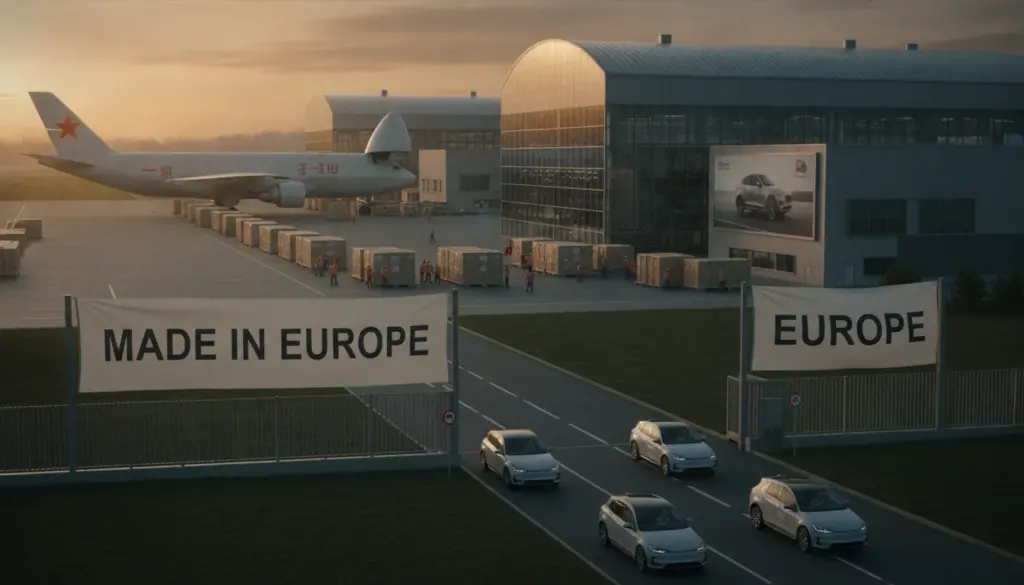
More Chinese automakers are setting up shop in Europe, but who actually benefits from this industrial shift? Does it boost the local economy, or does the real advantage stay in Asia? On paper, these new facilities seem like an incredible win, bringing fresh investments and carrying a familiar, trusted manufacturing label. But behind the polished PR campaigns hides an uncomfortable truth. Much of this so-called “European manufacturing” is little more than basic assembly work, relying heavily on components—and even labor—flown in directly from overseas.
From unseen to ubiquitous on European streets
Just half a decade ago, spotting a Chinese vehicle on local roads was a rare event. Today, brands like BYD, MG, and Chery have become a common sight in almost every major city. These electric models are successfully drawing in drivers with aggressive pricing, rich feature lists, and striking modern aesthetics.
Europe is definitely no stranger to Asian automotive waves. First came the Japanese giants like Toyota, Nissan, and Honda, followed later by Korean powerhouses Hyundai and Kia. They established massive production hubs in nations like France, the UK, Slovakia, and the Czech Republic. Crucially, entire local industries sprang up around these facilities, creating thousands of long-term jobs and extensive domestic supplier networks.
The current overseas expansion strategy looks quite similar at first glance. However, in practical terms, the actual European contribution often boils down to tightening a few pre-sorted screws and filling out import paperwork.
‘Made in Europe’ as a clever tax strategy
The underlying logic of this new manufacturing push is surprisingly straightforward: build locally to entirely bypass hefty import tariffs. As the European Union steadily hikes financial duties on imported electric vehicles—citing unfair market competition and massive state subsidies—manufacturers are finding a smart workaround. By placing facilities in countries like Spain or Hungary, these vehicles magically escape the strictest international trade penalties.
For everyday buyers, a local production label carries serious psychological weight. Consumers naturally equate a regional manufacturing origin with dependable quality, strict safety standards, and reliable oversight. Yet, this comforting perception is only partially accurate, as many of these new facilities function merely as the final puzzle piece in a logistics chain firmly rooted in Asia.
Assembly lines disguised as full production
Take a look at the former Nissan plant located near Barcelona, where Chery now puts together its Omoda and Jaecoo models. Calling this a fully-fledged automotive factory is stretching the truth. Operations here rely heavily on a technique known as Semi Knock Down (SKD). Vehicles arrive in massive crates, nearly finished right out of the box. The Spanish operation primarily handles mounting prefabricated components, bolting on wheels, fitting interior cabins, and topping up essential fluids.
Traditional European auto manufacturing operates on a vastly different and highly integrated scale. Across Germany, France, Spain, and the Czech Republic, hundreds of mid-sized enterprises manufacture critical, highly complex parts. They build the airbags, craft the dashboards, weave the wiring harnesses, and engineer the electronic braking systems. These intricate supplier clusters form the very backbone of the continent’s industrial sector.
While previous generations of international automakers cultivated deep local ecosystems, a significant number of the newest market entrants are effectively cutting domestic suppliers out of the loop entirely. This approach severely dilutes the promised economic boost. A factory that sources its components locally generates countless indirect roles for transport firms, engineering agencies, and maintenance crews. Conversely, a warehouse that simply snaps together ready-made kits creates only a fraction of that economic spin-off.
Importing a workforce to European soil
The growing controversy extends far beyond car parts and bleeds directly into the labor market. A prime example is the heavily discussed battery plant proposed by the battery giant CATL near Zaragoza. This massive facility is slated to supply power cells to Stellantis, the massive automotive group encompassing household names like Peugeot, Opel, Fiat, and Citroën.
Rather than hiring and training a massive local workforce, CATL is opting to import thousands of its own employees. Industry estimates suggest around 2,000 foreign laborers have been flown in just to handle the construction and initial startup phases. While perfectly legal, this strategy is a political powder keg. Local residents are forced to watch heavily subsidized mega-projects rise in their own backyards, yet the promised employment boom never seems to materialize.
- Management and technical expertise remain strictly overseas despite the new European zip code.
- The vast majority of essential components are still engineered and manufactured abroad.
- Supplier networks are significantly shallower than those utilized by traditional legacy automakers.
- Knowledge transfer to the local blue-collar and white-collar workforce is severely restricted.
Regional politicians find this reality incredibly tough to sell to voters. They might cut ribbons on shiny new “gigafactories” and promise a new industrial golden age, but regional unemployment statistics barely budge. Meanwhile, local manufacturing business owners quickly realize that securing lucrative contracts from this new, closed-off supply chain is nearly impossible.
Brussels explores strategic countermeasures
The European Commission is facing intense, mounting pressure from member states desperate to shield their historic domestic auto sectors. Legacy brands are already struggling to finance the incredibly expensive transition to electric mobility, all while their profit margins are squeezed by highly competitive overseas pricing.
Policymakers in Brussels are now floating the idea of taking a page directly out of Beijing’s own historical playbook. For decades, foreign automakers were only permitted to operate in the East if they formally formed a joint venture with a domestic partner. This clever mandate forced valuable technology transfers and ensured the host government maintained tight control over financial investments.
Applying a similar legislative framework in the EU could compel incoming brands to partner directly with local entities. Whether enforced through shared manufacturing spaces or mandatory minimum equity stakes for European firms, this strategy would guarantee greater regional influence over employment, technological development, and corporate decision-making.
Enforcing local component quotas
Beyond forcing strategic partnerships, authorities are also drafting aggressive regulations regarding the actual origin of vehicle components. Under current trade rules, a car can easily be marketed as locally produced even if the lion’s share of its financial value was actually generated halfway across the globe. Implementing a strict minimum threshold for European-made parts could drastically change the industrial landscape.
Such a localized quota would aggressively force open the doors for domestic producers of electronics, brake systems, proprietary software, and interior trims. However, this shift would inevitably raise overall production costs, which could potentially erode the steep price advantage that makes these imported models so appealing to budget-conscious drivers.
Expanding despite regulatory pushback
While bureaucrats fiercely debate new rules, the wave of overseas investment shows absolutely no signs of slowing down anytime soon. BYD, currently holding its position as one of the globe’s largest EV manufacturers, is already hunting for a second European production site. Catalonia has emerged as a very strong contender, largely thanks to its robust existing infrastructure and deep automotive heritage.
Similarly, MG—a historically British badge that is now wholly controlled by the conglomerate SAIC—is actively considering its own mainland facility. Securing a dedicated plant would help cement the brand as a formidable mid-market competitor alongside legacy heavyweights like Volkswagen, Renault, and Peugeot. Ultimately, this battle is about much more than mere market share; it is a fundamental struggle over who gets to dictate the future of global mobility.
What this means for the everyday consumer
If you are currently in the market for an electric vehicle, this aggressive market expansion undeniably works heavily in your favor. Fierce competition actively drives down sticker prices and accelerates critical technological advancements. In the highly competitive affordable EV segment—where legacy automakers unfortunately dragged their feet for years—these new challengers are setting a blistering, consumer-friendly pace.
However, the economic reality for local businesses and workers is far more complicated. Regional governments might eagerly pour millions into tax breaks and subsidies to lure a high-profile plant, only to be left without a sustainable supplier network. This leaves local economies dangerously dependent on corporate boardrooms situated thousands of miles away.
Trade unions and vocational schools face a massive uphill battle. They are constantly lobbying these new corporate arrivals to offer meaningful, long-term training and genuine upward mobility for local workers. While there are occasional victories to celebrate, structural success remains elusive. Europe’s collective bargaining power over the coming years will largely dictate the final outcome.
The hidden cost of basic assembly
The distinction between deep manufacturing and basic assembly might sound overly technical to the average driver, but it strikes at the very core of a nation’s industrial health. A facility solely focused on final assembly generates far fewer high-paying, specialized roles than a plant handling research, engineering, and raw component fabrication. True manufacturing hubs nurture regional technical colleges, foster innovation centers, and help launch hardware startups.
Furthermore, the physical structure of the supply chain determines exactly where the real money ends up. If nearly all components are fabricated overseas, the vast majority of the profit naturally flows right back there. The financial margins on mere assembly work are surprisingly thin, creating a major, looming headache for policymakers obsessed with maintaining strategic industrial autonomy.
Key industry terms decoded:
- SKD (Semi Knock Down): Vehicles arrive nearly finished in shipping containers and only require basic final assembly at their destination.
- CKD (Completely Knock Down): Cars are imported mostly as loose individual components and are entirely built up from scratch locally.
- Joint venture: A collaborative business entity where two distinct parties—such as a legacy European brand and a new Asian automaker—share ownership, profits, and risk.
Over the next decade, the critical metric will not be how many new factories pop up across the continent, but rather what actually happens deep inside their walls. How much local hardware is utilized, what intellectual property stays behind, and how many neighborhood residents actually secure meaningful, lasting careers? The answers to those pressing questions will ultimately decide if “Made in Europe” retains its prestigious integrity, or simply devolves into a clever marketing sticker slapped onto a foreign puzzle.