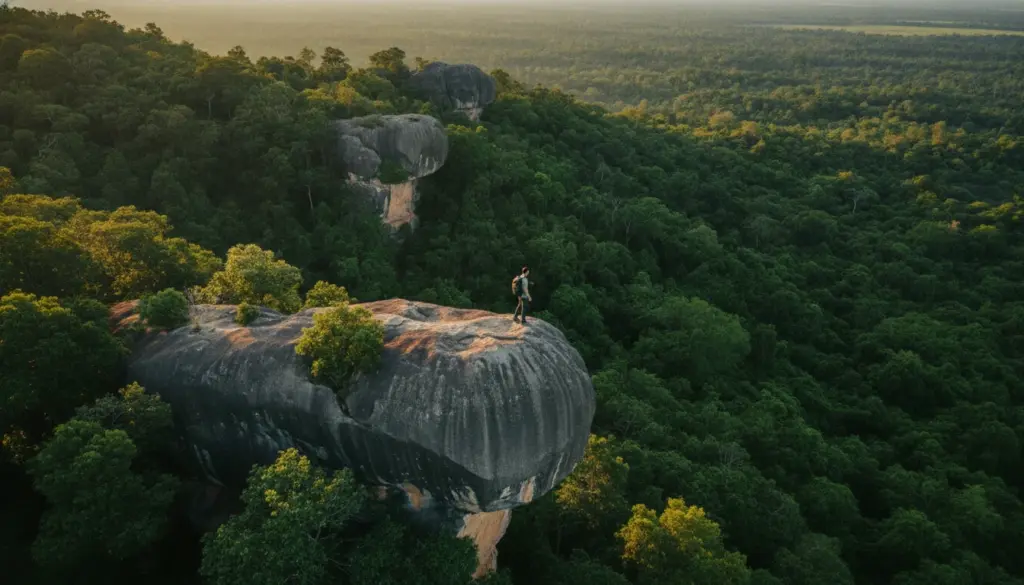
Most tourists flock to Thailand’s heavily trodden southern shores, completely bypassing one of the globe’s most bizarre geographical marvels. Picture yourself balancing on the back of an enormous stone leviathan suspended high above a canopy of emerald trees. As someone who carefully evaluates sustainable travel routes, I can share exactly how to experience Hin Sam Wan both responsibly and securely, ensuring you get the most out of this extraordinary expedition.
Tucked away inside the deeply protected woodlands of northeastern Thailand sits the Hin Sam Wan rock formation. Located within Bueng Kan province, this extraordinary site boasts an estimated age of 75 million years. When viewed from just the right angle, three distinct sandstone monoliths perfectly mimic a family of whales gliding over a mountainous crest.
The area belongs to the Phu Sing Forest Park, a dedicated sanctuary safeguarding diverse wildlife and ancient geological formations shaped across millennia. Standing atop these massive stones offers sweeping vistas of the Mekong River, dense surrounding woodlands, and even the distant mountains of Laos on a clear afternoon. Unsurprisingly, it ranks as one of Asia’s most visually striking locations, recently gaining traction through the “7 Greens” initiative aimed at championing responsible tourism and environmental preservation.
What Makes Hin Sam Wan So Extraordinary?
A well-planned network of trails allows visitors to hike directly to the main formations by winding through the park’s rugged terrain. Crucially, tourists are only permitted to walk upon the two larger “whales.” The smallest rock, affectionately dubbed the “baby,” remains strictly off-limits to pedestrian traffic to shield its fragile structure and immediate ecosystem from degradation.
In reality, these colossal monuments are ancient relics from an era when dinosaurs still roamed the earth. Today, the surrounding reserve flourishes with vibrant life, featuring rare endemic plant species and secluded jungle waterfalls. If you time your visit for dusk, the sandstone absorbs the setting sun, glowing in brilliant shades of orange that highlight the stark, majestic beauty of this geological phenomenon.
Trekking Options and Eco-Friendly Activities in Bueng Kan
Within the wider Bueng Kan province, outdoor enthusiasts can explore up to nine distinct trekking routes. These paths weave through thick forestry and cascading waters, offering exceptional opportunities to observe wildlife in entirely undisturbed habitats. Park management strategically designs these pathways to segment foot traffic, successfully preventing overcrowding in the environment’s most vulnerable zones.
Many travelers opt for a comprehensive full-day excursion, perfectly timing their arrival at the summit for the evening light. It is absolutely vital to pack proper footwear with excellent traction alongside ample drinking water, as several inclines demand serious physical exertion. However, gazing out over the natural border dividing Thailand and Laos makes every strenuous step worthwhile. Beyond the impressive boulders, the region features multiple panoramic viewpoints where visitors can engage with indigenous communities and learn about their deep commitment to land conservation.
Discovering Isan Culture at the Life Community Museum
For those wanting to truly grasp the authentic spirit of the region, stopping by the Life Community Museum is essential. Far from a conventional, static exhibition, this “living museum” was established by a local Thai designer right on her ancestral property. The initiative directly supports 45 local families who actively curate and manage the space, sharing their genuine Isan heritage without disrupting their daily routines.
The sprawling grounds feature classic architecture, a bustling neighborhood market, and a dedicated street art district. Visitors are frequently captivated by vibrant murals depicting the Naga—mythical serpents widely revered as the fierce protectors of the Mekong River. Seeing contemporary graffiti on corrugated metal seamlessly blend with ancient mythological tales and traditional craftsmanship is a truly unique aesthetic experience.
Tradition, Craftsmanship, and Thai Spirituality
Spiritual devotion remains at the very core of the Bueng Kan identity. Just a short distance from the museum grounds, a welcoming temple invites respectful travelers to explore the profound depths of regional beliefs. One specific area highlights intricate Buddhist craftsmanship, utilizing time-honored motifs to symbolically illustrate the local understanding of the journey between life and death.
This intentional effort to share cultural traditions ties directly into the broader philosophy of mindful travel. By carefully managing visitor volume and deeply respecting indigenous practices, delicate marvels like Hin Sam Wan can remain beautifully intact. Opting for these types of mindful destinations allows you to join a larger global effort dedicated to ensuring the planet’s most magnificent treasures endure for generations to come. Be sure to save these insights for your upcoming adventure planning.