
Always exceptionally useful, never genuinely joyful
He spent decades working relentlessly, always stepping up for everyone around him. To the outside world, he was the model colleague, devoted partner, and perfect father. Yet, it took reaching the age of 74 to uncover a quiet, unsettling truth. For his entire adult life, he had mistaken endless busyness and external validation for a deeply unfamiliar emotion: simple, unconditional joy.
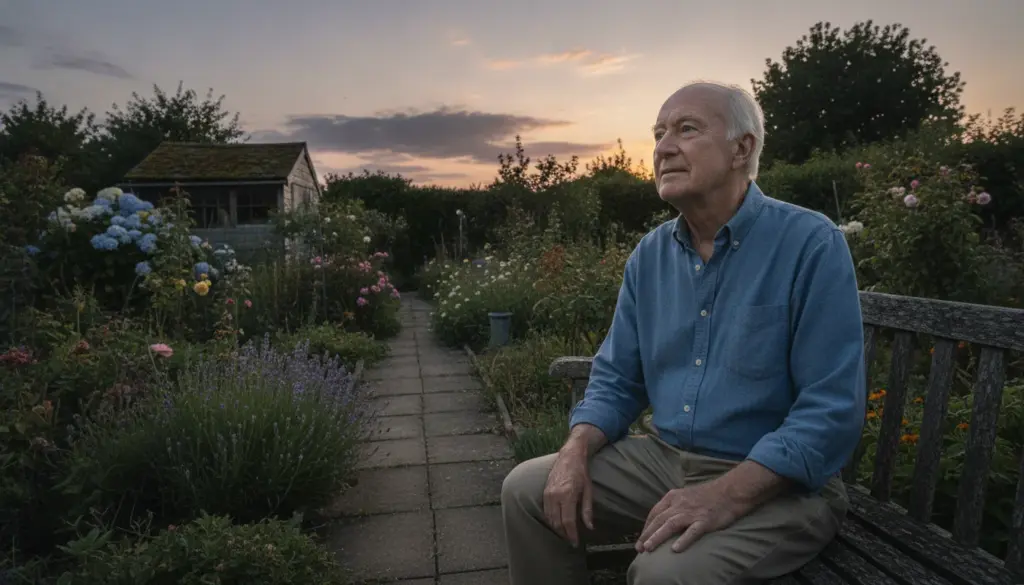
Life moves at a much slower pace these days. Sitting on a weathered bench in his modest garden, watching the sky shift into shades of twilight orange, a profound realization washes over him. Looking back, he struggles to recall moments where he felt happy for absolutely no reason—completely free from duties or heavy responsibilities.
His life story reads somewhat like an impressive resume. He was constantly active, heavily respected, and frequently deemed indispensable. Despite these achievements, asking himself a direct, honest question leaves behind a hollow ache. When did he last experience genuine delight that wasn’t tied to crossing off a task or receiving gratitude from a peer?
For decades, he walked in shoes that never genuinely fit, only noticing the sheer discomfort now that he has finally taken them off. He isn’t complaining. Instead, his reflection feels like someone turning on the harsh auditorium lights long after the standing ovation has faded, noticing the empty seats for the very first time.
Using a demanding career to prove his personal worth
Over a span of more than thirty years, he steadily climbed the corporate ladder. Starting as a regular employee, he eventually managed multiple sprawling departments. Every step up felt like concrete proof that his existence mattered. Late-night meetings, massive amounts of overtime, and bringing stressful files to the dinner table were his ultimate badges of loyalty and dedication.
However, he never paused to ask himself a crucial question: did he actually desire this demanding lifestyle, or had he simply made it impossible for anyone to function without him? Being overwhelmingly busy morphed into his core identity. Taking a break felt deeply suspicious, almost as if resting meant failing as a human being.
This dynamic mirrored itself exactly in his home life. Between juggling corporate deadlines and endless reports, he naturally took charge of school events, drove the children to sports and music lessons, prepared dinner, and mentally mapped out the next day’s itinerary. Nobody ever demanded he carry this much weight; his hyper-responsibility was purely automatic.
One distinct memory stands out from his mid-forties. He collapsed into an exhausted sleep on the couch, a pen and notepad still resting on his lap. His wife gently woke him and posed a straightforward question: when was the last time he did something entirely for himself, completely devoid of practical purpose? He had absolutely no answer.
The hidden emotional trap of wanting to be indispensable
Growing up as the eldest of five siblings, he learned a foundational lesson very early on: being helpful meant being seen. When his father abandoned the family during his twelfth year, he instinctively stepped into the void. He buttered the daily bread, managed his siblings’ homework, dried their tears, and fixed whatever was broken. From that pivotal moment forward, his self-worth became permanently tethered to serving others.
He developed an almost supernatural radar for spotting what people needed. Long before anyone even asked for assistance, he was already jumping in to help. While this behavior provided a comforting sense of control and meaning, it carried a heavy emotional cost. He only felt truly valuable when he was actively solving a crisis.
This deeply ingrained habit infiltrated every corner of his existence:
- In the workplace: He was always the last to leave the office, happily absorbing extra assignments and rescuing failing projects.
- Within his marriage: He independently managed calendars, navigated complex financial matters, and made practical household choices, often skipping joint consultations.
- With his children: He transformed into the ultimate chauffeur, dedicated coach, master planner, and emergency contact for fellow parents.
To the outside world, he was magnificent. Neighbors, relatives, and coworkers constantly leaned on his unshakable reliability. Unfortunately, he routinely mistook their visible relief and profound gratitude for his own personal fulfillment. If the people around him sighed happily, he assumed that meant he was experiencing joy.
Why external praise never actually fills the void
Even today, he freely admits that receiving recognition feels wonderful. A warm compliment, a sincere thank you, or a pat on the back delivers a quick, deeply pleasant emotional spike. The problem is that this feeling evaporates almost instantly. Relying on praise is like eating candy for dinner—briefly sweet, but ultimately leaving your soul starved.
To chase those fleeting moments of validation, he simply ran faster. He eagerly joined extra committees, launched more charity drives, and tackled countless side projects. He was consistently the first person to volunteer and the absolute last to decline a demanding request.
His wife used to joke that his future headstone would simply read: “He took care of it.” They would chuckle at the dark humor, but looking back, he recognizes the painful accuracy of her words. His entire existence revolved around fixing, carrying, and organizing. It never revolved around simply enjoying the ride.
It turns out, you can be universally cherished by your entire community and still feel completely empty when staring into your own bathroom mirror.
What you lose when you refuse to hit pause
Relentless hustling drains much more than just your physical stamina. It actively steals away irreplaceable, fleeting moments. He can perfectly recite every major corporate initiative he successfully launched. He remembers exact quarterly targets he crushed and the messy reorganizations he managed to stabilize.
The picture becomes painfully blurry when he searches his mind for small, intimate memories. What was his ten-year-old son’s absolute favorite bedtime story? He draws a complete blank. When did he last laugh so intensely that his ribs ached and he couldn’t catch his breath? The memory simply doesn’t exist.
Not long ago, he decided to volunteer for a local program teaching illiterate adults how to read. During a session, a woman around his own age confessed that she had faked her reading abilities for decades out of pure embarrassment. Only now was she brave enough to seek guidance.
She had spent a lifetime pretending she could read words on a page. He had spent a lifetime pretending that frantic busyness was the exact same thing as emotional fulfillment.
That evening, an emotional dam finally broke. The tears weren’t out of pity for his student, but out of profound self-recognition. He had suppressed his own fundamental human need for rest and play just as deeply as she had hidden her struggles with literacy.
Discovering what authentic joy actually feels like
He is slowly wrapping his mind around a radical new concept: joy is allowed to exist entirely without purpose. It doesn’t need to be attached to a productive goal, a stellar outcome, or someone else’s grateful smile. Happiness doesn’t require an explanation, nor does it need to be earned through hard labor.
Recently, he spent an entire afternoon immersed in a cheap, predictable crime thriller. It wasn’t a dense self-improvement book, it wasn’t a home renovation task, and it wasn’t community service. When he finished the final chapter, absolutely no one benefited from his time. Yet, for three solid hours, he felt wonderfully light and entirely at peace.
This gentle sensation feels incredibly foreign. He frequently catches his inner critic whispering that he is “wasting precious time.” But quickly, he reminds himself that leaning into this profound uselessness is a specific type of living he systematically denied himself for decades.
He and his wife have even instituted a new weekly tradition they fondly call “Useless Saturdays.” They ban all to-do lists, scrap any ambitious plans, and ignore lingering obligations. They sip coffee slowly, watch the birds out the window, and eat only when they feel genuinely hungry. Nothing more, nothing less.
The single internal question that shifts everything
During these quiet, unstructured days, a fundamental belief system is shifting inside him. He now understands that happiness isn’t a cosmic reward for flawless behavior or relentless grinding. It isn’t the roaring applause after a perfect performance. True joy is a quiet presence that sneaks up while sitting at the breakfast table, walking aimlessly through a park, or reading a paperback in the afternoon sun.
To navigate his remaining days, he is practicing using a brand-new internal compass. Instead of immediately asking “Who desperately needs me?” or “What task needs fixing right now?”, he pauses to ask:
- Does this activity bring me authentic, personal joy?
- Or does it merely make me a useful tool for someone else?
While those two answers can occasionally overlap, he is realizing they rarely do. Step by agonizing step, he is learning to spot the crucial difference.
Learning how to truly live in your seventies
At 74 years old, he is finally training himself in a skill most people consider totally basic: the ability to say “no.” For a man whose entire emotional survival depended on external praise, setting a firm boundary almost feels like committing treason. He regularly notices the flash of disappointment in people’s eyes when he refuses to automatically rescue them from their self-made crises.
Yet, letting go provides incredible breathing room. He is discovering the magic of tranquil evenings without a nagging checklist, solitary walks without a ringing smartphone, and casual conversations where he doesn’t immediately offer unprompted advice. Old habits die incredibly hard, and he still battles a jittery restlessness when he is forced to sit still.
Interestingly, he notices many peers grappling with this exact same emotional transition. They did everything “correctly” by society’s standards—working relentlessly, providing generously, and building impressive lives. Yet, as their daily schedules clear out, a gnawing emptiness remains. Who are you at your core when you stop being the load-bearing pillar of a massive company or a bustling family?
A vital psychological lesson for the rest of us
His deeply personal reflection highlights several universally common behavioral traps:
- Treating overwhelming stress and busyness as a bizarre badge of honor.
- Internalizing the childhood belief that your baseline worth equals your tangible output.
- Scaling a massive career without ever pausing to check if the destination matches your soul.
- Waiting until the twilight years to finally mourn a lifetime of missed, tiny joys.
If these emotional patterns sound uncomfortably familiar, you certainly don’t need to delay your awakening until retirement. Tiny, deliberate experiments can instantly alter your trajectory. Try blocking out an afternoon to do absolutely nothing, pick up a silly hobby that produces zero tangible results, or decline a weekend invitation without offering a sprawling, defensive excuse.
Psychological professionals frequently encounter this exact narrative in their practices. They regularly treat individuals who spent decades as the indispensable glue holding a business or family together, only to realize they have zero relationship with themselves. Having never explored what brings them personal delight outside of being a useful resource, they often face severe bouts of late-in-life irritability, gloom, and profound emptiness—even when everything looks perfectly fine on paper.
Sitting quietly in his garden, the elderly man is making a conscious vow. He no longer wishes to frantically fill his remaining years; he simply wants to experience them. He doesn’t succeed every single day. Occasionally, he slides backward into his old obsession with checklists and heavy responsibility. But whenever he catches himself, he circles back to that one vital question: am I choosing to be hopelessly busy right now, or am I choosing something that makes my heart feel genuinely light?
By daring to ask yourself that exact question a little earlier in life, you might just avoid reaching your mid-seventies only to realize you were everything to everyone—reliable, indispensable, highly valued—except genuinely happy.