
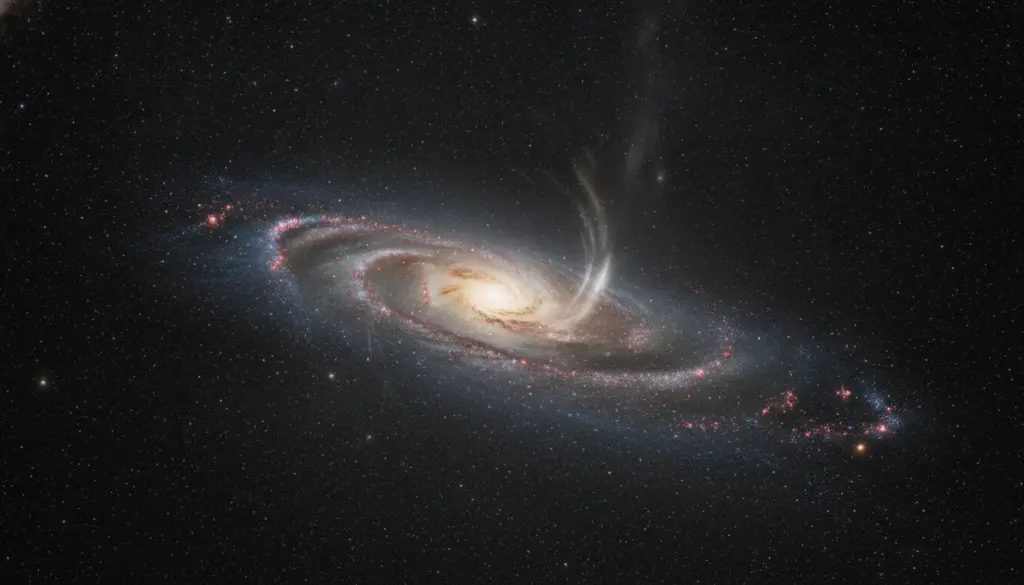
An ancient cosmic fossil hidden in plain sight
Astronomers have recently identified a faint ribbon of stars, dubbed C-19, which now holds the record as the most metal-poor stellar stream ever observed within our Milky Way. This remarkable find provides an incredible window into the earliest building blocks of our galaxy, while simultaneously exposing the invisible gravitational pull of dark matter.
Our galaxy is enveloped by a vast outer halo containing sparse gas, scattered stars, and massive amounts of unseen dark matter. Within this sprawling frontier wander the remnants of ancient dwarf galaxies and star clusters that were consumed long ago, forming stretched-out bands known as stellar streams. While C-19 represents one of these cosmic leftovers, it stands out as a truly extreme anomaly.
Situated roughly 58,700 light-years away from Earth, this celestial structure extends for more than 650 light-years. If visible to the naked eye, it would trace an immense arc stretching over 100 degrees across our night sky. However, the formation remains incredibly elusive to spot because its constituent stars are exceptionally dim and widely dispersed.
Unprecedented chemical purity
What truly sets C-19 apart is its staggering lack of heavy elements. In the realm of astrophysics, any element heavier than hydrogen and helium is broadly classified as a “metal.” The stellar bodies making up C-19 possess a metallicity below -3.0 dex, meaning they contain less than one-thousandth of the metal content found in our Sun.
This extreme chemical deficit places C-19 among the most pristine stellar populations ever mapped in the Milky Way, boasting a makeup that dates back to the universe’s earliest generations of stars. While the total mass of the stream hovers between 40,000 and 50,000 solar masses—comparable to a mid-sized globular cluster—its internal movements bear a striking resemblance to the chaotic dynamics usually seen in a dwarf galaxy.
How advanced technology mapped millions of stars
Uncovering this faint cosmic thread was made possible by the Dark Energy Spectroscopic Instrument (DESI), a state-of-the-art detector mounted on the 4-meter Mayall telescope at the Kitt Peak National Observatory in the United States. DESI boasts the incredible ability to capture the light spectra of thousands of stellar targets simultaneously.
By analyzing these highly detailed light signatures, experts can extract vital astronomical data:
- The exact radial velocity, showing whether a star is moving toward or away from us.
- The chemical fingerprint, which reveals the object’s overall metal content.
- The true intrinsic brightness, allowing for highly precise distance calculations.
After gathering details from more than 10 million individual stars, researchers combed through the massive dataset seeking groups with identical motion and chemistry. Through a specialized statistical mixture model, they successfully isolated the C-19 stars from the ordinary background noise of typical halo stars based solely on their unique trajectories and pristine chemical signatures.
A strange secondary track alongside the main stream
One of the most baffling discoveries about C-19 is its relatively wide velocity dispersion of roughly 7.8 kilometers per second. This indicates that the stars within the stream are moving rather chaotically relative to one another. Such turbulent behavior directly contradicts the orderly, “cold” flow typically associated with standard globular cluster streams.
Adding to the mystery, C-19 features a peculiar structural quirk: a faint secondary track or “spur” running alongside the primary ribbon. This parallel branch sits roughly 1,000 light-years away from the main core and stretches out over a distance of 3,000 light-years.
Although the stars in this offshoot clearly belong to the same cosmic family, their positions and velocities deviate from the central path. This unusual fork suggests that C-19 suffered a severe gravitational disruption in its past. Such a violent disturbance could have been triggered by a massive gas cloud, a passing galaxy, or even an invisible clump of dark matter.
The debate: Globular cluster or dwarf galaxy?
Astrophysicists are currently debating the true origin of this enigmatic formation. The evidence points toward two primary candidates: an ancient globular star cluster or a miniature dwarf galaxy.
On one hand, the severely depleted metal content strongly supports the globular cluster theory. These ancient spherical clusters crystallized shortly after the Big Bang, forming from pristine cosmic gas that was still untouched by heavier elements. On the other hand, the chaotic internal speeds and the presence of the parallel spur are classic hallmarks of a dwarf galaxy, a structure that naturally contains higher concentrations of dark matter and exhibits a complex internal architecture.
Tracing the Milky Way’s invisible dark matter
Beyond their sheer age, stellar streams serve as highly sensitive probes for mapping gravitational forces in the outer reaches of the Milky Way. When a star stream passes near a dense pocket of dark matter, the intense encounter can leave behind subtle kinks, gaps, or even fragmented side tracks like the one currently observed in C-19.
In this way, C-19 acts as a massive cosmic seismograph. Its distorted shape essentially records the ancient gravitational shocks our galaxy experienced during its turbulent youth. By pairing DESI’s robust chemical data with precise positional tracking from the European Space Agency’s Gaia satellite, scientists hope to rewind the stream’s orbit over billions of years to identify exactly what unseen obstacles smashed into it.
Why metal-poor stars unlock cosmic history
While a lack of heavy elements might seem like a trivial observational detail, it is an absolute goldmine for cosmologists. A metal-poor composition indicates that these celestial bodies ignited long before the universe was heavily polluted by the chaotic deaths of earlier stars.
The very first massive stars in existence violently disrupted the cosmos through colossal supernova explosions. These cataclysmic events forged crucial life-building elements like carbon, oxygen, silicon, and iron, scattering them into surrounding gas clouds. It was only after this widespread cosmic seeding that rocky planets like Earth could eventually form.
Because the stars within C-19 show almost zero evidence of this heavy element enrichment, they preserve the pristine chemical signature of perhaps just a single generation of those primordial supernovae. By analyzing their exact elemental ratios, researchers gain vital clues regarding the weight and explosive power of the universe’s earliest stellar inhabitants.
What the future holds for C-19 research
The initial findings represent just the beginning of a long investigatory journey. Over the coming years, powerful observatories will undoubtedly zoom in on C-19 to capture high-resolution spectra of its individual stars. This granular data will reveal the precise chemical breakdown element by element, confirming whether the stars were born from a single, uniform gas cloud or if multiple generations mixed together over time.
This breakthrough also highlights a massive shift in modern observational techniques. Finding this stream didn’t rely on snapping one lucky photograph, but rather on sophisticated data mining, advanced statistical modeling, and blending kinematics with chemistry. Massive automated surveys are pushing the field away from examining isolated objects toward identifying hidden patterns within colossal datasets.
Ultimately, this fragile, stretched-out, and seemingly invisible thread of stars offers a powerful new benchmark for cosmologists. It exists as a genuine paleontological fossil suspended in deep space, packed with vital clues about how our home galaxy was painstakingly assembled from smaller cosmic fragments.