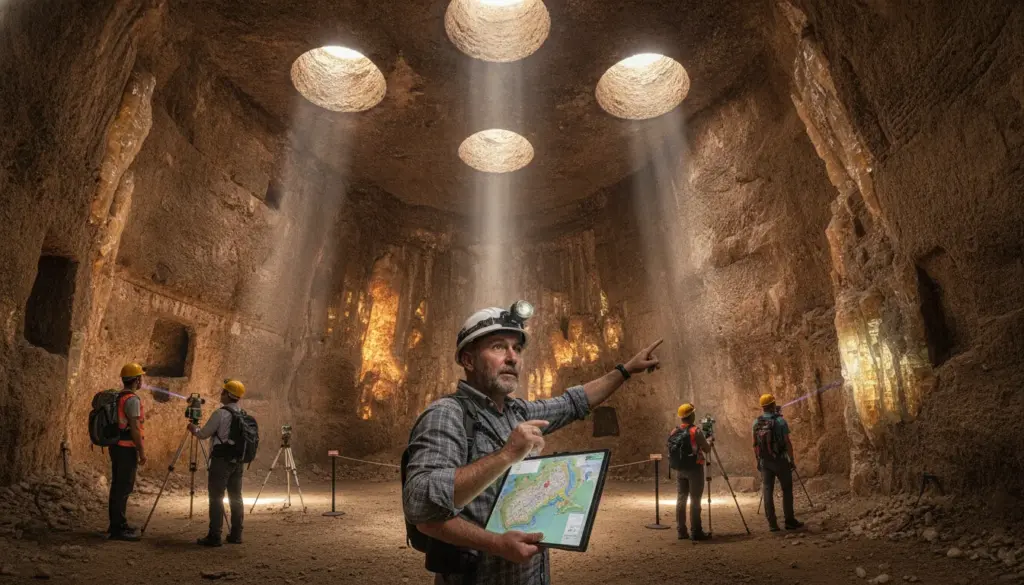
Have you ever wondered how wealthy Romans illuminated their estates before affordable, flat glass was invented? They bypassed this architectural hurdle in an extraordinary way. Ancient engineers constructed a vast underground maze stretching over 30 kilometers, which researchers have recently mapped in the Spanish province of Cuenca. This incredible discovery reveals the massive scale of an ancient “glass empire” that continues to leave modern geologists in absolute awe.
A research team, guided by geologist Antonio Alonso-Jiménez, determined that ancient builders carved out this gigantic network specifically to extract lapis specularis throughout the Segóbriga district. Their comprehensive assessment brings the true magnitude of this operation to light for the very first time. Experts pinpointed the subterranean system beneath the Loranca basin, a landscape still heavily marked by ancient sinkholes and access shafts. Here, workers discovered immense deposits of transparent selenite gypsum, which was meticulously sliced into thin panes to serve as window glass.
The Mining Network That Enriched Roman Cuenca
Recent fieldwork details an industrial-scale extraction zone that was virtually unparalleled in the Iberian Peninsula’s interior. The prized mirror stone, or lapis specularis, functioned as far more than a simple decorative element. Before traditional glass manufacturing became widespread, this unique mineral provided the Roman elite with beautiful diffused light, clear visibility, and excellent thermal insulation for various key structures:
- Luxurious bathhouses (thermae)
- Expansive private villas
- Major civic and public buildings
The region’s unique geological history perfectly explains why these ancient miners were so determined to dig here. Roughly 20 million years ago during the Miocene epoch, this specific area consisted of shallow, saline lagoons. Over countless millennia, water seepage combined with a highly stable subterranean climate—maintaining temperatures between 15 and 20 degrees Celsius—caused the gypsum to slowly crystallize into exceptionally pure, gigantic formations.
The renowned first-century Roman naturalist Pliny the Elder actually documented that the absolute finest mirror stone originated around Segóbriga. Modern topographical surveys completely back up his ancient claims. Subterranean complexes like La Condenada currently feature over 5 kilometers of explorable routes, while the Los Espejares sector and its neighboring excavations boast a combined total of over 20 kilometers of tunnels. The booming trade of this raw material transformed Segóbriga into a regional powerhouse, funding the construction of a circus, an amphitheater, and a grand theater.
Historical travel tip: If you ever find yourself touring Spain’s ancient excavation sites, keep an eye out for “lucernaria.” These are tiny wall alcoves where miners would carefully place their small oil lamps. Because they were carved at regular 1.5-meter intervals, overseers could accurately calculate both the progress of the excavation and the length of a worker’s grueling shift.
How the Empire Managed Cuenca’s Underground Operations
Navigating the subterranean workspace required absolute organizational mastery. Excavators would chisel out vertical drop shafts measuring precisely 2×2 meters, carving foot-holds directly into the rock walls to act as ladders. From these primary entry points, the pathways branched off into incredibly narrow corridors, many offering less than a square meter of breathing room. Astonishingly, these laborers relied entirely on basic iron chisels to break the earth.
Because these deep sites were completely abandoned during the second century AD and never touched again, those original tool marks remain perfectly preserved today. Roman administrators clearly prioritized both complex logistics and structural safety. At the Los Espejares site, archaeologists unearthed an impressive drainage system connected to the Cigüela river, expertly designed to protect the lower levels from devastating floods.
While the Empire maintained strict fiscal control over the entire district, local contractors actually managed the daily operations. Highly skilled artisans crafted the transparent panes right at the extraction site, whereas a massive workforce of forced laborers handled the heavy lifting. Eventually, as flat glass became significantly cheaper to produce, the intense demand for mirror stone plummeted.
Fortunately for modern historians and geology enthusiasts, this sudden halt in production left countless galleries beautifully intact. Today, preserved sites such as La Mora Encantada invite visitors to step underground and witness the staggering capabilities of ancient industrial engineering firsthand.