The quiet record-breaker of the commodities market
A little-known record-breaker has emerged on the commodities market, with a price said to exceed that of gold, platinum and many gem-quality diamonds. Osmium can currently be valued at around £1.13 million per kilogram, equivalent to roughly €1.33 million.
Osmium attracts not only scientists but also investors looking for unusual ways to preserve wealth. Its astronomical price is driven by a combination of factors: extreme scarcity, a highly complicated extraction process and exceptional physical properties.
The metal belongs to the platinum group and occurs naturally only in trace quantities.
The principal reason for its high price is surprisingly straightforward: minimal supply combined with growing demand.
Experts estimate that worldwide production of osmium amounts to only a fraction of a tonne each year. By comparison, more than 3,000 tonnes of gold are mined annually. The difference is enormous, and it is precisely this scarcity that pushes the price to extraordinary levels.
What is osmium, and why is it so extraordinarily expensive?
Osmium is a chemical element belonging to the platinum group. It carries the symbol Os on the periodic table and is considered one of the rarest metals in existence.
It occurs only in trace quantities, mainly alongside platinum- and iridium-bearing ores. Independent deposits are virtually non-existent, making extraction both difficult and expensive.
The price is also affected by the complex refining process. Separating osmium from a mixture of other precious metals requires advanced chemical procedures, considerable amounts of energy and highly specialised laboratories.
This is not a raw material that can simply be “panned from the ground” in the manner of prospectors during the historic gold rushes.
Scientists emphasise that processing osmium requires exceptionally sophisticated technology. A single gram is the end product of a lengthy and demanding operation involving separation from ore, multiple stages of purification and precise analysis.
Even a very small quantity can therefore carry a substantial value.
The highest density of any known metal on Earth
Osmium has an exceptionally high density and is regarded as one of the heaviest metals known to humanity.
A small cube roughly the size of a sugar lump can weigh as much as a considerably larger stone. In practical terms, a remarkable amount of mass can be concentrated in a very small object, which may appear particularly attractive from an investor’s point of view.
The metal is also characterised by exceptional hardness and resistance to wear. It does not rust, is highly resistant to corrosion and remains remarkably stable under normal chemical conditions.
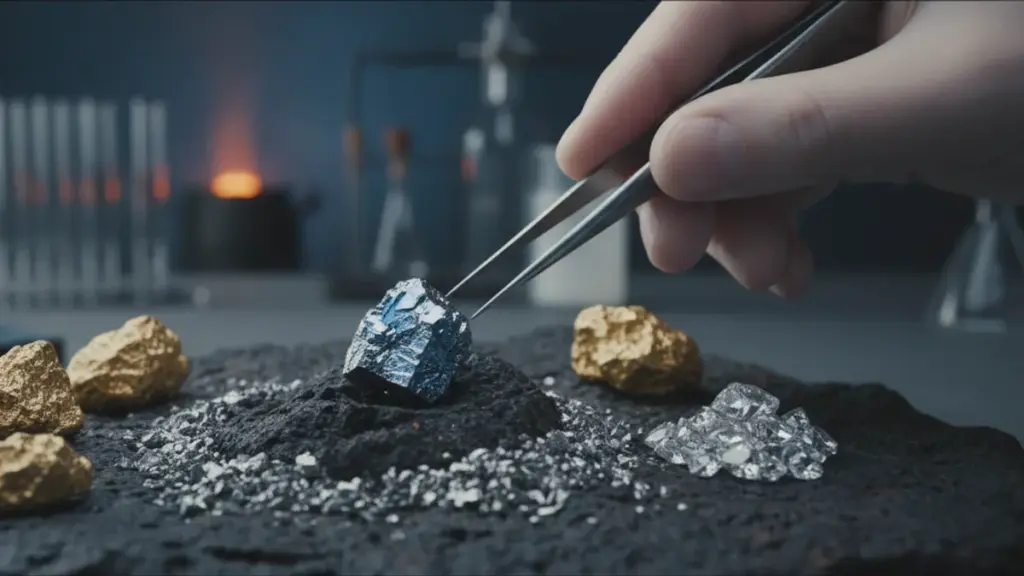
In crystalline form, it has a distinctive bluish metallic lustre that appeals to collectors and enthusiasts of rare materials.
Properties that distinguish osmium from other metals include:
• One of the highest densities of any known element
• An extremely high melting point of more than 3,000°C
• Exceptional extremely high melting point of hardness and resistance to wear
• Chemical stability under ordinary conditions
• A characteristic bluish metallic lustre following suitable surface treatment
• Minimal reactivity with common substances in the surrounding environment
These qualities attract both researchers and people fascinated by rare metals with an almost “otherworldly” appearance.
In practice, however, osmium is not an easy material to handle or one suited to everyday use — a point that is frequently overlooked in online discussions.
Where is osmium used in practice?
Despite its record-breaking price, osmium has a relatively limited range of industrial applications.
It is primarily used in alloys with other metals and only in extremely small quantities. Even a tiny addition may be enough to improve the wear resistance of the entire material.
Engineers and scientists particularly value osmium in precision instruments. Advanced laboratories may use osmium-containing alloys in electrical contacts where reliability is required over many years.
It can also be found in needles and tips used in specialised measuring devices, where dimensional stability is essential.
Practical technical applications include:
• Electrical contacts in equipment requiring long-term reliability
• Needles and tips in specialised measuring instruments
• Tips for premium fountain pens designed to withstand prolonged wear
• Components in scientific apparatus where dimensional stability is essential
• Catalysts used in certain chemical processes
Researchers also use osmium compounds in laboratories, including in electron microscopy to stain and provide contrast in biological tissue.
This is, however, a different field — one connected more closely with chemistry and medicine than with the investment-metal market. Such applications require only microgram quantities and therefore have little effect on overall demand.
Osmium as an unconventional precious-metal investment
Interest in osmium as an unusual means of preserving wealth has increased in recent years.
Some investors treat it in much the same way as gold or diamonds: as a scarce, easily transportable asset that is relatively detached from traditional financial markets.
Because of its extremely high price and exceptional rarity, osmium is normally purchased in very small units.
Dealers offer millimetre-thin discs, small pieces or crystals in protective cases, capsules or cassettes, often accompanied by a certificate of authenticity.
This packaging allows the material to be stored securely and may make a future transfer between owners easier. Individual pieces can be supplied with their own documentation, technical specifications and photograph.
For most people, osmium remains an intriguing curiosity that demonstrates how scarcity and extraction difficulties can influence commodity prices.
Financial advisers nevertheless warn that it should be regarded as a possible addition to an investment portfolio rather than its foundation. The osmium market is narrow and lacks the transparency of larger commodity markets.
What are the risks of investing in this rare metal?
Unlike gold, osmium presents several practical challenges. One of these involves chemical safety.
When it reacts with oxygen, osmium can form osmium tetroxide, a highly toxic substance that is particularly dangerous to the eyes and respiratory system. Chemists are well aware of this risk and handle osmium compounds only in controlled environments.
Metallic osmium is relatively stable, but the possibility of forming extremely harmful oxidised compounds means that processing requires strict safeguards.
Handling and storage therefore demand specialist knowledge and appropriate conditions. Crystalline osmium sold as an investment product is often sealed inside protective cassettes to limit its contact with the environment.
A second problem is market liquidity. Osmium is not quoted or traded nearly as widely as gold or silver.
Buying a small quantity may be comparatively straightforward, but selling it again at short notice and at an acceptable price can prove difficult. A specialist intermediary or a buyer with detailed knowledge of the market is usually required.
Anyone considering such an investment should investigate both the seller’s credibility and the certification of the material. Specialists recommend checking:
• The physical form: whether the metal is permanently sealed and clearly identified
• Repurchase options: whether the seller offers to buy the material back in the future
• Documentation: the certificate of authenticity, technical specifications and sample information
• Storage: whether the asset will be kept at home or in a specialist safe-deposit facility
• Insurance: how the investment will be protected against loss, theft or damage
Why osmium may appeal to those seeking unusual investments
Osmium has become a symbol of extreme scarcity and an exclusive approach to investing in raw materials.
On the one hand, it is fascinating because it demonstrates how much people may be prepared to pay for a single gram of rare material. On the other, it serves as a reminder that behind the mysterious shine of an extraordinarily expensive metal lie complex industrial processes, chemical hazards and a highly specialised, somewhat opaque market.
The price of such a niche metal can respond sharply to even minor changes in demand.
Should one large scientific institution reduce its orders while several investors decide to sell, quoted prices could move abruptly.
Osmium should therefore be approached carefully and should not be treated as a universal investment vehicle. It is more likely to suit those wishing to diversify a portfolio in an unconventional way and who are prepared to accept a distinctive set of risks.