
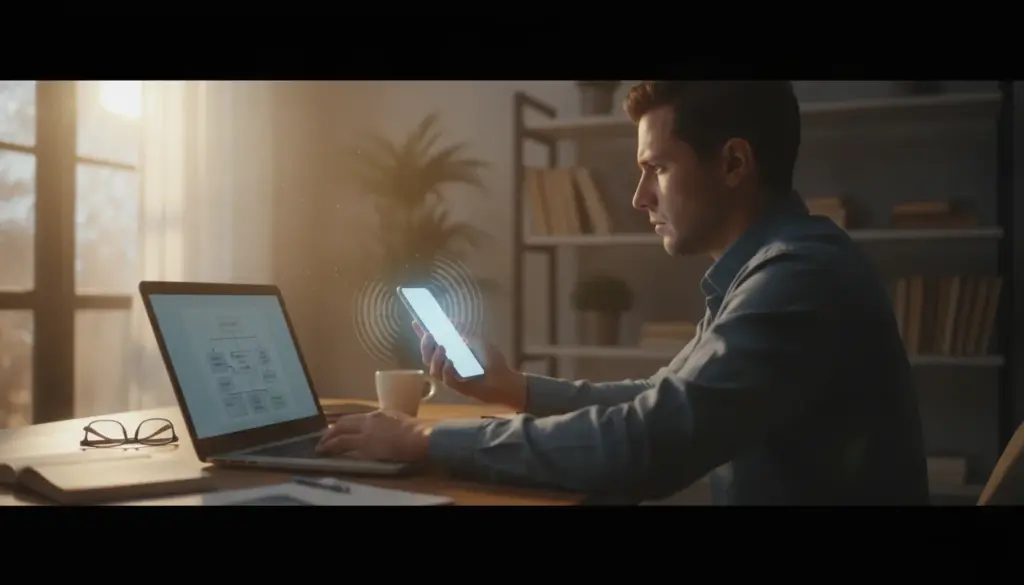
You sit down to concentrate, yet a single digital chime instantly shatters your workflow. Rather than signaling weak discipline, this rapid distraction actually stems from an ancient survival instinct deeply hardwired into human neurology.
Recent scientific insights reveal that human concentration does not operate like a steady, continuous beam of light. Instead, it resembles a rapidly flickering bulb. In mere fractions of a second, your mind continuously alternates between deep engagement and environmental vigilance. Notifications are perfectly designed to slip right into these microscopic gaps.
Your Brain Pulses Seven to Ten Times a Second
To understand what happens when we try to concentrate, researchers from the University of Rochester utilized electroencephalogram (EEG) technology to monitor cognitive activity. During the trial, participants were instructed to stare at a gray square positioned in the center of a monitor while actively ignoring bright colored dots flashing on the periphery.
While the objective seemed incredibly straightforward, the corresponding brainwave data revealed something fascinating. Cognitive activity displayed a highly rhythmic, fluctuating pattern. This wasn’t an occasional shift; the brain oscillated roughly seven to ten times every single second. Over the course of a day, this translates to hundreds of thousands of microscopic shifts in awareness.
Our focus simply cannot remain completely rigid. It constantly pulses in rapid biological waves, shifting fluidly between task-oriented concentration and a broad scanning mode that assesses the surrounding environment.
The experiment showed that whenever central focus on the gray square momentarily dipped, subjects became significantly more susceptible to the peripheral colored dots. During these split-second lulls, the brain temporarily prioritized scanning its surroundings over completing the assigned task.
An Ancient Defense Mechanism
While this oscillating mental rhythm might seem like a modern productivity nightmare, it originates from a highly effective evolutionary strategy. Thousands of years ago, a human who spent hours exclusively hyper-focused on a single task in a predator-filled environment would face a drastically reduced chance of survival.
Consequently, our neurological wiring developed a dual-state operating system:
- Deep Focus Mode: Attention narrows onto specific details, allowing for task execution while minimizing background noise.
- Vigilance Mode: The brain briefly detaches to scan the immediate surroundings, actively checking for novel or dangerous stimuli.
These two distinct cognitive states cycle back and forth at lightning speed. Though you never consciously register the shift, this biological rhythm dictates the exact moment a sudden flash, movement, or sound can successfully hijack your awareness.
For early hunter-gatherers, this was an incredible advantage. As you foraged for food, your nervous system automatically monitored the brush for rustling leaves or stalking predators. Releasing focus for a few milliseconds often meant the difference between making it back to camp or facing a lethal attack.
Why Modern Technology Exploits Our Biology
In today’s digital landscape, the immediate threat is no longer a wild animal, but rather a breaking news alert, a sudden email, or a group chat message. While our early ancestors only encountered occasional environmental triggers, modern society completely inundates us with glowing screens, red badges, and constant alerts.
A digital ping has the absolute highest probability of capturing your attention precisely during those fleeting milliseconds when your focus naturally recedes. Your brain interprets the incoming notification as a potentially critical change in your environment. As a result, that tiny app icon effortlessly overpowers your important report, textbook, or face-to-face conversation.
Whether intentionally or entirely by accident, tech companies have built interfaces that perfectly exploit these vulnerable cognitive windows. Unexpected chimes, vivid interface colors, and numbered notification badges all serve as powerful triggers that instantly activate your brain’s primitive warning circuitry.
What the Neurological Data Revealed
As the study participants stared at the central square over an extended period, the EEG equipment continuously mapped their neural responses to the distracting peripheral dots. Once the scientists filtered out natural eye movements from the data, a highly consistent rhythmic pattern emerged.
During the brief phases when cognitive sharpness dipped, the distracting peripheral noise had a vastly higher success rate in breaking concentration. During these exact windows, participants made more frequent errors and failed to notice subtle visual changes in their primary focal point.
By mapping these specific brainwave patterns, researchers could literally predict the exact milliseconds when a person was most vulnerable to breaking their concentration.
This groundbreaking data proves that losing focus isn’t merely a failure of willpower. Your mind naturally opens tiny “windows to the outside world,” and aggressive digital notifications simply smash through them.
A New Perspective on Attention Deficits
Although the Rochester research did not exclusively focus on subjects with ADHD, the findings introduce compelling new questions for cognitive science. If normal concentration naturally pulses in rhythmic waves, how do these patterns manifest in individuals dealing with attention disorders?
Scientists are currently exploring two primary hypotheses:
- The natural biological transition between deep focus and environmental scanning may occur more erratically in those with ADHD.
- The underlying neural oscillations might operate at uniquely accelerated or sluggish speeds, causing tasks to receive disproportionately long or short bursts of genuine concentration.
If these natural biological rhythms are calibrated differently, it could fundamentally alter how flexibly an individual switches between complex tasks or filters out background noise. This fresh perspective paves the way for innovative diagnostic approaches and highly targeted therapies, potentially involving specialized cognitive training.
Can We Harness These Neurological Waves?
Looking toward the future, experts foresee highly practical applications for this neurological data. By understanding precisely when the human brain is most susceptible to disruption, we can design smarter daily habits and improved digital tools.
Imagine intelligent software designed to silently batch your notifications, only delivering them during your natural breaks in concentration rather than during your deepest periods of focus. Additionally, study techniques and workplace schedules could be completely redesigned to honor our natural cognitive waves, rather than demanding impossible hours of uninterrupted labor.
When you finally understand how human attention actually operates, you can strategically optimize your environment to ensure your brain stops battling its own biology.
This paradigm shift also holds tremendous value for educators and therapists. Instead of endlessly demanding better discipline from students or patients, the focus can shift toward proper timing, natural rhythm, and smart environment management. When is the optimal time for complex problem-solving? When should you tackle mindless admin work? We can even intentionally trigger our brain’s scanning mode through activities like walking or strategic daydreaming.
Actionable Steps to Break the Notification Cycle
You certainly cannot rewire millions of years of human evolution overnight, but you can immediately alter your physical environment. Here are several highly effective strategies to protect your concentration:
- Purge your alerts: Disable push notifications for almost everything. Only permit alerts from truly mission-critical applications.
- Create physical distance: Place your device in another room or inside a drawer during deep work sessions. Out of sight truly translates to out of mind.
- Embrace time blocking: Structure your tasks in 25 to 45-minute sprints followed by deliberate breaks. This perfectly accommodates your mind’s natural rhythmic shifts.
- Ditch the disruptive noises: Rely on silent mode instead of jarring synthetic chimes, especially when studying or attending meetings.
- Schedule your digital check-ins: Intentionally view your inbox or messages just three times an hour, completely eliminating the constant drip of mid-task interruptions.
For those who constantly feel their concentration slipping away, this scientific framework offers a profound sense of relief. It isn’t a lack of drive or inherent laziness—your nervous system is simply functioning exactly as it was designed to. It just wasn’t built for a modern ecosystem overflowing with daily digital alerts.
Interestingly, this ancient biological mechanism also provides incredible hidden benefits. Brilliant creative breakthroughs frequently strike during the exact moments your brain temporarily drops its intense focus. Within these tiny windows of environmental scanning, the mind easily connects random concepts and uncovers fresh solutions. The ultimate goal isn’t to eradicate these mental shifts, but rather to master exactly when and where you allow them to happen.