Four Moons Above St. Petersburg: Ice, Not Optical Illusions
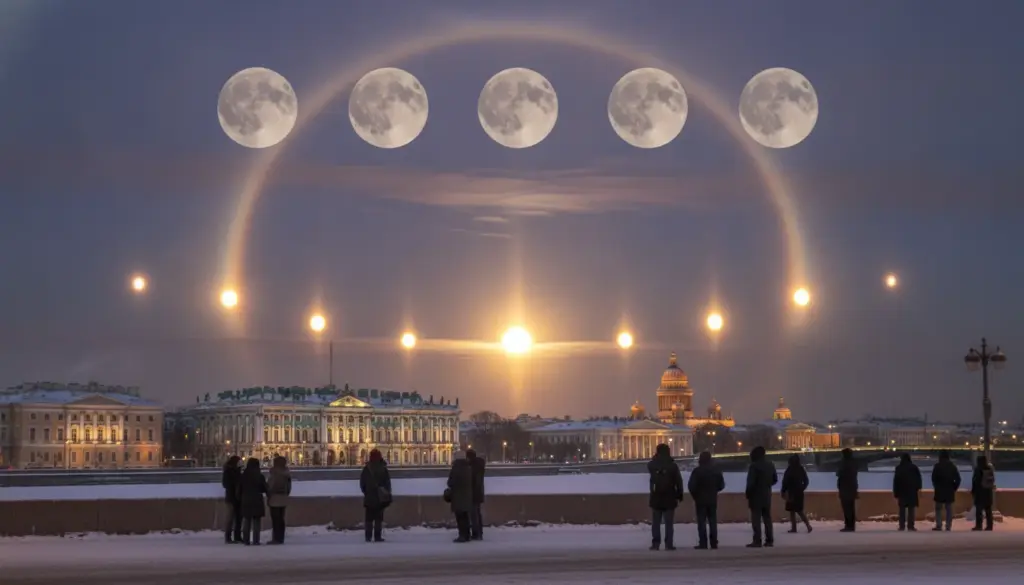
Imagine looking up at the night sky and seeing four moons hanging perfectly side-by-side. Recently, residents in Russia experienced exactly this mind-boggling sight, sending social media into an absolute frenzy. Feeds quickly filled with incredible footage of multiple celestial bodies aligned perfectly in the freezing sky.
While it might look like an elaborate computer-generated scene from a science fiction blockbuster, this is a completely real atmospheric event. In early February 2026, the people of St. Petersburg documented a stunning optical display that has fascinated meteorologists for decades. Naturally, the viral images triggered wild internet theories ranging from optical illusions to secret space experiments.
The actual scientific explanation is far more fascinating than any conspiracy. This breathtaking display is a natural phenomenon known as a paraselene, commonly referred to as a “moondog.”
How Ice Crystals Create Phantom Moons
These ghostly lunar duplicates appear when moonlight is intercepted and bent by tiny ice crystals floating high up in the Earth’s atmosphere. Acting as microscopic mirrors and prisms, these crystals refract the glowing light, projecting brilliant spots on either side of the actual moon.
Because of this intense refraction, it creates the stunning illusion that several moons are shining at once. The remarkably frigid, clear winter weather over St. Petersburg provided the absolute perfect breeding ground for these high-altitude ice particles to form and manipulate the light.
From Moondogs to Multiple Suns
The exact same optical mechanics apply to sunlight, creating what atmospheric experts call a sundog or a solar halo. When temperatures drop drastically, microscopic hexagonal ice crystals form within high-altitude cirrus clouds.
As the wind gently pushes these crystals, they align in a highly specific orientation. When radiant light passes through this icy veil, it bends at very precise angles. This natural refraction results in several mesmerizing visual effects:
- Brilliant patches of light flanking the primary sun on the left and right.
- A complete, luminous ring circling the glowing celestial body.
- Several distinct glowing orbs that look like entirely separate, disconnected suns.
Under the right atmospheric conditions, you might spot three, five, or incredibly, even seven suns arranged in a neat row. Smartphone camera sensors often amplify this brightness, making the digital outcome look even more surreal than what the naked eye actually perceives.
Why Are Lunar Illusions So Incredibly Rare?
While many avid skywatchers have spotted a daytime solar halo, catching a glimpse of a paraselene is exceptionally unusual. There are two primary reasons why these nighttime duplicates are so elusive.
First, moonlight is significantly dimmer than sunlight. It takes a tremendous amount of precise refraction to create visible reflections in the dark sky. Second, the atmosphere must be exceptionally cold and crisp, containing exactly the right type of pristine ice crystals at the perfect elevation.
Because of these strict meteorological requirements, moondogs are typically only documented in freezing climates during deep winter. A city like St. Petersburg offers the ultimate atmospheric recipe, seamlessly blending biting continental cold with intense moisture rolling in from the nearby Baltic Sea. Furthermore, the rarity of the event is also partly due to human behavior—most of us simply forget to look up at the night sky.
The Optical Magic Explained Simply
To understand this phenomenon without complex physics equations, just picture the atmospheric ice crystals as tiny hexagonal plates or microscopic floating rods. As they slowly drift, spin, and tumble toward the ground, calm weather conditions cause millions of them to align in the exact same direction.
When beams of celestial light hit this synchronized field of falling ice, the rays are precisely redirected. Because countless crystals are bending the light simultaneously, brilliant glowing spots emerge at fixed, predictable distances from the original light source.
If the crystal shapes and their alignment are absolutely flawless, multiple bright spots can form in a surprisingly straight line. This creates the breathtaking optical illusion of a sky entirely filled with duplicate suns or moons.
Why Social Media Amplifies Sky Phenomena
In decades past, these breathtaking sightings were mostly shared among dedicated amateur astronomers, specialized weather clubs, or printed in scientific journals. Today, nearly everyone carries a high-powered digital camera right in their pocket.
This widespread access to technology has completely transformed how we document rare weather events. Unique occurrences are now instantly recorded, while complex social media algorithms rapidly push these striking visuals to millions of screens worldwide. This massive digital exposure actively encourages more people to monitor their local skies.
However, there is a distinct downside to this modern digital sharing. Because modern digital editing tools are incredibly advanced, many skeptical viewers immediately dismiss these genuine photos as fake news. Meteorologists frequently have to step in and reassure the public that Mother Nature is perfectly capable of producing her own jaw-dropping visual effects without any digital manipulation.
How to Spot These Celestial Mirages Yourself
While a perfect lineup of four moons might be a once-in-a-lifetime sighting, spotting basic halos and sundogs is entirely possible if you know exactly what to look for. These optical treats happen worldwide, provided the atmospheric conditions perfectly align.
If you want to witness this atmospheric magic firsthand, keep a close eye out for a few specific weather patterns:
- Bitterly cold, dry air or periods of severe freezing temperatures.
- A delicate, high-altitude veil of wispy cirrus clouds.
- A low-hanging sun or moon, typically occurring right around dawn or dusk.
Pro tip: Never stare directly into the sun. Instead, safely block the main light source with your hand or a building and scan the area just to the sides. This not only protects your vision but makes the subtle glowing side-spots stand out much more clearly against the sky.
Photography Tips for Rare Weather Enthusiasts
Multiple suns and moons are just the tip of the iceberg when it comes to atmospheric optics. Countless other effects, from vibrant light pillars to ghostly glowing arcs, rely on the exact same principles of light scattering through suspended ice and water.
You do not need professional, expensive camera gear to capture these fleeting moments. A modern smartphone is perfectly capable, especially if you apply a few simple photographic techniques:
- Experiment with exposure: Take multiple shots at varying brightness levels. Sometimes, slightly under-exposing the image is the absolute best way to reveal the faint glowing edges of a delicate halo.
- Include the landscape: Frame your unique shot with trees, buildings, or mountains. This gives the digital image a clear sense of scale and grounds the incredible phenomenon in reality.
- Watch out for lens flares: Intense light can easily create artificial glowing orbs inside your camera lens. These internal reflections can be mistakenly identified as actual atmospheric events.
Once you start paying close attention to intricate cloud formations and how crisp winter light interacts with frosty air, you will quickly realize the sky is full of endless surprises. With a little patience and a bit of luck, you might just capture your own spectacular lineup of phantom suns.