Many individuals appear gentle, understanding, and eager to help, yet they are actually performing a carefully orchestrated script. Whether in romantic relationships, the workplace, or even your own family tree, you will inevitably encounter people who project genuine warmth while remaining entirely self-serving. Their outward pleasantness might feel comforting at first, but your intuition likely senses that something is off. By learning to identify these early warning flags, you can save yourself years of being stuck in an exhausting, one-sided dynamic.
The illusion of kindness: why we get fooled so easily
True compassion is quiet, reliable, and completely uninterested in a round of applause. It involves looking out for others even when the spotlight is turned off. However, socially intelligent individuals can mimic this exact behavior remarkably well—provided it benefits them in some way.
Genuine warmth never demands a reward, social status, or a guilt trip in exchange for a favor. It operates as a conscious choice rather than a calculated strategy.
Behavioral experts note that those with a deep-seated need for admiration often meticulously direct their public image. They construct a “brand personality” that comes across as charming, attentive, and humorous. It is only when you get uncomfortably close that you realize the emotional tab is always picked up by someone else. Here are five recurring patterns exhibited by individuals who mask their darker traits with a polite exterior.
1. Charming in public, cold when no one is watching
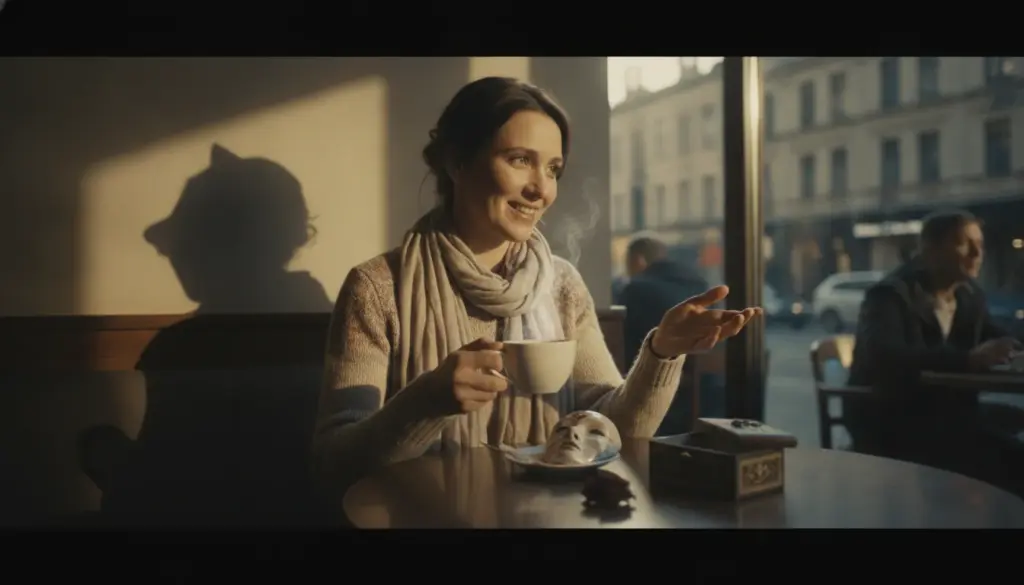
A major red flag is someone who seamlessly switches between two entirely different personas. In a group setting, this person shines with charm, offers constant help, and hands out compliments freely. Yet, behind closed doors, their entire demeanor shifts toward emotional distance, subtle jabs, or outright harsh remarks.
- For the crowd: Playful banter. For you: Hurtful, passive-aggressive digs.
- In public spaces: Endlessly patient and understanding. In private: Easily irritated and deeply condescending.
- On social media: Inspirational, highly empathetic posts. In real life: Zero room for your actual feelings.
Behavioral analysis of narcissistic tendencies reveals that these types of individuals invest heavily in their outward appearance. That friendly facade serves purely as an instrument to harvest sympathy and admiration, completely failing to reflect their true disposition.
Whenever someone consistently treats complete strangers with more respect than their own spouse, children, or immediate coworkers, it speaks volumes about their actual priorities.
2. Kindness used as currency: “After everything I’ve done…”
Another glaring indicator is the type of generosity that never truly comes for free. This person listens, assists, and is always there to help—but they secretly attach an invisible price tag to every action. Eventually, the invoice will be presented to you.
Watch out for loaded phrases like:
- “You can do this little favor for me, right? I am always there for you.”
- “I sacrificed so much for you, how can you possibly refuse this?”
- “After everything I arranged for your benefit, you’re just going to abandon me?”
In psychological terms, this is often referred to as “strategic altruism.” The person performs good deeds primarily because it grants them leverage, influence, or the ability to make you owe them. You will quickly notice a heavy sense of guilt creeping in whenever you try to set a boundary, making you feel as though you simply aren’t grateful enough.
Authentic kindness creates breathing room, whereas manipulative favors suffocate you with heavy obligations and manufactured guilt.
3. Gossip disguised as concern: “I’m only saying this because I care”
A third warning sign involves someone who frequently discusses the struggles of others using a deeply worried tone, yet entirely lacks discretion. They broadcast intimate, sensitive details to a surprisingly large audience.
Common phrases include:
- “I’m telling you this in strict confidence, but I am just so incredibly worried about her.”
- “I have no idea if this is actually true, but if it is, that’s incredibly intense…”
- “I wish him the absolute best, but honestly, I don’t think he’s doing well at all.”
This is simply gossip wrapped in a cozy, benevolent sweater. The speaker successfully positions themselves as a highly empathetic, involved friend, while actively using someone else’s personal tragedy as social currency or entertainment. They want the prestige of being the person in the know.
Someone who genuinely worries about a friend protects their privacy at all costs and reaches out to the person directly, rather than building an audience around their misfortune.
4. Never defending others unless it serves their agenda
Real compassion requires a distinct dash of courage. You see this courage clearly when someone is being treated unfairly, mocked, or systematically excluded. A truly caring individual will step in and try to say or do something to help the victim.
A person displaying fake kindness will remain entirely passive in these uncomfortable situations, unless intervening suddenly makes them look like a hero. If there is a crowd watching, they will suddenly jump on the barricades.
When someone only springs into action when social status, online likes, or influence can be gained, they are loudly declaring that their main priority is themselves, not the person in distress.
5. Wonderful to you, ruthless to everyone else
This particular variation can be incredibly confusing. The person treats you exceptionally well. They appear loyal, attentive, and are always at your beck and call. However, you slowly notice that the rest of the world has a drastically different experience with them. Their former partners, family members, or colleagues consistently describe them as cold, unpredictable, or highly disrespectful.
Keep an eye out for these behaviors:
- Service staff are snapped at or treated poorly, while you are placed on a pedestal.
- Former romantic partners are exclusively spoken about with intense disdain, often labeled as “crazy,” “toxic,” or “ungrateful.”
- Mistakes are universally blamed on outside forces, never on their own actions.
If an individual is only capable of respect within dynamics that directly benefit them, you are looking at a calculated strategy rather than a genuine personality trait.
This selective warmth might feel incredibly flattering at first, making you believe you are “the exception” who brings out their absolute best. Over time, however, severe tension will build as your personal experience violently clashes with how they treat the rest of humanity.
How to protect yourself without becoming cynical
Walking around with permanent suspicion only drains the joy from your life. At the same time, it is highly advisable to evaluate long-term behavioral patterns rather than solely relying on charming words.
Here are three practical reality checks to use on seemingly nice people:
- Consistency: Does this person maintain the same general demeanor across different environments, or does their character completely shift depending on the audience?
- Boundaries: Do they gracefully accept your “no,” or is your refusal instantly met with emotional blackmail, heavy pressure, or guilt trips?
- Accountability: Can they offer a sincere apology without attaching a lengthy defense, or do they systematically deflect all blame onto others?
When someone repeatedly fails these three essential checks, they are likely using pleasant behavior as an emotional tool. This doesn’t necessarily mean they are purely evil, but it certainly dictates that you should establish firm boundaries and avoid handing over all your trust at once.
When reaching out for professional support makes sense
If you have spent a long time feeling diminished, drained, or constantly guilty in a dynamic with someone who appears “fantastically kind” to the outside world, your self-esteem can take a massive hit. In these scenarios, speaking with a certified coach, counselor, or trusted mental health professional provides immense value. The goal isn’t necessarily to slap a clinical label on the other person, but rather to gain clarity on the covert dynamics at play and rediscover your own agency.
It can also be incredibly revealing to consult a few grounded individuals in your social circle who interact with this same person. Instead of simply asking, “Do you think they are nice?” try asking, “How do they handle things when situations go wrong?” A person’s authentic character is always exposed during conflicts, setbacks, and moments of deep discomfort.
By learning to observe these subtle behavioral flags, you won’t need to view everyone with constant mistrust. Instead, you will simply become immune to perfectly polished illusions. This newfound awareness creates valuable space for authentic connections where kindness isn’t a rehearsed performance, but a natural, effortless habit.