Reviving a Shattered Ecosystem
Imagine a native species vanishing from your local environment nearly two centuries ago, only to suddenly return and reclaim its rightful place as the ultimate natural landscaper. For decades, the fragile ecosystem of Floreana Island steadily deteriorated without the presence of these crucial grazing animals. Today, thanks to an extraordinary and unprecedented conservation rescue effort, we are witnessing a genuine ecological miracle.
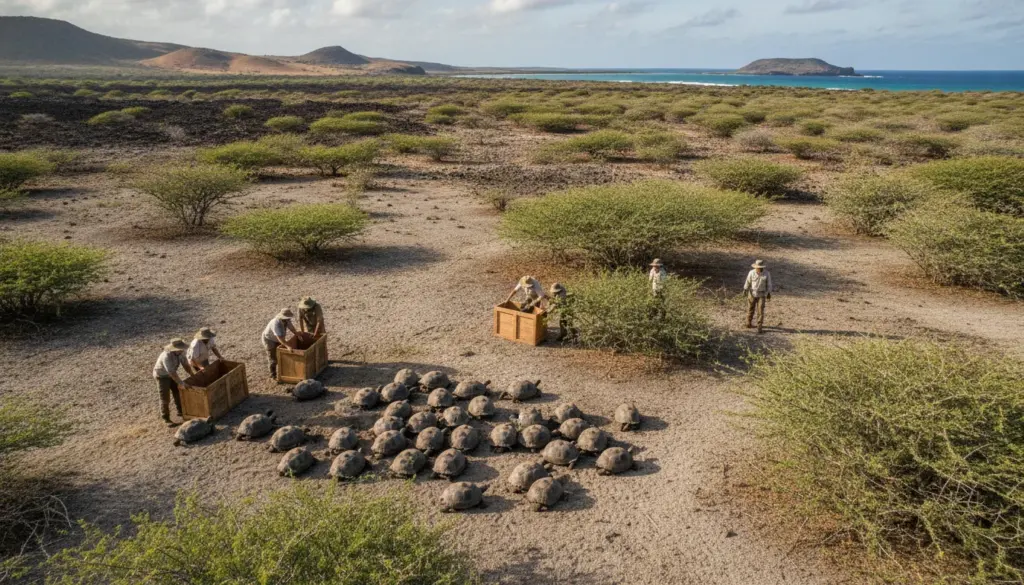
A carefully orchestrated release of 158 juvenile tortoises is currently offering a legitimate chance to fully heal this unique corner of the globe. After a 170-year absence, these magnificent reptiles are once again navigating the island’s rugged terrain. The Galapagos National Park spearheaded this ambitious deployment to resurrect a biological lineage that was tragically eradicated during the 1800s.
This initial release represents merely the opening phase of a massive environmental restoration master plan. Conservationists have set their sights incredibly high, aiming to eventually introduce a total of 700 individuals over the coming years to establish a thriving, genetically robust population.
Giant Tortoises Reclaim Floreana Island
Wildlife officials successfully relocated the 158 tortoises to the higher, more verdant elevations of Floreana, a volcanic landmass encompassing 173 square kilometers at the southern edge of the archipelago. Ranging in age from 8 to 13 years, these specific reptiles were chosen because they have achieved the necessary body mass and shell durability to successfully fend off feral cats and invasive rats that continue to plague the territory.
The logistical preparation for this historic move was remarkably intricate. Following years of rigorous veterinary screening and sanitary isolation, the animals were transported from a specialized breeding center on Santa Cruz Island. Researchers have equipped every single reptile with a tracking microchip, empowering scientists to continuously monitor their territorial expansion, growth rates, and overall survival.
Timing played a critical role in the operation’s success. The scientific team deliberately scheduled the release to align with the arrival of the rainy season. This guarantees a sudden explosion of fresh, nutritious vegetation, dramatically easing the animals’ transition into true wilderness.
Strategic Selection and Fascinating Genetics
When analyzing complex wildlife reintroduction initiatives, biological professionals consistently emphasize that a specimen’s physical mass and maturity are fundamental survival metrics. For terrestrial reptiles specifically, sufficient body weight acts as a vital biological safety net, enabling them to weather those vulnerable first months in the wild without direct human intervention.
Fredy Villalba, who manages the breeding facility, emphasized that the team strictly prioritized releasing the most physically formidable candidates. This highly practical approach ensures that only the strongest animals face the immediate challenges of navigating unfamiliar topography and foraging in a completely new habitat.
The foundational science driving this initiative is absolutely captivating, originating from a breakthrough discovery over on Isabela Island. Researchers stumbled upon wild hybrid tortoises that surprisingly retained significant portions of authentic Floreana DNA. Comprehensive genetic testing revealed that passing sailors had relocated the ancestors of these unique hybrids centuries ago.
Armed with this vital genetic reservoir, conservationists launched a highly targeted selective breeding program. Biologists meticulously paired adult tortoises exhibiting the strongest ancestral traits, successfully producing a new generation that carries between 40% and 80% of the extinct species’ original genetic blueprint.
The Tragic Disappearance of Floreana’s Tortoises
Christian Sevilla, the park’s ecosystem director, notes that this specific genetic ratio is more than adequate to steadily rebuild a population that is virtually indistinguishable from the island’s original inhabitants. This is welcome news for Floreana, a complex habitat supporting roughly 200 human residents who share their shores with marine iguanas, native penguins, and flamingos. As the community continually battles destructive invasive pests, these newly returned tortoises serve as heavy-duty allies in the fight for environmental balance.
The historical extinction of these gentle giants remains a grim environmental lesson. During the 19th century, severe human interference and aggressive habitat destruction decimated the native wildlife. Arriving settlers and transient whalers captured thousands of these vulnerable creatures.
Because the hardy reptiles could survive in dark ship cargo holds for countless months without water or sustenance, they became intensely exploited as a convenient source of fresh meat during lengthy oceanic voyages. This relentless harvesting outpaced any natural reproductive cycle.
Restoring an Altered Landscape
Early human arrivals further compounded the disaster by introducing devastating foreign species. Invasive goats aggressively consumed the low-hanging vegetation essential for adult tortoise survival, while feral pigs and aggressive rats mercilessly raided their nests. By the late 1800s, an utter lack of new hatchlings caused the entire local population to definitively collapse.
Without the continuous, natural grazing of these massive creatures, the island’s entire geographic profile was fundamentally altered in several detrimental ways:
- Woody shrubs aggressively overtook previously open, grassy expanses.
- Natural, sunlit clearings completely vanished from the landscape.
- Essential seed dispersal across the varied terrain dropped dramatically.
Washington Tapia, a dedicated Galapagos biology expert, points out that this triumphant reintroduction achieves two deeply interconnected goals: it resurrects a ghost genetic lineage and revives an irreplaceable ecological dynamic that simply cannot be performed by any other native animal.
While environmental scientists project it will take at least ten years to document measurable transformations in the island’s soil dynamics and plant structure, the long-awaited return of these heavy-shelled gardeners already represents a monumental leap toward Floreana’s ultimate environmental rebirth.