A Black Diablo VT Hiding Extraordinary Secrets
What initially seemed like the routine purchase of a relatively standard Italian supercar quickly evolved into an extraordinary tale of automotive archaeology, seller’s remorse, and ultimate redemption. It wasn’t until this vehicle was sitting in a different collector’s garage that its staggering historical significance finally came to light.
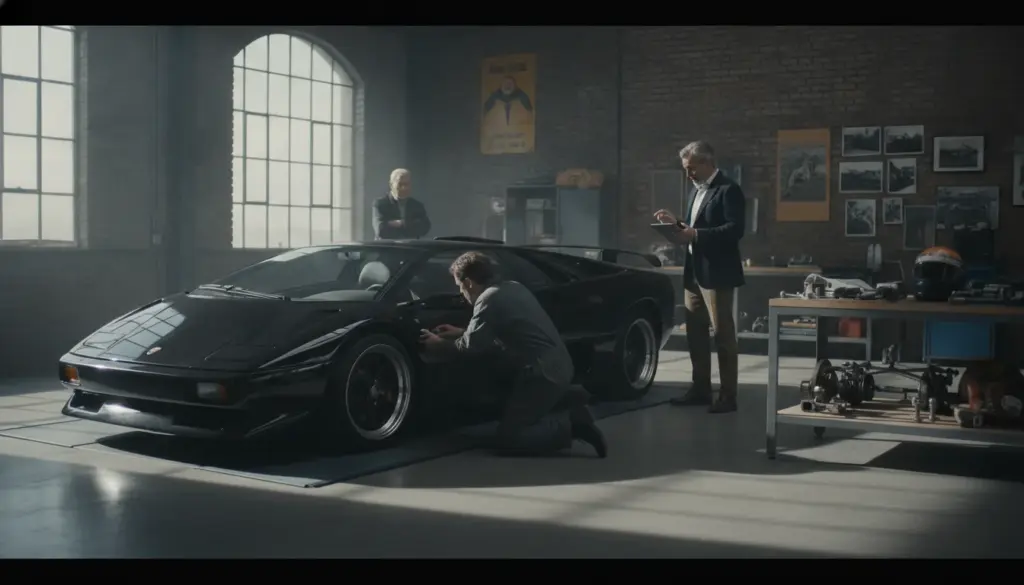
At first glance, this black Lamborghini Diablo VT with a subtle grey interior looked like a highly desirable modern classic, but certainly not a piece of legendary motorsport history. However, seasoned enthusiasts would soon spot a few puzzling anomalies that hinted at a much wilder past.
- Unconventional air intakes integrated into the engine cover
- A highly unusual, prominent roof scoop
- Mysterious remnants of old mounting brackets scattered throughout the cabin
- A technical maintenance dossier that aggressively contradicted standard VT specifications
While these subtle deviations raised eyebrows, they didn’t immediately reveal the full picture. The supercar performed flawlessly on public roads, turning heads while masquerading as a conventional, albeit striking, street-legal machine.
From Public Roads to the IndyCar Circuit
The true breakthrough emerged when a trove of vintage 1990s American IndyCar Championship photographs was unearthed. During that high-octane era, organizers deployed heavily modified, visually spectacular pace cars to manage the track. Hidden within those archival snapshots was a black Lamborghini Diablo, bristling with racing decals, a full roll cage, and heavily altered bodywork.
By meticulously cross-referencing these historical images with their own vehicle, the owners discovered astonishing parallels. The precise contours of the air scoops, microscopic bodywork imperfections, and bespoke chassis drilling aligned flawlessly. It slowly dawned on them that their seemingly ordinary ride had once served as a high-speed pace car for the IndyCar series.
Far from a simple aftermarket conversion, this vehicle revealed itself to be a highly specialized factory engineering project originally engineered for promotional track duty.
Solving the Roof Scoop Mystery and the Elusive Yota Package
The most glaring visual clue was undeniably the roof scoop—a feature that categorically does not belong on a factory Diablo VT. After consulting with a veteran technician who walked the floors of the Lamborghini factory during that era, and scrutinizing hours of vintage track footage, the automotive puzzle finally clicked together.
This specific chassis had been equipped with the incredibly scarce Yota (or Jota) factory preparation. Typically reserved exclusively for the ultra-rare SE30 anniversary edition, this dramatic aerodynamic and powertrain upgrade was grafted onto the pace car to ensure optimal high-speed stability and massive engine cooling on the oval tracks.
Disaster eventually struck during a rigorous track session at Laguna Seca when the aggressive V12 engine failed. Following the mechanical catastrophic event, the bespoke Yota components were stripped away, and the repaired vehicle was quietly exported to Europe to live a mundane life as a civilian street car. For decades, the whereabouts of that missing aerodynamic package remained a mystery, until a dedicated parts hoarder surprisingly came forward claiming he still possessed the original hardware.
Restoring a Nearly Forgotten Track Specification
Against all odds, the owners successfully negotiated the purchase of the surviving Yota components. Armed with these original parts, they embarked on a painstakingly accurate journey to return the supercar to its glorious pace-car configuration. This exhaustive restoration process required immense dedication:
- Carefully reinstalling the hyper-specific aerodynamic body panels
- Re-calibrating the complex suspension geometry for track-focused dynamics
- Reconstructing the stripped interior, complete with an authentic roll cage and racing harnesses
- Executing vital mechanical overhauls to push the engine output back toward its historic track specifications
With every tightened bolt, the Diablo transformed from a mere exotic collectible into a breathing, running artifact of 1990s motorsport heritage.
Official Factory Authentication: A Sant’Agata One-Off
Absolute validation arrived when Lamborghini Polo Storico, the legendary automaker’s official heritage department, opened their private archives to examine the vehicle’s dossier. Within those sacred production logs, archivists uncovered data that permanently cemented the car’s legendary status.
Records proved this exact chassis was originally commissioned for the North American market as an all-wheel-drive Diablo VT, but it was heavily modified on the assembly line with the Yota tuning kit. This makes it the only factory-built Diablo in existence to pair the VT drivetrain with the extreme Yota package, specifically purposed for pace car and exhibition duties.
Alongside the aggressive engine and aero tuning, Sant’Agata engineers blessed the build with a custom front fascia and structural safety gear tailored to survive grueling IndyCar race weekends. This extensive factory pedigree elevated the car from a cool vintage ride into an irreplaceable, one-of-one prototype.
A Highly Regretted Sale to a Fellow Collector
Despite unearthing this magnificent pedigree, the owners astonishingly decided to part ways with the vehicle. A deep-pocketed collector, known for his obsessive focus on the Diablo lineage, acquired the masterpiece. At the time, the sellers rationalized the move by believing the one-off machine was going to a caretaker who genuinely understood its profound significance.
It didn’t take long for a crushing wave of seller’s remorse to wash over them. They slowly realized they hadn’t simply traded a beautiful Italian exotic; they had relinquished an unrepeatable chapter of automotive history. The certified factory paperwork, the salvaged track components, and the triumphant restoration formed an origin story that simply cannot be replicated.
Nightmarish thoughts began to plague the former owners. What if the new buyer flipped the car to an anonymous overseas bidder? What if this irreplaceable piece of IndyCar history vanished forever into a dark, climate-controlled vault, never to be driven again?
A Second Chance: Bringing the Prototype Home
Then, a miraculous twist of fate occurred. The collector who had purchased the bespoke machine decided to restructure his private garage and casually mentioned he might be open to a sale. For the previous owners, no negotiation was necessary—reclaiming the vehicle became an absolute, non-negotiable priority.
They repurchased the legendary Lamborghini, vowing that it would never leave their possession again. Today, rather than locking it away, they use the hypercar as a rolling historical exhibition. They actively run the ex-pace car at prestigious automotive gatherings, passionately sharing its incredible narrative with awe-struck fans.
Even the original manufacturer now champions the vehicle’s cultural importance. The factory formally invited this specific chassis to Lamborghini’s 60th-anniversary celebrations in Italy, proudly displaying it alongside their most revered experimental prototypes and championship-winning race cars.
How Provenance Skyrockets Modern Classic Values
This extraordinary saga perfectly highlights why rigorous documentation and historical provenance dictate the modern classic market. Two vehicles that look virtually identical parked side-by-side can command vastly different valuations based entirely on their past lives.
An authenticated track veteran boasting factory-installed performance upgrades naturally sits on a completely different financial plateau compared to a standard consumer model. For top-tier automotive investors, the technical specifications are only half the appeal. A documented racing pedigree supported by photographic evidence and official manufacturer certificates acts as an absolute magnet on the international auction block.
Essential Lessons for Vintage Car Hunters
If this story proves anything, it is how dangerously easy it is to overlook a masterpiece hiding in plain sight. Unexplained drilled holes, bizarre aftermarket-looking modifications, or swapped engine parts can sometimes lead directly to an incredible motorsport heritage.
Anyone venturing into the high-stakes world of classic exotics should adopt a forensic approach to ownership to uncover hidden provenance:
- Always cross-reference the exact chassis number with dedicated brand registries and factory archives
- Relentlessly scour vintage forum boards and digitized magazines for historical racing imagery
- Meticulously catalog every non-standard component to trace its exact origin
- Actively track down previous mechanics or owners who turned wrenches on the vehicle decades ago
Premium manufacturers maintain highly specialized heritage divisions capable of issuing definitive certificates of authenticity. Securing these official documents not only drastically elevates a vehicle’s market worth but guarantees its legacy is protected from historical erasure.
For the truest automotive romantics, the ultimate ownership experience extends far beyond driving dangerously fast. It lies within preserving the soul and the stories engineered into the chassis. Having successfully rescued their ex-track star from obscurity, let it go, and miraculously won it back, the owners of this spectacular one-off Diablo will undoubtedly hold onto the keys for a lifetime.