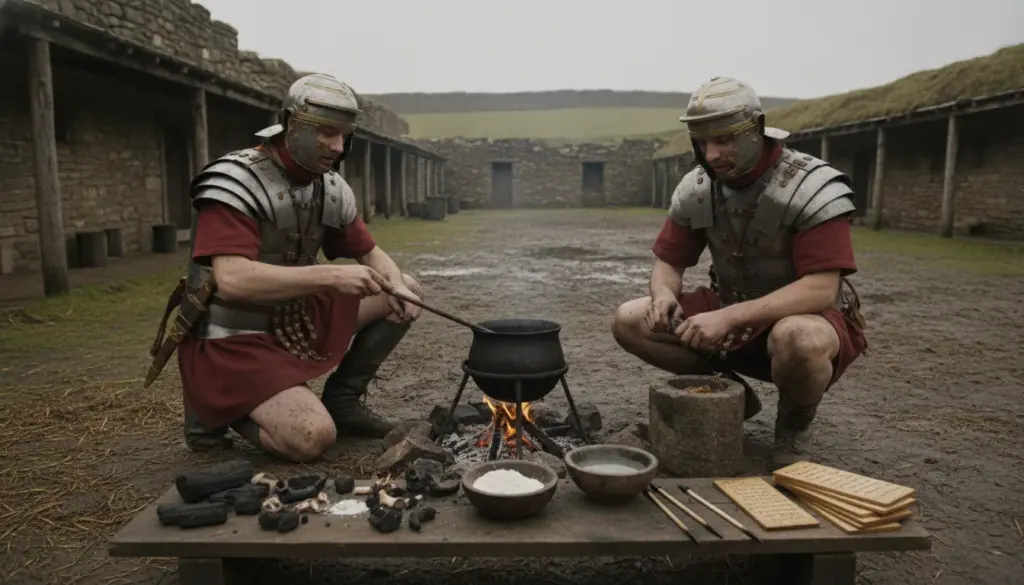
Guarding the furthest fringes of the Roman Empire, ancient troops did more than just document history. They actively manufactured the tools needed to write it down. Recent material analyses of the famous Vindolanda wooden tablets, unearthed near Hadrian’s Wall in Britain, reveal a fascinating DIY approach to military administration. Rather than relying on premium writing supplies shipped from luxurious Roman workshops, these border guards mixed their own ink in a damp, muddy outpost using simple ingredients like charred wood, animal bone, water, and plant gum.
A Muddy Outpost Hiding an Ancient Archive
Tucked away in northern England just south of Hadrian’s Wall, the Vindolanda fort served as a crucial base for auxiliary forces patrolling the empire’s northernmost frontier during the first and second centuries AD. At first glance, it was a desolate, rain-soaked garrison. Yet, beneath the waterlogged soil lay an extraordinary wooden archive. Since the 1970s, archaeologists have carefully excavated more than 1,500 incredibly fragile writing tablets.
Measuring less than two millimeters thick, these delicate artifacts look more like wood shavings than historical documents. However, they preserve hundreds of intimate messages and official records dating between roughly 85 and 130 AD.
The contents of these tablets are remarkably relatable and everyday:
- Inventories tracking vital supplies like grain and beer
- Duty rosters detailing which soldiers were on patrol or guard duty
- Requisitions for winter clothing, sturdy shoes, and weaponry
- Personal letters sent to distant family members and friends
- Social correspondence, including a now-famous birthday party invitation
Thanks to the oxygen-free, permanently damp ground, both the wooden slivers and the dark letters written upon them survived intact. This exceptional preservation allows today’s specialists to not only read the ancient Latin scripts but also analyze the exact chemical makeup of the writing fluids.
Decoding the Chemistry Behind the Black Lines
For decades, historians primarily focused on translating the fascinating texts. Recently, however, material scientists and chemical experts have joined the conversation to uncover what exactly created those dark strokes. A specialized international research team, featuring analytical experts Giovanna Vasco and Joanne Dyer from the British Museum, examined twenty-six individual tablets. They utilized a non-destructive analytical technique known as Raman spectroscopy.
By directing a specialized laser beam at the dark strokes, the team could read how the light scattered, effectively revealing the molecular fingerprint of the ancient pigments. These detailed light signatures proved that the Roman army did not use a single, standardized recipe.
Researchers identified at least five distinct varieties of carbon-based pigments. The chemical traces pointed to an array of raw materials:
- Charred wood, highly likely sourced from nearby British forests
- Carbonized animal remains, particularly heated bone fragments
- Traces of scorched grapevines, a material well-known in other ancient manufacturing processes
In every instance, the writers utilized what experts classify as carbon inks. This simple but highly effective mixture requires a dark soot or charcoal base, a binding agent like plant gum, and water. When combined, these elements yield a thick, resilient fluid that creates high-contrast lines on pale wooden surfaces.
Homemade Ink as a Clever Logistical Solution
The sheer chemical variety detected across the tablets strongly suggests that this essential fluid was not shipped in massive, factory-made batches. Instead, military scribes essentially brewed their own supplies right inside the fort, utilizing whatever materials were readily available. This resourceful approach resulted in small, highly variable batches rather than a uniform, mass-produced product.
Given Vindolanda’s extreme geographical isolation, this decentralized production strategy makes perfect sense. The garrison sat incredibly far from the sprawling Mediterranean manufacturing hubs. Relying on imports meant navigating unpredictable weather patterns, rough seas, and treacherous overland routes. Naturally, premium stationary ranked exceptionally low on the military’s logistical priority list.
By firing up their own ovens to burn bone and timber, the border troops essentially bypassed a fragile supply chain. This DIY ink production perfectly illustrates the rugged practicality of frontier garrisons. When standard supplies ran dangerously low, resourceful soldiers instantly pivoted to artisanal, localized solutions, ensuring their vital administrative tasks and personal correspondence never missed a beat.
Traditional Recipes Enduring on the Empire’s Edge
The spectroscopic analysis also highlights a fascinating cultural divide between the bustling imperial core and its distant fringes. During the first few centuries AD, administrators in the sunny Mediterranean cities were steadily transitioning to modern iron-gall formulations. Meanwhile, the northern troops remained stubbornly loyal to traditional, straightforward carbon mixtures.
This contrast offers a brilliant glimpse into how technological trends traveled through the ancient world. Novel innovations simply took longer to reach the outermost outposts. Scribes stationed on the rainy borders preferred working with trusted, time-tested methods rather than experimenting with the latest trends coming out of Rome or Alexandria.
However, clinging to older methods did not mean these troops were technologically disadvantaged. In fact, the sheer longevity of these wooden records proves the absolute superiority of their traditional recipes. After nearly two millennia in the dirt, their handwriting remains remarkably legible. For churning out fast inventory lists, quick memos, and casual letters, this basic black mixture functioned flawlessly.
Sourcing Materials: From Local Woods to Distant Vines
A vast majority of the identified chemical signatures point straight to the immediate environment, utilizing nearby timber and leftover bones from the mess hall. Yet, the distinct presence of scorched grapevines hints at a much wider geographical footprint. Vine shoots were commonly burned in other complex ancient industries, such as early glassmaking and metalwork.
The inclusion of this specific agricultural byproduct suggests that specialized knowledge—and perhaps even raw materials—traveled right alongside the marching legions. The Roman military was an incredible melting pot of regional cultures. A highly trained artisan who routinely burned vines to make pigment in a warmer Mediterranean province could easily adapt that exact same technique while shivering in a damp British encampment.
The Administrative Backbone of Military Life
These remarkable wooden slivers demonstrate exactly how heavily the ancient war machine relied on constant, obsessive record-keeping. Within the walls of a single garrison, archaeologists found everything from urgent tactical orders to deeply personal notes. If the ink supply vanished, the entire military infrastructure would immediately grind to a halt.
The surviving texts provide an intimate window into ancient logistics:
- Meticulous daily audits of vital wheat and beer rations
- Detailed personnel reports tracking unit movements outside the defensive walls
- Desperate requests for warm socks and durable footwear to survive the brutal winter
- Formal applications for vacation time or additional manpower
- A famous birthday invitation penned by a commander’s wife, standing as one of the oldest known party invites in Britain
Every single word scrawled on those boards required a sharp stylus, smooth wood, and a highly stable pigment that stubbornly resisted the perpetually damp British climate. The fact that these soldiers completely controlled their own production pipeline—from burning the base carbon to sealing the final letter—showcases the incredible self-sufficiency of a frontier base.
Hidden Craftsmanship Within the Ranks
Digging deeper into this chemical evidence reveals a frequently overlooked dimension of military life: highly specialized technical education. Operating an effective scriptorium required far more than just nice handwriting. Someone inside the camp had to possess the precise chemical knowledge needed to perfectly char organic matter into a fine, clump-free soot. They needed an intimate understanding of plant gums, precise mixing ratios, and proper fluid storage techniques.
Such specialized expertise perfectly aligns with the vast array of professional trades operating within the fortress walls. Alongside the busy blacksmiths, skilled carpenters, and essential cobblers, the scribes proved themselves as true master artisans. The empire’s vast military network ultimately served as a massive highway for sharing technical skills, allowing an eastern recruit to pass down his unique pigment recipes to comrades stationed along the rugged Atlantic coast.
Why Tracing Ancient Chemistry Matters Today
Today’s material specialists are increasingly pointing their highly advanced equipment at seemingly ordinary artifacts. Analyzing microscopic pigment traces, ancient boat adhesives, or dried instrument resins unlocks crucial data regarding global trade, supply chains, and human ingenuity that ancient historians completely forgot to write down. In the fascinating case of Vindolanda, these molecular clues perfectly illustrate the astonishing adaptability of the imperial network, particularly in its most remote corners.
Furthermore, this scientific approach breathes incredible life into dry historical terms. The phrase “carbon ink” no longer conjures up the image of a faceless, mass-produced commodity. Instead, it reveals a deeply human moment: a scribe carefully stirring a small bronze pot of crushed charcoal and sticky sap, likely stationed just steps away from his busy desk.
This granular data is incredibly valuable for modern historical reconstructors and professional calligraphers. Armed with precise ingredient ratios, they can accurately recreate these resilient ancient formulas, testing their drying speeds, viscosity, and performance across varying textures.
Ultimately, the compelling story of this frontier writing fluid offers a deeply grounded counter-narrative to the sweeping epics of mad emperors and massive battlefield conquests. It serves as a beautiful reminder that sprawling empires were not just held together by swords. They were maintained by millions of quiet, everyday actions—a smoldering fire, a tiny pot of black liquid, and a lonely soldier meticulously updating an inventory list by flickering candlelight on the edge of the known world.