
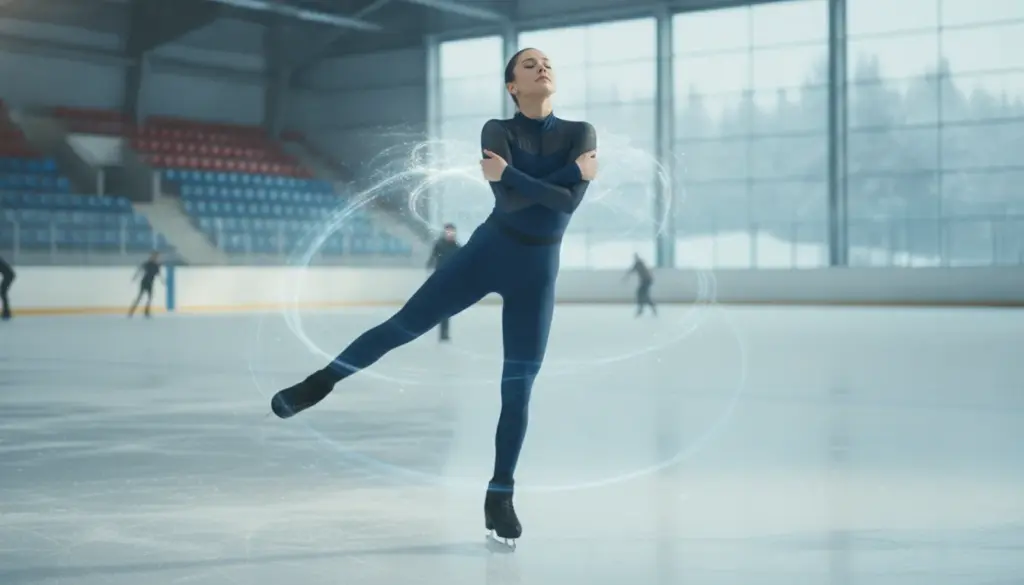
When millions of viewers tune in to the 2026 Winter Olympics, an invisible neurological marvel will take place right before their eyes. While those iconic leaps and pirouettes radiate pure elegance and athletic power, the effortless grace actually masks a fascinating biological experiment. Over countless hours of practice, these athletes have meticulously rewired their minds to endure breathtaking rotations without instantly tumbling to the ice.
Why a simple twirl leaves ordinary people staggering
Anyone who has ever stepped off a whirling carnival ride or spun around playfully on a frozen pond knows that familiar sensation. The ground tilts, the horizon wobbles, and a sudden wave of nausea hits. This biological reaction originates deep inside the ear, within the complex vestibular system. Acting as our body’s internal gyroscope, this network tracks every head tilt and rapidly fires signals to our neural command center to keep our posture and vision perfectly steady.
However, continuous, rapid spinning sends this delicate mechanism into absolute overdrive. Your eyes begin darting uncontrollably—a reflexive phenomenon known scientifically as nystagmus. Consequently, vision blurs, straight edges morph into wavy lines, and the nervous system slams on the emergency brakes by triggering intense vertigo.
Professional ice dancers entirely shatter these natural limitations. While an average person loses spatial awareness after a mere handful of quick turns, Olympic contenders routinely execute more than four full revolutions per second. Mathematically, that translates to hundreds of rotations per minute. Yet, their vision remains razor-sharp, allowing them to stick complex landings flawlessly to the beat of the music. Their central nervous system has simply learned to mute the inner ear’s frantic alarm bells.
How the mind learns to silence the inner ear
Leading neurologists point out that elite ice competitors are not genetically gifted with an unshakeable stomach. Instead, they painstakingly cultivate one. Through deliberate, long-term conditioning, their neurological pathways fundamentally alter how they process sensory input from the ear canals. The brain gradually figures out that extreme spinning does not actually represent a physical threat, systematically dulling the automatic reflexes that typically induce dizziness and nystagmus.
Extensive studies involving high-level dancers and winter athletes reveal a remarkably consistent pattern. The longer an individual practices high-speed turning, the less intensely their vestibular organs react. This fascinating biological adaptation is known as neural habituation. Essentially, the nervous system accepts the chaotic motion as a normal state of affairs.
- Initial exposure: The vestibular network screams in protest, resulting in heavy disorientation and severely clouded vision.
- Months of repetition: Post-spin eye twitching becomes noticeably smoother and less frantic.
- Years of dedication: Bouts of vertigo become incredibly brief and exceptionally mild.
- Ultimate mastery: The visual field remains astonishingly anchored, even following blistering rotational speeds.
Naturally, this astonishing transformation requires calculated patience. Coaches rely on progressive, safe off-ice drills and basic two-footed gliding circles long before introducing high-velocity professional routines.
Neuroplasticity: The secret advantage of youth
One crucial advantage professional skaters share is their incredibly early start in the sport. A child’s mind is exponentially more malleable than an adult’s, utilizing a powerful characteristic called neuroplasticity. This allows cellular connections within the nervous system to easily reorganize, strengthening essential pathways while discarding unhelpful ones.
In practical terms, tackling extreme rotational forces at a young age allows the developing mind to effortlessly adapt to highly unnatural physical stress. In fact, numerous seasoned champions admit they routinely left the rink feeling terribly sick during their formative years, only for those nauseating symptoms to eventually vanish. What starts as raw muscle memory slowly evolves into neural memory, ensuring the mind anticipates the dizzying forces rather than panicking.
Developing an extraordinary internal compass
Endless repetition does more than just numb the ear’s motion sensors. These winter athletes also forge an incredibly precise internal compass. They maintain total awareness of their limb positioning, even while blurring past spectators at speeds that seem almost impossible to track.
This profound spatial awareness relies on a sophisticated blend of sensory inputs:
- Deep physical intuition (Proprioception): Specialized receptors nestled within joints and muscles constantly update the mind on knee bends, arm extensions, and pelvic tilts.
- Strategic visual cues: Many performers subconsciously lock onto fixed environmental landmarks for micro-seconds during or immediately following a spin.
- Directional habit: The vast majority of top-tier competitors strongly favor spinning in one specific direction, allowing their neurological circuits to tune themselves optimally to that exact motion.
By hyper-specializing their senses, these athletes build an intricate mental map of the rink. Even with their eyes squeezed shut, veterans can accurately gauge their exact location on the ice and sense exactly how close they are to the outer boards.
The 2026 Winter Games: A premier neurological laboratory
As you watch the upcoming 2026 Winter Olympics, remember that you are witnessing far more than dazzling outfits and theatrical music. Every single performance serves as a masterclass in long-term neural conditioning. Each rapid twirl highlights thousands of repetitions that taught a human mind to treat chaotic tumbling as standard operating procedure.
Unsurprisingly, sports scientists view these elite performers as the ultimate test subjects. By using advanced brain scans and controlled testing, researchers can decode how human biology manages balance, spatial awareness, and gaze stabilization under extreme duress. The insights gathered from these ice warriors are already paving the way for remarkable real-world applications:
- Improving rehabilitation protocols for patients recovering from inner ear surgeries or chronic vertigo.
- Enhancing motion training for aerospace pilots and astronauts exposed to intense gravitational shifts.
- Refining virtual reality headsets to combat the notorious motion sickness experienced by many users.
Practical takeaways for recreational skaters
You do not need to be an Olympic hopeful to benefit from these fascinating biological principles. While an amateur enthusiast’s mind won’t undergo the same radical rewiring as a gold medalist’s, the core mechanism of habituation applies to absolutely everyone. By slowly exposing yourself to rotational forces, you will quickly notice a drastic reduction in dizziness.
If you want to safely improve your own spinning tolerance, keep these expert-backed tips in mind:
- Practice basic turning motions off the ice first, wearing simple socks or supportive sneakers.
- Keep your initial attempts to just one or two slow revolutions, immediately followed by a short rest period.
- The moment you finish turning, deliberately lock your gaze onto a stationary object along the wall to steady your vision.
- Listen to your body and pause immediately if nausea creeps in; pushing through sickness will only stall your progress.
- Gradually increase your repetitions week by week to give your nervous system time to adapt.
Navigating fear and the natural limits of the mind
Of course, biological adaptation is never perfectly uniform. Certain professionals battle a lingering susceptibility to mild dizziness throughout their entire careers. Mental anxiety frequently exacerbates this issue; a deep-seated fear of crashing causes athletes to tense their muscles and breathe shallowly, which actually amplifies physical discomfort. Because of this, elite coaching staffs prioritize building confidence, perfecting safe falling techniques, and providing robust psychological support.
Furthermore, the incredible power of neuroplasticity has a distinct downside: it can easily encode poor habits. Repeatedly spinning off-axis or relying on awkward bodily compensations can quickly lead to severe joint, back, or neck issues. Dedicated sports physicians and physical therapists closely monitor these routines, ensuring that any dangerous mechanical flaws are corrected long before they trigger chronic injuries.
From the frozen rink to everyday balance
The breathtaking way figure skaters conquer dizzying forces beautifully illustrates the extreme lengths our biology will go to master a challenging physical task. Adapting to severe motion isn’t some magical parlor trick reserved for a select few; it is a systemic process that anyone can tap into with enough patience.
We see these exact same neurological principles at play across various demanding disciplines. Whether it is a gymnast flipping through the air, a sailor navigating volatile ocean swells, or a mountain biker bombing down a jagged descent, the underlying goal remains identical. The mind must learn to filter out useless static, amplify crucial spatial data, and suppress innate panic responses.
So, when the 2026 Winter Games inspire you to lace up a pair of skates, remember that you are stepping into a miniaturized version of this exact scientific journey. With every cautious turn and wobbly glide, you are whispering a vital message to your nervous system: this motion is safe, and we can handle it. Over time, that unsettling wobble will inevitably fade, bringing you just a tiny bit closer to the unshakable giants commanding the Olympic ice.