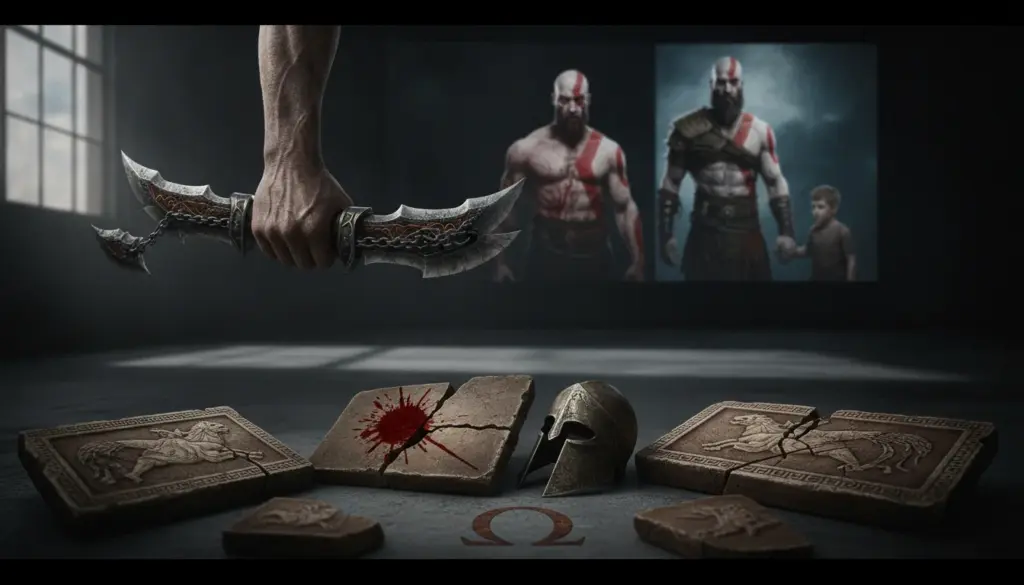
A stark contrast to the ruthless warrior of the past
Word on the street suggests Santa Monica Studio might be brewing up a remake of the classic God of War trilogy. However, one specific returning element from those vintage titles fiercely clashes with Kratos’s contemporary image.
While the Greek sagas of the first three mainline games remain legendary milestones in action gaming, they carry baggage that developers will struggle to navigate today. We are talking about hyper-violent sequences that hit differently in the modern era, alongside notorious mini-games carrying heavy sexual undertones.
Anyone jumping from the 2018 reboot or Ragnarok back into the original trilogy is in for a massive tonal whiplash. The classic iteration of Kratos operated as an unstoppable hurricane of rage, showing absolutely zero restraint or hesitation. Across those initial three adventures, he leaves a trail of collateral damage in his wake.
- During the first game, he roasts a soldier alive purely to solve a puzzle inside Pandora’s Temple.
- The third installment sees him wedge a terrified servant girl into a gear mechanism to prop a door open, ultimately crushing her.
- Innocent bystanders frequently serve as disposable props designed solely to highlight the Spartan’s unbridled fury.
Back then, this almost cartoonish brutality fit the zeitgeist perfectly. It was a bombastic, over-the-top action franchise engineered to shock and awe its audience. Fast forward to 2018, and our protagonist evolved into an entirely different being. He is now visibly older, exhausted, burdened by profound guilt, and operating primarily as a reflective father figure.
Transitioning from a mindless revenge machine to a tormented dad renders a direct, one-to-one remake practically impossible. The overarching tone absolutely has to shift. This necessity applies just as much to the franchise’s historical handling of intimacy as it does to the gore.
The ticking time bomb of notorious mini-games
Aside from Ascension, almost every chapter of the Greek saga allowed players to trigger optional encounters where Kratos took women to bed. While these segments refrained from explicit graphical nudity, clever camera angles and suggestive audio cues left zero room for misinterpretation.
From a mechanical standpoint, these were glorified Quick Time Events. Players had to mash buttons at precise intervals to help Kratos “finish the job.” Successfully completing the sequence rewarded you with red orbs, the in-game currency used to upgrade magical abilities and weaponry. The third game even tied a rather revealing trophy to this activity, famously titled “Ladies Man.”
At the time of release, many gamers viewed these interactive moments as cheeky, juvenile humor that perfectly matched the unapologetically edgy vibe of the series. The brand deliberately marketed itself as mature, shocking, and delightfully shameless.
Traces of hidden character development
Interestingly enough, the very first game actually featured an underlying narrative purpose for these encounters. Early interviews with creator David Jaffe revealed that Kratos’s bedroom escapades were meant to showcase a desperate man attempting to drown out the agonizing grief of losing his wife.
There is even a journal resting next to the bed where the Spartan confesses that no amount of female company can erase the haunting memory of Lysandra. Initially, these interactive moments symbolized profound sorrow and escapism, rather than serving purely as juvenile fan service.
Unfortunately, subsequent sequels completely abandoned this emotional layering. The encounters morphed into a predictable running gag. Fans anticipated the scenes, developers dutifully supplied them, and the narrative context shrank down to a simple wink and a gameplay reward. Because of this regression, the sequences now feel incredibly dated and awkward, especially when placed next to the emotionally mature portrayal of Kratos in recent titles.
Why a modern overhaul requires a new approach
If the development team elevates the original trilogy to the staggering visual and technical heights of the 2018 reboot, the tone of those vintage scenes transforms instantly. Introducing hyper-realistic character models, sophisticated lighting, and meticulously detailed animations inherently makes everything far more explicit, even if the camera still pans away at the crucial moment.
Furthermore, modern audiences evaluate female representation in gaming with a much more critical eye. The classic QTEs fundamentally reduced women to decorative background objects and mechanical rewards. Dropping this dynamic into a modern framework where Kratos actively grapples with themes of accountability, grief, and parenthood creates immense narrative friction.
- Today’s Kratos is remarkably reserved and self-aware, bearing no resemblance to a grinning casanova.
- Players now expect a higher degree of nuance regarding relationships and intimacy.
- The studio has successfully rebranded itself as a premier creator of emotionally sophisticated narratives.
A copy-paste approach to the classic formula wouldn’t just feel bizarrely out of place; it would actively undermine the core purpose of a remake. A reimagining should frame the classic trilogy through the lens of our current understanding of the character.
Redefining these encounters for a modern audience
The conversation extends beyond a simple binary choice of keeping or deleting the content. A ground-up remake provides the perfect canvas to reinterpret the original intent behind these scenes. There are three logical paths the developers could take.
1. Complete removal of the mechanics
The most straightforward solution involves entirely scrapping the rhythm-based intimacy mechanics and their associated rewards. The protagonist could still engage in relationships or brief encounters, but these would unfold naturally within standard narrative cutscenes. By removing the interactive element, the game stops rewarding players for sexual conquests.
2. Pivoting to poignant character moments
Alternatively, the studio could preserve the concept of a broken man seeking refuge in physical pleasure, but completely remove the player’s active participation. Instead of a mini-game, we could witness brief, uncomfortable dialogue exchanges, subtle non-verbal cues, or an internal monologue highlighting the sheer emptiness of his actions.
What used to be a playful nod could easily transition into a tragic, deeply uncomfortable sequence that exposes his shattered psyche. This approach salvages the themes of mourning and guilt while leaving the adolescent humor behind.
3. Transforming the interactive choices
Should the team insist on maintaining interactivity, the core philosophy must change. Rather than requiring rhythmic button presses to reach a climax, the game could present a profound moral choice. Does the Spartan give in to his baser instincts, refuse the offer, or simply walk away? Implementing a narrative crossroads makes his internal conflict genuinely tangible to the player.
Reconciling legacy DNA with new standards
A massive chunk of this debate highlights a broader struggle facing long-running video game franchises. Developers must constantly figure out how to handle foundational elements that once defined their brand’s DNA but now feel completely obsolete. For this specific mythical saga, the hurdle involves navigating both exorbitant gore and highly sexualized scenarios.
The contemporary iteration of the Ghost of Sparta proves that this figure embodies far more than raw testosterone and blind rage. Fans deeply resonate with his modern incarnation precisely because he stumbles, expresses doubt, and actively strives to overcome his blood-soaked history. Ignoring this evolution in a remake would feel like a monumental betrayal of the creative direction established in 2018.
Conversely, a vocal segment of the fanbase cherishes the classic trilogy specifically for its unapologetic, over-the-top execution. The ultimate challenge will be capturing that raw, aggressive energy without falling back on outdated tropes that currently evoke more discomfort than awe.
A reflection of industry-wide evolution
This hypothetical project perfectly illustrates how rapidly cultural standards shift within the gaming landscape. Material that was easily dismissed as edgy, mature humor in 2005 faces an entirely different level of scrutiny today. This shift isn’t just driven by the audience, but by the creators themselves, who harbor grander artistic ambitions than merely generating shock value.
Interactive entertainment is increasingly treated with the same narrative reverence as prestige television and cinema. As a result, heavy themes encompassing grief, culpability, and interpersonal dynamics demand serious, thoughtful exploration. Our favorite Spartan stands as the ultimate testament to this shift. He evolved from a shallow vessel for revenge fantasies into a complex figure wrestling with fatherhood and his own monstrous legacy.
If this rumored project eventually sees the light of day, it will serve as far more than a simple graphical facelift. It will be the ultimate litmus test to see if the studio possesses the courage to carve away pieces of its past to honor the incredible growth its legendary protagonist has achieved.