From a Local Bakery to Global Culinary Tastemakers
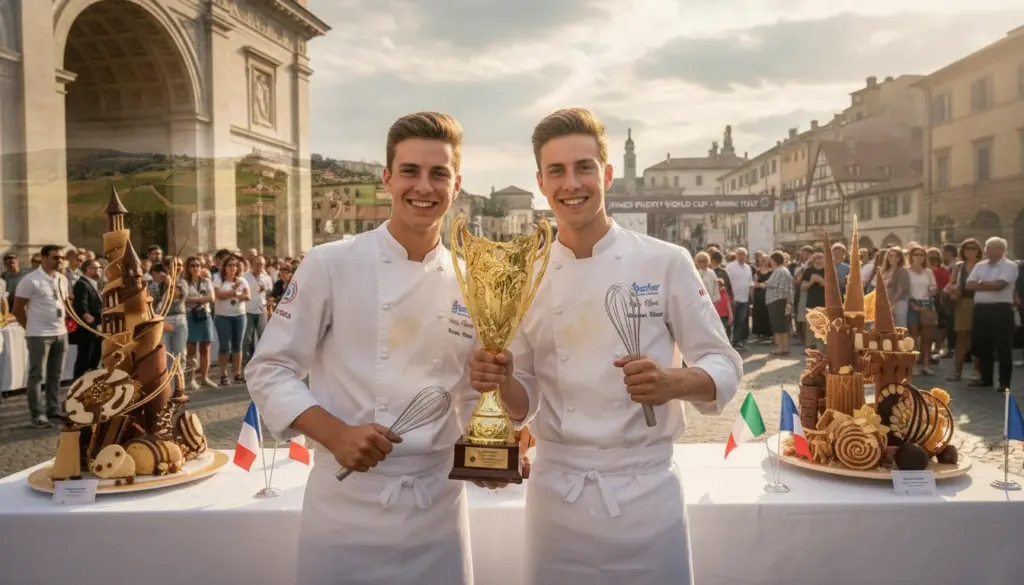
Two young pastry chefs from a tiny Alsace village just completely outsmarted the international judging panel during a grueling World Championship in Italy. What started as a quiet passion in a local bakery culminated in a massive triumph on the global stage. Twins Mathis and Samuel Anstett, who grew up in Zimmersheim in the French Alsace region, claimed the Junior Pastry World Cup in Rimini, leaving the industry’s absolute elite speechless.
Ever since they were children, Mathis and Samuel spent their days whisking batter and tempering chocolate side by side. They attended the same culinary programs, shared the same workbenches, and gradually developed an identical, razor-sharp eye for detail. Today, they share the ultimate professional crown: Junior Pastry World Champions, a title secured at the prestigious Sigep 2026 international trade fair in Rimini.
A High-Octane Workday: Ten Hours and Zero Margin for Error
The grand finale was a pure test of endurance and surgical precision. In a mere ten hours, the brothers had to execute a flawless, cohesive sweet signature menu. They worked under intense time constraints, with cameras rolling and eagle-eyed judges scrutinizing their every move.
The rigorous schedule featured four monumental trials:
- A delicate vegan cake highlighting coffee as the primary flavor profile.
- A highly creative street food dessert rooted in French culinary inspiration.
- A specialized sourdough breakfast pastry.
- A jaw-dropping, 1.2-meter-tall showpiece constructed entirely out of chocolate.
Every single component faced intense evaluation based on taste, texture, originality, presentation, and technical execution. In competitive pastry, a slightly tilted layer, a fragile snapping element, or an underdeveloped aroma easily dictates the difference between the winner’s podium and total obscurity.
Flawless Execution Stuns a Demanding Jury
Eighteen nations entered the fierce competition, with many teams backed by prominent national pastry academies and legendary chefs. Industry heavyweights like South Korea and China dominated the field in terms of reputation and skill level. While these powerhouses ultimately secured podium spots, they were forced to concede the gold to the relentless brothers from Alsace.
Under the strategic guidance of pastry chef and coach Alexis Beaufils, the twins meticulously structured their training regimen. Yet, on the actual competition day, Mathis and Samuel were entirely on their own. For ten grueling hours, they maintained a blistering pace and unbreakable concentration. While rival teams visibly buckled under mounting stress and physical fatigue, the brothers remained remarkably calm and profoundly consistent.
According to the competition organizers, their unparalleled cohesion ultimately sealed the victory. Intelligent flavor profiles echoed beautifully across different courses, while their visual storytelling flowed seamlessly from the plated desserts to the towering chocolate sculpture. For an international jury accustomed to wild culinary spectacles, it was this distinct sense of control and clarity that truly made a lasting impression.
From Television Screens to the World Stage
French audiences were already familiar with Mathis and Samuel thanks to their stellar appearances on the M6 television show Le Meilleur Pâtissier: Les professionnels. On screen, they captivated viewers with their natural chemistry, absolute mastery of classical French techniques, and the effortless way they built single creations using four hands.
That television success was clearly no fluke. Their triumph in Rimini proves that their meticulous approach holds up in a much more punishing environment, where compelling backstories vanish and only the final plate matters. The judges couldn’t care less about their media image; their verdict relied solely on the masterpieces presented on the tasting table.
The Hidden Advantage of Twin Pastry Chefs
In elite pastry competitions where timing and precision dictate success, being twins offers a completely unexpected competitive edge. The brothers don’t just share an identical culinary education; they operate on the exact same reflexes. They seamlessly anticipate each other’s physical movements without uttering a single word, meaning they rarely bump into one another in a cramped kitchen setup.
This unique dynamic translates to highly tangible advantages in a high-pressure kitchen team:
- Lightning-fast task delegation, as both chefs understand each other’s strengths completely.
- Zero arguments regarding style, since their creative vision is inherently synchronized.
- Instinctive communication during high-stress moments, often relying on just a subtle glance or a half-spoken phrase.
- An equally relentless drive for perfection, keeping the bar incredibly high for both of them at all times.
When you are handling incredibly fragile blown sugar elements and complex, gravity-defying chocolate structures under a strict deadline, this synchronization means fewer misunderstandings, less wasted time, and a drastically reduced chance of making catastrophic errors.
Breathing New Life into Alsace’s Baking Traditions
The Alsace region boasts a formidable baking and pastry heritage, famous for classics like rich kougelhopf, festive stollen, and generously filled tarts. The brothers’ sweeping victory successfully casts this historic tradition into a much more contemporary light. Their innovative portfolio proves that chefs can treat classical techniques with immense respect while simultaneously exploring modern trends like vegan baking, street food concepts, and bold international flavors.
For regional patisseries and local culinary schools, a world title of this magnitude sparks a surge in student enrollments, heightened public curiosity, and increased financial investments. Aspiring young bakers can now see that originating from a deeply traditional region doesn’t restrict them to a quiet local bakery—it can absolutely launch them onto the most prestigious international stages.
Inside the High-Stakes World of Competitive Pastry
For years, the Sigep event in Rimini has served as the premier global gathering space for top-tier pastry chefs, gelato artisans, and master chocolatiers. Beyond the dazzling trade demonstrations and bustling vendor booths, the Junior Pastry World Championship acts as a vital showcase for emerging culinary prodigies.
Serious preparation for these events typically kicks off a full year in advance. Elite teams meticulously develop:
- Airtight recipes guaranteed to yield the exact same phenomenal results every single time.
- Rigorous structural stress tests to ensure monumental showpieces remain sturdy yet visually delicate.
- Minute-by-minute execution schedules specifically mapped out for competition day.
- Comprehensive backup plans ready to deploy the second a crucial element breaks or seizes.
When the big day arrives, the challenge extends far beyond mere culinary technique. Physical stamina plays a massive role, as performing highly concentrated, intricate work under blinding studio lights for ten hours is utterly exhausting. That is why many elite teams approach their preparation exactly like professional athletes, focusing heavily on optimal sleep, sports nutrition, and advanced stress management techniques.
Looking Ahead: What This Victory Means
Claiming this coveted title delivers far more than a gold medal and a shiny trophy; it grants unparalleled industry visibility. High-end pastry boutiques and luxury five-star hotels monitor these fierce competitions obsessively, constantly hunting for the next generation of culinary superstars. Incredible opportunities are already lining up for Mathis and Samuel, though recent interviews suggest they are determined to chart their own unique course.
The ambitious duo frequently speaks about pursuing further specialized education, securing internships alongside globally renowned master chefs, and potentially launching their own signature boutique down the line. Thanks to their young age, they still have ample time to experiment creatively, learn from inevitable mistakes, and sharpen their already distinct culinary signature.
Professional Secrets Home Bakers Can Steal
While competing in a World Championship might seem completely out of reach for the average home baker, the twins’ incredibly disciplined workflow offers brilliant, actionable takeaways. Anyone looking to elevate their weekend baking game can easily adopt these exact same foundational principles:
- Commit to a detailed plan: Write out your steps comprehensively, factoring in precise baking durations and essential cooling periods.
- Test your recipes repeatedly: Only tweak one ingredient or method at a time, allowing you to understand what actually drives the improvement.
- Prioritize architectural structure: A luscious mousse or delicate cream must taste divine, but it also needs to hold its structural integrity on the plate.
- Practice against the clock: Set a strict kitchen timer and challenge yourself to flawlessly finish a complex cake within a predetermined window.
For those eager to push their skills to an even higher tier, exploring intensive short courses, vocational workshops, or premium online masterclasses is a smart next step. These educational platforms teach the exact same high-level techniques utilized in global arenas, including advanced thermometer work, structural layer building, and stabilizing incredibly airy mixtures.
The twins’ spectacular victory is a powerful reminder of how far relentless dedication, long-term practice, and a unified creative vision can take you. For aspiring young bakers everywhere, their journey outlines a highly replicable roadmap: start small in your hometown, meticulously develop your personal style, and never be afraid to systematically work your way toward the world’s biggest culinary stages.