
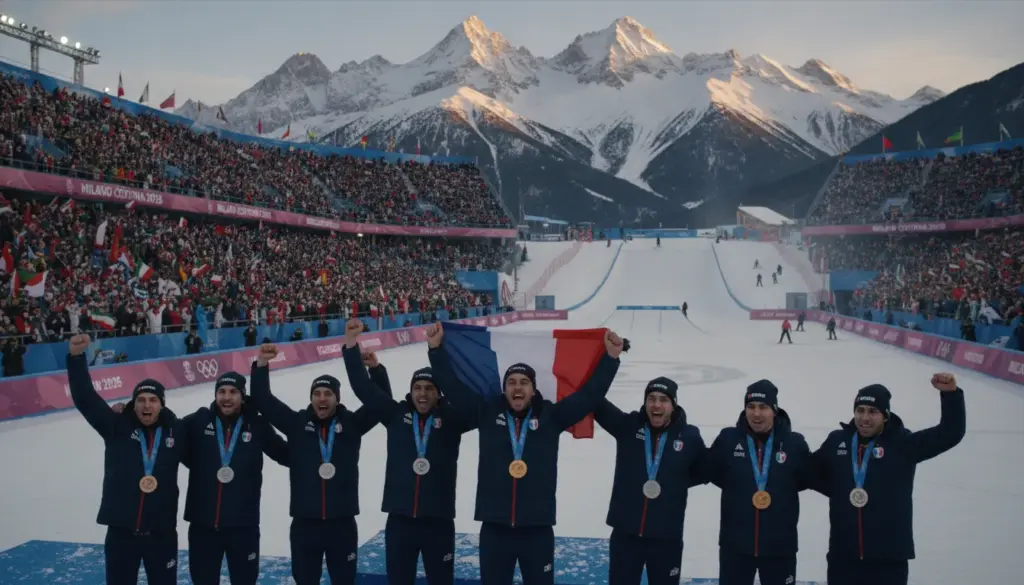
A Historic Shift in Winter Sports Dominance
The 2026 Winter Olympics in Milan and Cortina d’Ampezzo delivered an unforgettable fortnight of athletic excellence that will be discussed for decades. Nestled among the stunning Italian Alps, these Games featured massive medal hauls, a thrilling new discipline, punishing crashes, and deeply emotional farewells. As the dust settles on the slopes and rinks, a remarkably different landscape of international power has emerged across the ice and snow.
France Secures Its Greatest Winter Performance
The French national team achieved its best Winter Games to date, wrapping up the event in sixth place on the overall medal table. The squad accumulated a remarkable 23 medals, including eight prestigious golds. However, one specific sport single-handedly fueled this historic national triumph: the biathlon.
French biathletes captured 13 of the country’s 23 medals, seizing six Olympic titles in a staggering display of supremacy on the snow. Julia Simon emerged as the undisputed star of the roster, walking away with three gold medals and one silver while becoming the global face of the team. Fans also witnessed Océane Michelon claiming a spectacular victory in the mass start, alongside the crucial relay contributions of Lou Jeanmonnot.
On the men’s side, Quentin Fillon Maillet continued to build upon his already legendary career. Adding to his 2026 haul, the veteran now holds an incredible nine Olympic medals across multiple editions. This unmatched achievement makes him the most decorated French Olympian in history.
Unbeatable Team Spirit in the Relays
The French squad proved absolutely invincible when working together, taking the top spot in every single biathlon team event. These collaborative victories proved that their national success relied on a deep roster rather than just a single standout star.
- Swept all biathlon relay golds across the men’s, women’s, and mixed categories.
- Claimed multiple individual championships in both male and female divisions.
- Blended seasoned veterans with fresh rising stars to dominate the podiums.
Ski Mountaineering Makes a Thrilling Debut
A fresh addition to the Olympic roster, ski mountaineering immediately captivated audiences with its high-octane blend of uphill climbing, rapid descents, and tactical gear management. France capitalized heavily on this inaugural event, with Emily Harrop and Thibault Anselmet securing gold in the mixed relay.
This successful introduction highlights a clear Olympic shift toward rugged, endurance-based mountain sports. Younger fans instantly connected with the discipline, recognizing elements of backcountry touring that have exploded in global popularity.
Challenging Norway’s Grip on Cross-Country
While traditional powerhouse Norway maintained its dominance in cross-country skiing, an unexpected challenger managed to break through the ranks. Mathis Desloges captured three medals, including two silvers, successfully disrupting the usual sea of red and blue Norwegian racing suits.
His breakthrough indicates that the established Nordic hierarchy is beginning to fracture. Nations are investing heavily in their cross-country teams, utilizing the same altitude training and professional support systems that Norway and Sweden have relied on for years.
Legendary Icons and Record-Breaking Feats
Norwegian sensation Johannes Klaebo solidified his status as an absolute legend in the snow. He achieved an unprecedented six gold medals in a single edition, setting a towering new benchmark in Olympic history for both summer and winter athletes.
His unique blend of explosive sprinting power, endless endurance, and tactical brilliance left competitors utterly helpless. For his rivals on the tracks, it often felt as though they were racing with a severe handicap from the moment the starting gun fired.
Lindsey Vonn’s Heartbreaking Final Run
Early in the tournament, viewers witnessed a deeply moving moment on the alpine slopes. Lindsey Vonn, the undisputed queen of downhill, attempted one final shot at glory despite competing with a torn ACL. Unfortunately, a slight edge miscalculation led to a devastating, high-speed crash on the piste.
Medics were forced to airlift the American icon off the mountain. The footage of a visibly shaken Vonn offering one final wave to the crowd broadcasted globally, signaling a somber but heroic end to a monumental alpine career.
Queens of the Slopes Claim Their Crowns
Stepping firmly into the spotlight, Mikaela Shiffrin silenced any lingering doubts after a quiet eight-year Olympic stretch. The American skier absolutely crushed the women’s slalom field, taking gold with a massive, undeniable lead over her competitors.
Meanwhile, local crowds roared for 42-year-old Federica Brignone. Returning from severe injury setbacks, the Italian veteran captured gold in both the giant slalom and super-G. Her double triumph turned the grandstands into a tearful, triumphant farewell party on home snow.
Franjo Von Allmen Shocks the Alpine World
Predictions for men’s alpine skiing heavily favored Marco Odermatt, but his Swiss compatriot Franjo Von Allmen stole the headlines entirely. Racing with fearless abandon, Von Allmen clinched a stunning triple crown with golds in the downhill, super-G, and combined events.
This spectacular performance instantly etched his name into skiing royalty. The immense pressure placed on Odermatt contrasted sharply with the relaxed, uninhibited style Von Allmen used to conquer the mountainside.
Triumphs and Heartbreak on the Ice
Eileen Gu continued her absolute reign over freestyle skiing, successfully defending her title while adding big air and slopestyle medals to her collection. With six Olympic medals across two Games, she now holds the ultimate freestyle record and remains a massive digital role model for younger generations.
Conversely, figure skating favorite Ilia Malinin buckled under immense expectations. A disastrous fall during a crucial jump in his free skate shattered his rhythm completely. His tense, unpolished routine pushed him entirely off the podium, resulting in one of the most shocking and discussed upsets of the entire Games.
The Final Medal Standings
The top tier of the national rankings remained fiercely competitive. Norway comfortably topped the final standings with 41 medals. The United States followed closely in second, while the Netherlands fought their way to an impressive third place overall.
As usual, the Dutch squad relied heavily on their traditional dominance in speed skating and short track events. However, securing the third spot proves that the team is expanding its depth, bringing specialized talent across a wider variety of ice disciplines.
A Golden Finale in Ice Hockey
The Games concluded with a fiercely contested ice hockey finale, where the United States secured the ultimate prize. This specific gold medal is universally regarded as one of the most prestigious titles of the event, representing weeks of physical rivalry and immense national pride.
Looking forward, the 2026 Milan-Cortina Games proved exactly how winter sports are evolving to embrace thrilling outdoor adventures and modern digital audiences. The upcoming 2030 Games in France will ultimately reveal if these newly established power dynamics become a permanent fixture on the world stage.