How a Mild Cold Snap Takes Down an Ocean Giant
A critically endangered sea turtle was recently discovered clinging to life on a Texas beach after a sudden temperature drop effectively shut down its body. This distressing find highlights just how easily a minor shift in ocean temperatures can completely derail a vulnerable marine species. The affected animal is a Kemp’s ridley, heavily concentrated in the Gulf of Mexico and globally recognized as one of our most threatened sea turtles.
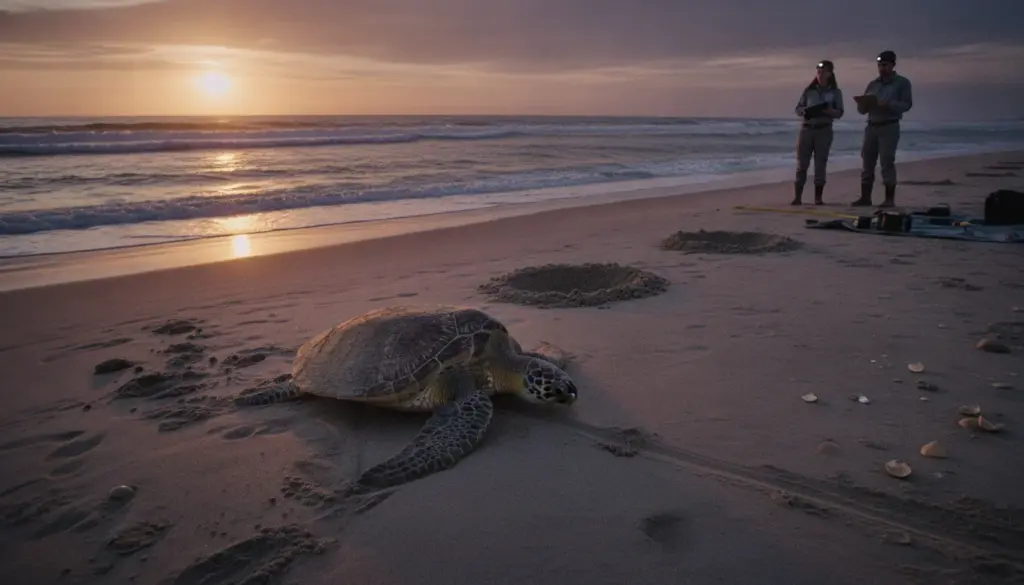
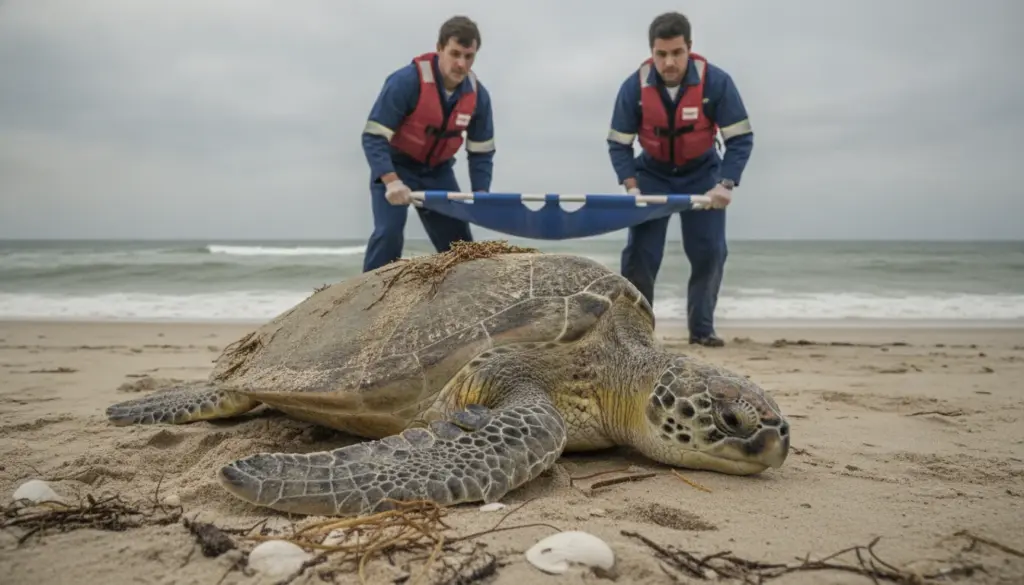
Marine rescue teams immediately recognized severe underlying issues when they found the profoundly exhausted creature near Galveston on the Texas coast. Its entire shell was heavily encrusted with thick algae and barnacles. Instead of swimming actively, the animal had been reduced to a passive, floating rock drifting aimlessly among the waves.
Marine biologists identify this scenario as a textbook case of “cold stunning,” an acute form of hypothermia in marine reptiles. Rather than leaving visible wounds, the chill silently and systematically disables the animal’s essential bodily functions.
It isn’t a single freezing night that causes this, but rather a gradual decline in ocean warmth that forces the reptile’s body into a dormant standby mode.
For the Kemp’s ridley, water temperature acts as an absolute physical boundary. Above a specific threshold, their metabolism remains sufficiently high to hunt, digest, and escape predators. But once the water cools toward 55 degrees Fahrenheit (13 degrees Celsius) and approaches the critical 50-degree mark, their physiological systems begin to unravel.
- Muscle responses become sluggish, losing significant power.
- Reflexes sharply decline, drastically reducing the turtle’s alertness.
- Breathing patterns grow erratic, leading to rapid exhaustion.
- Digestion and food consumption plummet, rapidly depleting vital energy stores.
While the turtle remains alive under these conditions, independent movement becomes nearly impossible. This is precisely the grim reality faced by the specimen stranded in Texas.
From Powerful Swimmer to Rudderless Driftwood
As the turtle’s swimming speed drops, its body literally transforms into a floating artificial reef. Marine organisms like barnacles build their calcium-rich homes on the shell, while algae take root. This rough, heavy biofouling creates immense drag in the water.
Consequently, the creature must expend much more energy for every single flipper stroke, exactly when its biological engine is producing less power. This triggers a deadly cycle: diminished strength leads to increased water resistance, which in turn causes overwhelming fatigue.
Eventually, active propulsion ceases entirely. The turtle no longer dictates its own path; ocean currents and surface winds completely take over navigation. It merely bobs along the surface as a helpless, drifting object.
The Long, Silent Drift
What appears to beachgoers as a localized stranding event often begins hundreds of miles away, at the exact moment the animal loses motor control.
Extensive oceanographic tracking of stranded Kemp’s ridley turtles reveals a clear, tragic pattern. By using advanced computer modeling to trace suspected drift routes, marine experts note that these immobilized animals often travel for several weeks. They pass through vast expanses of water colder than 57 degrees Fahrenheit (14 degrees Celsius). Once temperatures hover around 50 to 54 degrees, severe movement impairment becomes almost guaranteed.
The ultimate stranding location is essentially locked in the moment the turtle enters these frigid open-sea masses. The shoreline merely serves as the final stop of a long, involuntary journey.
A Species Already Balancing on the Edge
The Kemp’s ridley holds the unfortunate title of being one of the rarest sea turtles on the planet. During the 1980s, their population experienced a catastrophic collapse, with researchers documenting a mere 702 nests globally in 1985. Decades of intense conservation efforts on nesting beaches across Mexico and the United States have helped the species rebound slightly.
Nevertheless, current estimates suggest only slightly more than 20,000 adult individuals remain globally. Because the vast majority reside within the Gulf of Mexico, this heavy geographic concentration makes the population incredibly vulnerable to localized environmental shocks.
The compounding risks include:
- Accidental entanglement in commercial fishing gear.
- Devastating collisions with high-speed marine vessels.
- Severe chemical and plastic pollution along coastal waters.
- The degradation and total loss of crucial nesting beaches due to coastal erosion and human development.
- Abrupt weather shifts and extreme cold snaps triggered by a changing climate.
Female turtles require roughly thirteen years to reach sexual maturity. Therefore, every single adult lost represents a massive blow to over a decade of survival and future breeding potential. The recent Texas discovery painfully illustrates how a seemingly minor drop in temperature can flip a vulnerable creature’s odds of survival overnight.
What a Cold Snap Does to a Sea Turtle
Cold stunning is a frequent phenomenon along coastlines where these reptiles migrate or spend their winters. A sudden, fierce northerly wind can easily push warm surface waters out to sea, forcing frigid deep water to upwell. While humans might just consider this a “refreshing dip,” for a tropical or subtropical marine reptile, that thermal shock is life-threatening.
Because they lack the internal biological thermostat found in mammals, a sea turtle’s body temperature rises and falls with its surrounding environment. When the ocean chills rapidly, the animal’s core temperature plunges with it. Muscles seize up, reaction times plummet, and the creature experiences severe disorientation. In the most extreme scenarios, the turtle loses its ability to lift its head to breathe, leading to drowning even on relatively calm sea days.
During freezing weather, dedicated coastal volunteers and emergency responders conduct rigorous beach patrols. Animals discovered in time are rushed to specialized rehabilitation facilities. There, they receive carefully warmed water, thorough medical evaluations, and vital rest until their strength returns enough for an ocean release.
Protection in Times of Climate Stress
The ongoing situation in Texas fits into a much broader environmental pattern, where climate instability places immense pressure on already struggling ecosystems. It isn’t just extreme heat making waves; rapid, unpredictable temperature swings are proving equally deadly. For a marine animal biologically tuned to a very narrow environmental bandwidth, any sudden fluctuation can be disastrous.
As a result, modern conservation strategies are evolving. Rather than just guarding nesting sites or enforcing fishing regulations, efforts now encompass the entire marine habitat. This holistic approach involves rigorous water temperature monitoring, specialized training for volunteer rescue networks, and significantly expanding coastal rehabilitation capacities.
Every rescued adult turtle is a monumental victory for the species, as a single healthy female can lay eggs for several decades.
What You Can Do to Help
Even if you are just vacationing near coastal habitats, everyday citizens can make a tangible difference in marine conservation.
Here are a few practical ways to assist:
- Report immediately: Always alert local wildlife authorities or coast guard units if you spot a weakened or deceased sea turtle.
- Keep beaches clean: Never leave trash on the shoreline; floating plastics are frequently mistaken for jellyfish and consumed by marine life.
- Mind your lights: Avoid using bright artificial lights near nesting beaches, as the glare easily disorients newly hatched babies trying to find the ocean.
- Give them space: Maintain a respectful distance from turtles in the water or on the sand to let them breathe and nest without stress.
For those following the plight of this rare animal, understanding its official status is crucial. International conservation lists classify the Kemp’s ridley as “critically endangered,” indicating a massive, looming risk of extinction in the wild. While saving one stranded animal won’t magically reverse that status, each successful rescue drastically improves the odds that these majestic creatures will still be swimming the Gulf of Mexico for generations to come.
Ultimately, the stranded Texas turtle represents a much larger, high-stakes battle. It isn’t merely fighting against unseasonal cold snaps, but against a converging storm of modern threats in a rapidly shifting ocean. Looking at this single washed-up survivor means looking at an entire species desperately trying to keep its head above water.