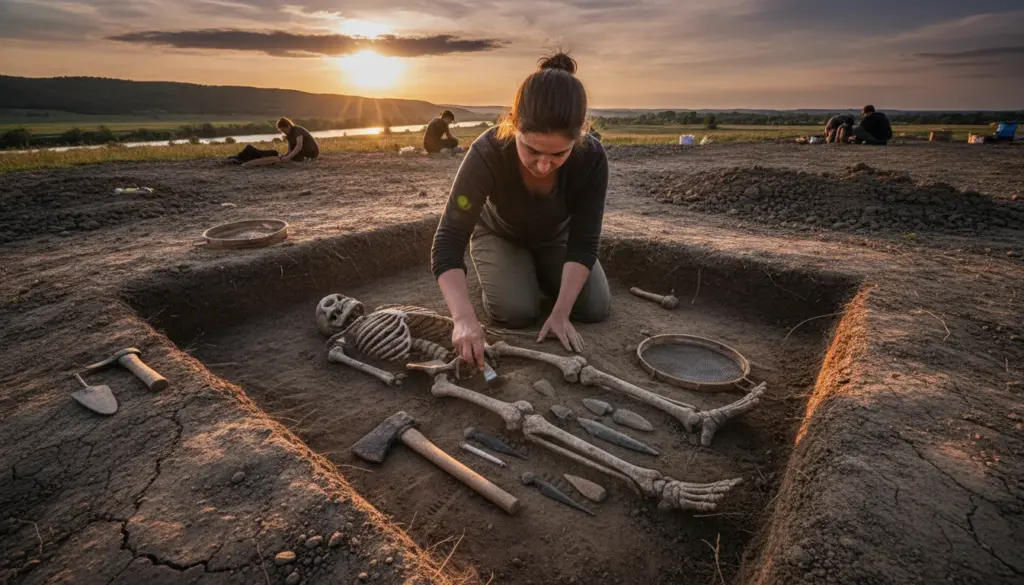
Many of us grew up believing that early human societies operated on a strict division of labor, where men hunted and women tended to the hearth. Clinging to this rigid view of antiquity often causes us to miss remarkable details about our ancestors’ adaptability. A recent archaeological breakthrough in Hungary is completely shifting our understanding of life 7,000 years ago. It reveals that early farming communities might have embraced individual skills far more readily than previously imagined.
Unearthing Secrets in Ancient Burial Grounds
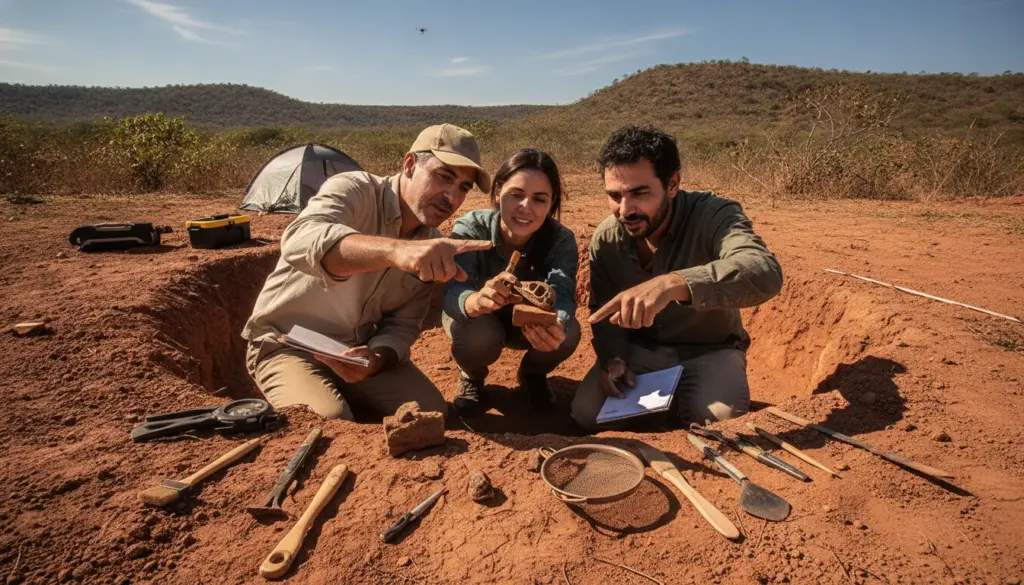
The findings stem from an exhaustive examination of 125 skeletons recovered from two distinct burial sites in eastern Hungary: Polgár-Ferenci-hát and Polgár-Csőszhalom. These individuals belonged to communities thriving in Central Europe during the early Neolithic era, specifically between 5300 and 4650 BC.
Having migrated from Anatolia, these early settlers introduced foundational practices to the continent. Their arrivals sparked a technological shift, bringing with them:
- Advanced agriculture and animal husbandry
- Sophisticated pottery production techniques
- The creation of polished stone tools
What Skeletons Reveal About Daily Chores
Have you ever considered the stories your own skeletal structure could eventually tell? To piece together social dynamics, specialists look beyond the artifacts left in a grave and study physical alterations in the bones themselves. Certain male remains displayed a noticeable elongation of the right upper limb, a trait experts link to the repetitive motion of hurling javelins or spears.
Conversely, numerous female remains exhibited a distinct hyperextension of the toes. This specific anatomical marker is the direct result of countless hours spent kneeling while grinding grain on heavy stone querns. Processing food was undeniably one of the most demanding and essential tasks in these primitive farming villages, and these biological clues allow us to visualize their grueling daily routines.
Expert insight: Archaeological work involves much more than unearthing precious metals and rare items. The most telling evidence of social hierarchies and task distribution often lies in anatomical quirks. Physical wear on joints and pronounced shoulder asymmetry serve as an undeniable physiological record of how a person spent the majority of their waking hours.
A Burial Standard That Seemed Definitive
For decades, excavators noticed a highly predictable pattern at these sites. Men were generally positioned on their right side, accompanied by various stone tools. Women, on the other hand, were laid to rest on their left side, surrounded by decorative belts, shell beads, and intricate jewelry.
Everything pointed toward a deeply entrenched boundary separating the sexes. However, the Polgár-Csőszhalom site threw a massive curveball into the mix, prompting researchers to heavily reassess their established theories regarding ancient labor divisions.
The Discovery That Challenges Traditional Roles
Truth be told, this specific excavation caused quite a stir in the scientific community. Excavators uncovered the remains of an older female who was interred with polished stone tools. In this particular society, such grave goods had always been exclusively categorized as typically masculine equipment.
The anomalies didn’t stop at the artifacts. An in-depth evaluation of her bones showed physical strain patterns that closely mirrored those of the local men, rather than the other women buried nearby. Ultimately, the team identified seven unique burials across the site—five female and two male—that completely defied standard conventions. This strongly suggests that the connection between biological sex and communal duties was far from absolute.
A Surprisingly Adaptable Social Structure
The comprehensive analysis indicates that while these early groups had standard expectations, they actively allowed for flexibility. Simply put, if an individual displayed a distinct talent or physical aptitude for a certain type of labor, the community likely permitted them to take on that role, regardless of their gender.
Experts naturally advise maintaining a level of caution with these interpretations. Grave placements can sometimes symbolize familial ties or spiritual beliefs rather than everyday realities. Even so, this discovery sparks an incredibly compelling conversation regarding the true diversity of Europe’s first agrarian cultures.
A Conversation Spanning Millennia
Variations in funerary customs have been documented across Europe dating back to roughly 6500 BC, yet fresh data proves these traditions were never entirely uniform. How ancient people expressed their identity often hinged on their specific region, the historical era, or even their particular stage of life.
The cemetery at Polgár-Csőszhalom serves as a vital puzzle piece in our understanding of antiquity. It stands as a powerful reminder that human communities were inherently complex and multidimensional long before anyone began recording history. Save this historical breakdown for your next deep dive into ancient civilizations.