Transforming the Toughest Spots in Your Landscape
Transforming that gloomy, desolate patch beneath a mature oak or pine tree into a vibrant carpet of greenery is entirely possible. It all comes down to selecting the correct perennials and utilizing a clever, step-by-step planting approach.
Often, the ground surrounding massive conifers, oaks, or thick hedges becomes a dead zone where absolutely nothing seems to thrive. The lawn turns brown, standard perennials slowly wither away, and thick tree roots push aggressively through the surface. As landscape professionals will tell you, this isn’t a gardening failure on your part, but simply a natural consequence of that specific environment.
A large tree’s root system greedily absorbs almost all available moisture and nutrients from the earth. Simultaneously, the dense canopy blocks out the vital sun. Horticulturists refer to this challenging combination as “dry shade”—a brutal mix of low light, minimal water, and intense root competition packed into one space.
Research conducted by the French institute INRAE reveals that certain tree species take survival a step further. They secrete specific compounds from their roots that actively stunt the development of neighboring vegetation, a fascinating biological phenomenon known as allelopathy. When you pair this chemical warfare with fewer than two hours of daily sunlight, it becomes painfully clear why a traditional grass lawn will never survive there.
Why Classic Shade Varieties Always Fail
Gardeners frequently attempt to fix these problematic spaces using popular shade-loving varieties like ferns, hostas, and astilbes. While they look gorgeous in nursery catalogs, these species actually demand entirely different growing conditions to survive.
- Hostas require a consistently damp, nutrient-dense environment to flourish.
- Astilbes thrive only when planted in fresh, humus-rich earth.
- Ferns generally suffer rapidly if their root zone dries out completely.
Beneath a towering tree canopy, these ideal conditions simply do not exist. The established roots vacuum up every drop of moisture, rainwater tends to cascade down the trunk rather than soaking the surrounding soil, and the ground heats up incredibly fast during the summer months. Within a single growing season, the results become obvious: drooping stems, scorched leaf edges, pathetic blooms, and ultimately, a return to bare dirt.
To genuinely rescue this part of your yard, you need a completely different strategy. The secret lies in finding a botanical specimen that can handle drought, deep shadow, and fierce root rivalry all at once.
Meet Barrenwort: The Unsung Hero of Dark Corners
Fortunately, the perfect candidate already exists, though it often sits unnoticed in the quiet corners of local garden centers. Meet epimedium, commonly known as barrenwort or bishop’s hat. While it doesn’t boast flashy, oversized blooms or aggressive growth habits, it possesses a resilient profile that virtually no other perennial can match.
This remarkable species creates a low-growing, impenetrable carpet of foliage. As spring arrives, delicate flowers emerge in exquisite shades of white, pale yellow, pink, or coppery orange, with some cultivars even showcasing bi-colored petals. Its leaves remain fully or semi-evergreen throughout the year, frequently transitioning into gorgeous bronze or warm red tones when temperatures drop in the winter.
The true magic of barrenwort lies in its structural growth habit. Utilizing short, creeping rhizomes, it steadily spreads to form a dense groundcover that gives weeds absolutely no room to sprout. Once properly established, its tolerance for severe drought in heavily shaded areas is nothing short of astonishing.
Long after your prized hostas have surrendered to the dry heat, epimedium is just settling in and making itself at home.
A Step-by-Step Guide to Establishing Epimedium
While barrenwort would ideally prefer well-draining, humus-rich earth, it consistently outperforms classic shade divas even under highly suboptimal conditions beneath mature timber. Success simply requires the right initial approach.
Timing Your Planting Correctly
Achieving a lush groundcover starts with perfect timing. Avoid putting new additions in the ground during a scorching summer. Instead, let seasonal weather patterns do the heavy lifting for you.
The optimal window opens with the arrival of consistent autumn rain showers. During this period, the ambient air is cooling down, yet the earth retains its summer warmth. Natural rainfall helps the root system anchor securely, saving you from hauling a watering can every single day.
Preparing Harsh Soil Without Damage
Digging aggressively beneath an ancient tree is a terrible idea, as severing the structural roots will severely harm the tree itself.
- Gently loosen just the top two to four inches (5 to 10 centimeters) of the soil surface using a hand tool.
- Carefully work your way around any thick, woody roots, leaving them completely undisturbed.
- Spread a thin layer of decomposed leaves or leaf compost over the area to mimic a natural woodland floor.
That final step makes a world of difference. Decomposing foliage locks in moisture, feeds beneficial microorganisms, and slowly breaks down into the exact type of rich humus that barrenwort loves.
Setting the Plants in the Ground
Before placing them in the earth, give the young nursery plants a thorough soaking. Submerge their pots in a bucket of water for roughly fifteen minutes until air bubbles stop rising, then allow them to drain fully.
Position the barrenworts in a staggered, zigzag formation, spacing them roughly twelve inches (thirty centimeters) apart. This specific layout ensures they will merge into a seamless, solid mat within one to two years, completely avoiding a patchy appearance.
Water generously immediately after planting. Throughout their first year in the garden, supplemental hydration is critical. Whenever a dry spell hits, provide a deep, substantial soaking so the creeping rhizomes can firmly wedge themselves between the thick tree roots.
Apply a very light mulch of fine wood chips or dried leaves to trap humidity and block weeds. However, always ensure the plant’s central crown remains uncovered so that dangerous rot cannot set in.
Minimal Upkeep for Maximum Impact
Once it has acclimated to its new home, epimedium requires shockingly little attention. As winter comes to a close, simply snip away any browned or tattered foliage to make way for the vibrant new spring shoots to emerge cleanly. Supplemental feeding is rarely necessary, especially if you allow fallen leaves to naturally decay around the base each autumn.
Dynamic Companion Plants for Dry Shade
If you want to introduce a layered, dynamic look to your shadowy zones, consider pairing barrenwort with other resilient varieties that laugh in the face of dry shadow.
Alchemilla mollis, frequently called Lady’s mantle, produces delightfully soft, lime-green mounds of foliage. By early summer, it erupts into clouds of tiny yellow-green blossoms that act like natural light reflectors in dark spaces. Because it appreciates just a touch more sunshine, position it along the outer borders of the tree canopy where dappled light filters through.
Vinca minor, or lesser periwinkle, serves as another incredibly dependable companion. This low-profile spreader fills out rapidly, tolerates nutrient-poor dirt, and pushes out lovely purple-blue or pristine white blooms from early spring well into the autumn months. Let periwinkle trail along the extreme edges of the bed, allowing the barrenwort to command the primary real estate closer to the trunk.
By weaving together these three robust species—epimedium, Lady’s mantle, and periwinkle—a dusty tree base magically transforms into an enchanting woodland edge.
From Dead Zone to Woodland Oasis
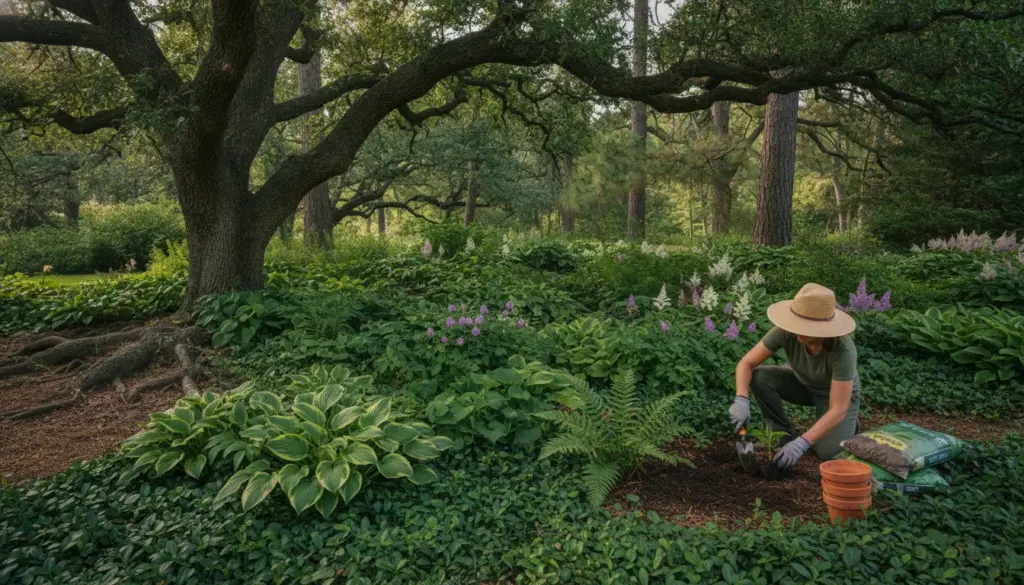
Consider a classic landscaping headache: the ground directly beneath an old pine. The earth feels rock-hard, roots are exposed, and lawn grass refuses to grow. With minimal effort, you can completely flip the visual script.
- Gently scratch the hard surface with a small hand cultivator.
- Scatter a nourishing layer of breaking-down leaves or leaf compost.
- Nestle the epimedium plugs into a staggered grid, spaced a foot apart.
- Fill the transitional borders with Lady’s mantle and creeping periwinkle.
By the following spring, the entire patch will look exponentially greener. Fast forward one more year, and a thick, resilient carpet will have replaced the dusty wasteland. The contrasting foliage and delicate blooms will give the once-barren space an authentic, forest-like atmosphere.
Pro Tips for a Resilient Shade Garden
If you want to permanently conquer dry shade, you must focus on soil health as well as plant selection. When autumn leaves fall, leave them exactly where they land beneath your trees. This provides a constant supply of free mulch and essential nutrients. Avoid synthetic fertilizers entirely; they wash away quickly in these areas and do absolutely nothing to improve the soil’s drought resistance. Organic matter, on the other hand, naturally aerates the dirt and dramatically increases its water-holding capacity, creating an environment where epimedium thrives.
Finally, during periods of extreme summer drought, it is far more effective to water deeply just once a week rather than giving the surface a light sprinkle every single day. Deep watering forces the root systems to stretch further down into the earth. When combined with a thick, living groundcover, this targeted strategy ensures your once-problematic corner never reverts to cracked, barren earth again.