From Science Fiction to Serious Astrophysics
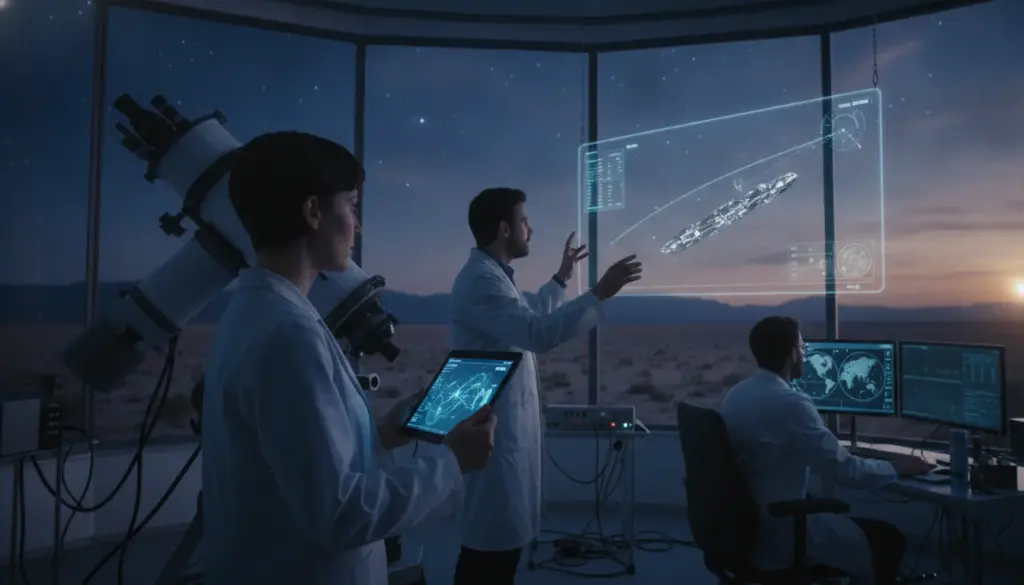
A rapidly expanding community of astronomers is finally tackling a highly controversial question with absolute seriousness. This isn’t about wild internet speculation, but rather heavily structured scientific inquiries armed with strict, measurable parameters. The core message from these experts is incredibly straightforward: if unusual technological artifacts are floating through our cosmic neighborhood, researchers want the exact tools needed to identify them.
For decades, the concept of extraterrestrial remnants drifting through our solar system lingered in the shadowy space between Hollywood movies and legitimate academia. Thanks to powerful modern telescopes, massive digital databases, and innovative analytical frameworks, that outdated perception is dramatically shifting.
Instead of dismissing the concept entirely, modern space experts are crafting testable hypotheses backed by hard data. The current focus heavily revolves around technosignatures—distinctive physical traces of non-human engineering. While this often brings radio waves to mind, it equally applies to tangible items like dormant probes, highly reflective panels, or unnaturally shaped metallic structures exhibiting unusual flight paths.
Leading astrophysicists emphasize that this current wave of interest isn’t just a fleeting trend focused on a single strange anomaly. It represents a steadily maturing branch of astrophysics, complete with rigorous peer-reviewed studies published in highly respected academic journals.
Hunting for Anomalies in Historical Archives
Interestingly, one of the most fascinating investigative methods doesn’t involve looking up at the night sky, but rather digging deep into dusty observatory archives. Specialized research teams are meticulously analyzing vintage photographic glass plates captured well before 1957. That specific year is crucial because it marks the launch of humanity’s very first artificial satellite.
These historical images provide an incredibly valuable baseline, capturing the heavens before human-made orbital debris cluttered the atmosphere. If any streak resembling a modern satellite appears in these vintage snapshots, it entirely rules out contemporary aerospace technology.
Initially searching for vanishing stars, astronomers unexpectedly discovered fleeting pinpricks of light mimicking satellite trajectories decades before such devices existed. Naturally, these fascinating visual anomalies invite intense professional scrutiny and require alternative scientific explanations.
- Equipment flaws: Scratches, degradation, or chemical errors on the original glass plates.
- Atmospheric reflections: Unusual weather phenomena temporarily bouncing light into the camera lens.
- Classified aviation: Undocumented military flights, secret balloon launches, or early rocket testing.
- Human bias: The psychological tendency to spot artificial patterns where none actually exist.
The fierce debate surrounding these old photographs highlights the lingering sensitivity regarding potential alien artifacts. Many professionals remain hesitant to fully engage with the topic, desperately wanting to avoid any association with fringe conspiracy theories. A phenomenon truly transitions from a bizarre mystery to accepted evidence only when physical, close-up analysis becomes possible.
Interstellar Wanderers: Cosmic Rock or Engineered Artifact?
Beyond analyzing historical photographs, observational scientists are keeping a close watch on transient visitors from deep space. These are interstellar bodies that briefly streak through our planetary system before vanishing back into the infinite cosmos. Because these structures originated around distant stars, they carry unique foreign materials completely alien to our local environment.
These transient guests serve as the ultimate cosmic test cases. Researchers meticulously observe them to determine exactly how a potentially manufactured structure might behave differently from a standard chunk of frozen ice or rock. To do this effectively, the astronomical community is building highly detailed observation checklists.
Almost everyone in the scientific community safely assumes that the vast majority of these strange passing objects possess completely natural origins. The universe is absolutely packed with jagged boulders, shattered comets, and oddly shaped icy debris. The true challenge lies in systematically filtering out the ordinary space rubble to isolate that tiny percentage of anomalies demanding intensive further study.
Establishing a Scientific Benchmark for Technosignatures
Moving forward requires universally accepted evaluation standards. Rather than debating what looks suspicious on a case-by-case basis, scientists are actively drafting generic, standardized criteria. These new observational frameworks draw heavy inspiration from the highly successful techniques currently used to discover exoplanets.
The ultimate goal is to create a rigorous scientific benchmark. Researchers need to know exactly when an object graduates from a mere curiosity to a legitimate candidate for an artificial artifact. To achieve this, several critical categories are carefully weighed.
- Material composition: Can the object’s chemical makeup be fully explained by naturally occurring cosmic processes?
- Orbital movement: Does the object follow a predictable, gravity-bound trajectory, or does it display unexplained propulsion?
- Spatial context: Where exactly is the object located, and is it a region where similar natural bodies are frequently spotted?
- Data integrity: How many independent observatories successfully confirmed the sighting using different instruments under varying conditions?
Next-generation facilities are preparing to sweep the night sky, generating overwhelming avalanches of fresh observational data. Because millions of light flashes and moving dots will be logged every single night, engineering teams are already programming advanced algorithms specifically designed to automatically flag bizarre trajectory deviations.
Preparing for Discovery: Policy and Global Protocols
This relentless search extends far beyond simple optical observation. Experts are currently mapping out the profound practical and societal implications of a potential discovery. If a telescope spots something tomorrow that strongly indicates non-human engineering, the global scientific community needs an actionable plan.
Several pressing logistical questions are already being debated behind closed doors:
- Mission control: Who holds the global authority to approve and launch a physical reconnaissance probe?
- Planetary protection: What strict safety protocols must be enforced regarding biological contamination or the accidental activation of dormant technology?
- Public transparency: How, and exactly when, should such a monumental discovery be communicated to the general public?
- Global oversight: Which international governing bodies will step in to manage the situation alongside traditional space agencies?
Leading thinkers desperately want comprehensive response plans ready for a hypothetical affirmative answer, even if they never actually need to use them. This proactive stance prevents every minor data glitch from being sensationalized online, while simultaneously ensuring that genuinely intriguing data isn’t quietly buried due to academic fear.
Why the Hunt for Space Anomalies is Accelerating
The sudden professionalization of this niche field stems from several massive technological leaps. Modern optical sensors are incredibly sensitive, while advanced machine learning models can instantly spot hidden patterns inside massive datasets that human eyes simply cannot process. Furthermore, the rapidly expanding catalog of confirmed exoplanets makes the concept of other habitable worlds feel significantly less theoretical.
Simultaneously, the cultural climate within elite academic circles is shifting. While discussing extraterrestrial possibilities used to be instantly dismissed as pure folklore, there is now ample room for sober, calculated hypothesis testing. As long as a theory offers clear, measurable predictions, it is welcomed into the scientific discussion.
For the average reader, this paradigm shift guarantees a steady upcoming stream of news headlines featuring strange orbital anomalies and potential technosignatures. Naturally, many spectacular initial claims will eventually turn out to be ordinary asteroids, fragmented ice blocks, or simple software glitches.
Nevertheless, this precise methodology fundamentally alters how we perceive our local solar system. Rather than viewing drifting comets and space debris as boring background scenery, astrophysicists now treat them as potential data carriers from distant civilizations—or as definitive proof that our immediate cosmic neighborhood consists entirely of lifeless rock.
How to Evaluate Future Space Discoveries
Navigating upcoming headlines about potential non-human artifacts requires a highly critical mindset. Keeping a few essential evaluation tools in mind will help you easily separate sensationalized news from genuine astronomical breakthroughs.
- Demand raw data: Always check if the breaking news relies on concrete, measurable instrument readings rather than vague visual assumptions.
- Look for consensus: Verify whether multiple, entirely independent research teams have successfully analyzed and agreed upon the same raw data.
- Check the alternatives: Ensure that the researchers have systematically tested and completely ruled out every possible natural explanation.
- Stay highly skeptical: Exercise extreme caution regarding explosive claims circulating exclusively on social media or relying on heavily pixelated imagery.
By adopting this analytical perspective, you can follow the ongoing hunt for artificial technosignatures with a calm, rational understanding of the rigorous scientific process. The odds of actually discovering a forgotten, ancient probe drifting near our planet remain incredibly uncertain. However, the sophisticated tools required to either completely rule it out or shockingly confirm it are becoming sharper every single day.