Have you ever paused to consider the hidden activity occurring beneath the jungle floor? For years, cicadas in the Amazon remain entirely out of sight, only to construct staggering architectural feats just before reaching maturity. These impressive creations have baffled biologists for decades. Let’s dive into a captivating tale of biological engineering and the bizarre methodology researchers adopted to understand this colossal construction project.
Deep within the incredibly diverse Brazilian Amazon, these insects thrive mostly unnoticed. Operating as subterranean nymphs, they pass years in pitch-black conditions. Their entire diet consists of plant root sap as they patiently await their dramatic debut above ground.
Subterranean Architects of the Rainforest
While we rarely see them at work, cicadas function as masterful landscape designers beneath the surface. Through a vital ecological process known as bioturbation, these creatures carve out intricate underground networks for travel.
Rather than blindly digging, they actively reshape the soil matrix, providing a crucial service for the broader rainforest environment. Ultimately, their tunneling allows the forest floor to properly “breathe” while drastically improving its ability to soak up heavy rainfall.
A Warning for Jungle Travelers
Expert tip: Should you ever spot tiny mud chimneys on the forest floor during a tropical trek, leave them entirely undisturbed. These fragile transitional spaces act as essential shields, guarding the bugs against both hungry predators and sudden deluges during their most defenseless developmental phase.
Puzzling Mud Structures and a Highly Unorthodox Experiment
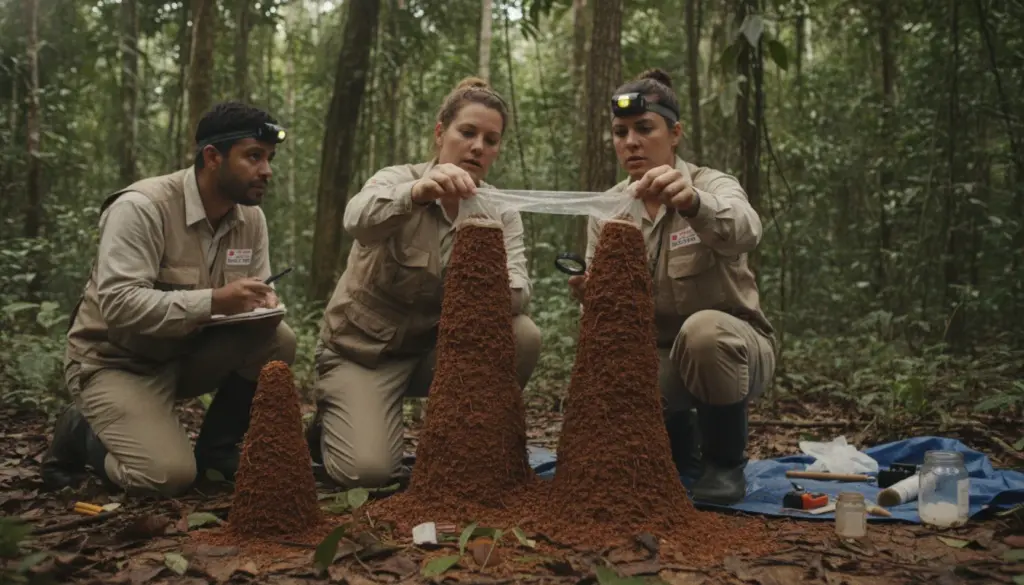
As their nymph phase concludes and adulthood approaches, specific cicada varieties undertake a mammoth task. They push up from the dirt to erect mud towers that perfectly resemble tiny chimneys.
What exactly drives this behavior? Truthfully, this question has perplexed the scientific community for generations, sparking theories ranging from temperature control to flood evasion.
To finally crack the case, an investigative team featuring scientist Catalina Sanabria Devia deployed a remarkably clever tool: condoms. These everyday items served as the perfect airtight, elastic covers to seal off tunnel openings.
By utilizing this unorthodox equipment, the team could meticulously track bug activity and gather interior microclimate statistics without interfering with the creatures’ normal habits. It stands as a brilliant reminder that out-of-the-box thinking often unlocks the wildest mysteries of the natural world.
Be sure to save these fascinating insights for your next foray into nature!