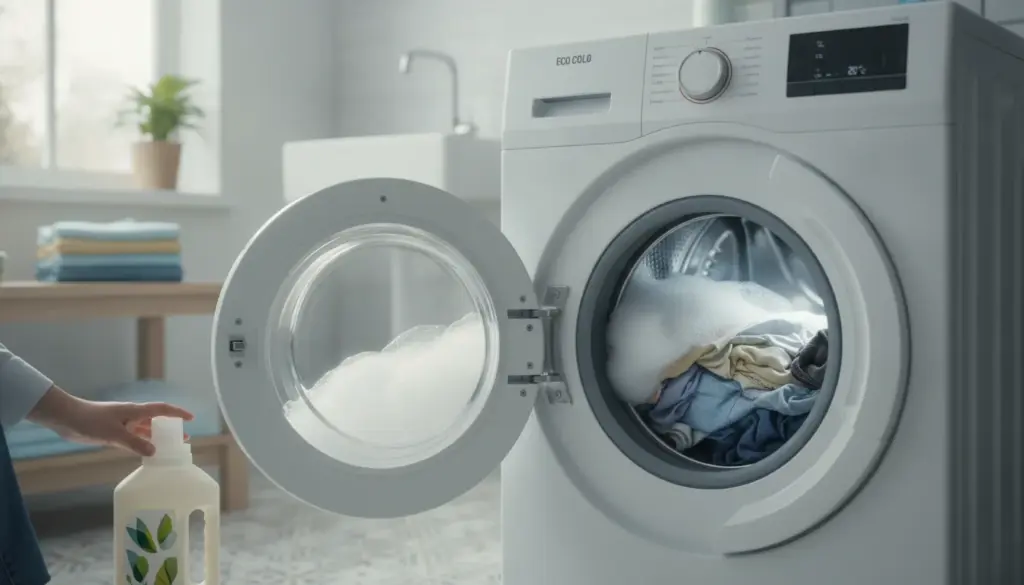
Washing your clothes at lower temperatures serves as the easiest method for quickly dropping your utility expenses, and bubble systems ensure you never have to sacrifice a spotless clean to achieve this. Today’s home appliances no longer require boiling water to tackle stubborn stains. The real secret lies in the way the soap blends with the water before it ever enters the main drum.
The magic of bubbles penetrating grime twice as fast as standard powder
The underlying mechanics of this specific technology are brilliantly straightforward and require zero technical expertise from the user. Before the actual wash cycle truly gets underway, the machine transforms your detergent into a highly active foam. This frothy solution penetrates fabric structures up to 2.5 times faster compared to a standard mixture. Because of this, moisture flows much more evenly through the garments, resulting in a deep clean that completely avoids punishing your favorite fabrics with extreme heat.
Without any unnecessary exaggeration, the method simply performs well, backed by hard data that is tough to overlook. By utilizing these bubbles, households can cut energy usage by as much as 25% while simultaneously using 14% less water. Beyond the obvious environmental benefits, this approach offers a tangible 20% increase in fabric protection, meaning your go-to outfits simply won’t wear out as quickly. Best of all, modern models activate this feature completely automatically, so you won’t even need to press an extra button.
Lacking the newest model isn’t a problem if you know these simple laundry tricks
If your current washer lacks these high-tech bells and whistles, don’t worry. You can still squeeze maximum efficiency out of older equipment without dropping a fortune on a replacement. The primary secret lies in choosing the correct detergent—specifically, transitioning to liquids or pods. These options dissolve much more effortlessly in cool temperatures, entirely preventing those annoying white streaks from ruining your dark trousers.
Just remember to avoid overloading the tray with cleaning products, as excessive suds often lead to pump failures and unpleasant drum odors. Instead, focus your routine around a few core principles:
- Always match the cycle to the specific fabric type rather than tossing everything into a standard 60-degree cotton setting.
- Embrace short cycles and cool settings as your go-to solution for lightly worn, everyday items.
- Avoid forcefully cramming items inside; an overloaded drum essentially guarantees half your load will emerge dirty.
- Occasionally treat your appliance to a “spa day” by running an empty, hot cycle with vinegar to eliminate lingering bacteria.
Pre-soaking heavily soiled garments in a basin before the main wash is another excellent strategy. Spending just a few minutes submerged in a mild soapy mixture breaks down the grime, giving your appliance a significantly easier job. Should you eventually decide to upgrade your laundry setup in the future, definitely prioritize units equipped with water aeration systems.
Your wallet will thank you for adjusting these three temperature settings
Lowering your electricity consumption during laundry tasks is largely about skipping the heating phase, since generating warmth drains the most kilowatts from your meter. Modern chemical formulas are highly advanced, allowing them to perform exceptionally well at merely 20 or 30 degrees Celsius. Simply try ditching the boiling hot settings for your standard t-shirts just once, and you will quickly notice the results are completely identical.
Load optimization also plays a massive role—running a full cycle for two pairs of socks is purely wasteful. Whenever your wardrobe is merely sweaty rather than caked in mud, take advantage of the quick wash function. Furthermore, regular filter maintenance isn’t an old wives’ tale; a clogged system forces the motor to strain harder, naturally increasing your utility costs. If you happen to be on a variable-rate electricity plan, scheduling your loads during late-night off-peak hours provides an immediate financial advantage.
Your washer will last for years if you stop ignoring these hidden areas
To ensure your equipment doesn’t break down after just two years, make it a habit to scrub the detergent drawer and the bottom filter monthly. These spots collect the most sludge and lint, which can easily cause a flooded bathroom if left unchecked. Wiping down the rubber door seal is another brilliant habit, considering this dark crevice acts as the primary breeding ground for mold. Taking a moment to inspect the drainage hoses will also save you from funding a highly expensive renovation for the neighbor living directly beneath you.
Maintaining a pristine machine prevents foul odors while simultaneously minimizing energy waste and eliminating frivolous repair calls. Taking charge of basic upkeep independently ensures the savings on your energy statement become incredibly apparent over time. Have you ever attempted to run a cycle using only vinegar, or does the potential scent make you nervous? Feel free to share your thoughts!