From a Barn Foundation to an Archaeological Masterpiece
For years, a farmer in a South Moravian village absentmindedly stepped over a seemingly unremarkable gray rock. Only much later did it become clear that he was actually walking over a rare archaeological treasure. What spent decades serving as a simple structural support for a barn foundation is now recognized as a 3,300-year-old casting mold for bronze spears.
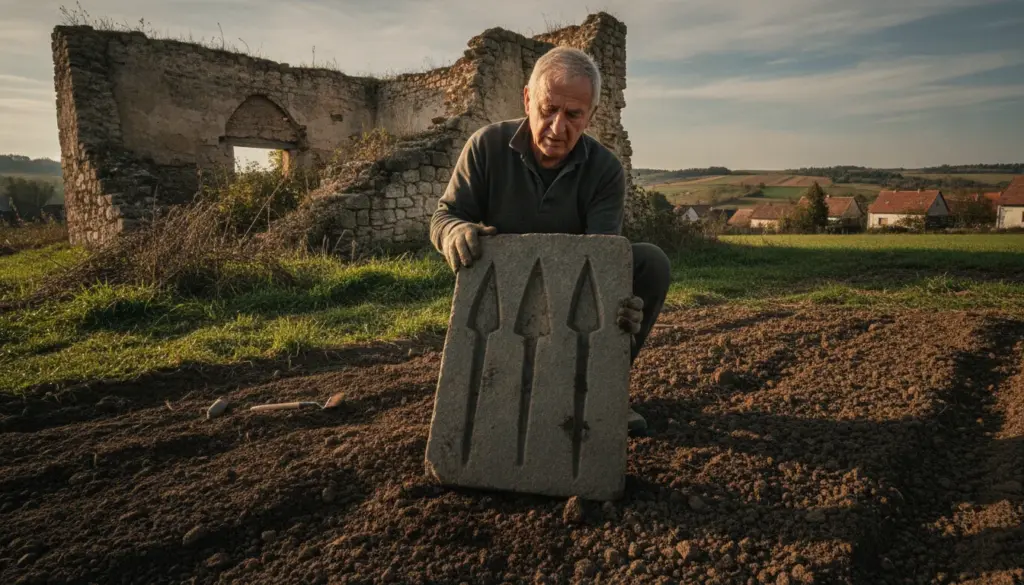
The remarkable journey of this artifact began back in 2007 within the village of Morkůvky. A local resident noticed a rectangular, gray slab protruding slightly from the soil in his yard. The heavy rock had rested there for years, functioning simply as a stabilizing block beneath his shed.
However, the homeowner eventually noticed something unusual about the block. Its highly regular shape and exceptionally precise edges stood out from typical field stones. He found the object intriguing enough to set aside, though he remained completely unaware of its true historical value. The slab was tossed into a storage space, where it gathered dust for more than a decade.
It wasn’t until 2019 that the man decided to transport the heavy slab to the Moravian Museum in Brno. There, the artifact was carefully examined by a specialist who immediately recognized its significance. In that single moment, a forgotten garden rock transformed into a crucial scientific artifact.
Hidden beneath layers of shed dirt lay one of the most immaculately preserved bronze weapon molds ever recovered in Central Europe. Measuring roughly 23 centimeters in length and weighing over a kilogram, the slab features a deep, perfectly carved indentation. This is not decorative art, but rather a highly functional, engineered cavity designed specifically for casting metal spearheads.
Engineering a Bronze Age Spear
Researchers quickly identified the artifact as a specialized stone mold, specifically designed to mass-produce bronze spearheads. While only one half of the tool survived, its exceptional detail allows metallurgical experts to fully reconstruct the ancient manufacturing process.
Microscopic analysis reveals that the two halves of the mold were positioned vertically during the casting phase. They would have been tightly bound together using a thick copper wire or band, ensuring no molten bronze could leak from the seams. Liquid metal was then carefully poured directly into a narrow opening at the top.
The carved cavity reveals a highly specific weapon design known as a socketed spearhead. The base featured a hollow cylindrical tube, allowing the deadly point to be firmly mounted onto a long wooden shaft. Distinctive ridges run along both the socket and the outer blades.
- These deliberate ridges provided crucial structural integrity, making the blade highly resistant to snapping during combat.
- The streamlined profile allowed the spear to penetrate armor and tissue with devastating efficiency.
- The molded design guaranteed that every weapon produced shared a standardized, uniform shape.
Clear evidence of thermal fracturing and deep discoloration stains the stone’s surface, indicating intense, repeated exposure to extreme temperatures. The research team estimates this specific mold was utilized dozens of times to churn out fresh spearheads. In modern economic terms, this single stone represented a highly efficient, localized weapons factory.
This discovery confirms that ancient fighters did not rely on random, one-off blacksmithing jobs. Instead, they had access to sophisticated, serial weapon production networks.
Geological Clues Point to a Massive Journey
Surprisingly, the most groundbreaking revelation does not stem from the weapon’s shape, but rather from the geological composition of the rock itself. Specialized mineralogical testing utilizing X-ray diffraction techniques mapped the stone’s exact crystalline structure.
The results were definitive: the mold was carved from rhyolitic tuff, a specific type of volcanic rock. However, this distinct variant of tuff is practically nonexistent in the immediate region. In Central Europe, it naturally occurs almost exclusively within northern Hungary and specific pockets of southeastern Slovakia, particularly around the Bükk Mountains.
The quiet village of Morkůvky sits incredibly far from those volcanic deposits. Hundreds of kilometers of dense forests, winding rivers, and steep valleys separate the garden where it was found from its geological origin. Despite the total absence of paved roads or modern transport, this heavy stone successfully made that vast trek during the Bronze Age.
For geologists examining the find, this completely eliminates the possibility of random chance. Recovering a highly specialized tuff mold so far from its natural source serves as undeniable proof of a complex, well-established trade network.
This was not simply a convenient rock picked up along a path. It most likely moved through a sophisticated supply chain of merchants, craftspeople, and elite warriors, traveling all the way from the Carpathian Basin into South Moravia. It represents a carefully selected, imported piece of industrial technology, prized specifically because rhyolitic tuff handles extreme heat and intricate carving brilliantly.
Rethinking Trade and Power in the Bronze Age
Historians date this fascinating artifact to the Urnfield culture, an expansive societal complex that dominated large swaths of Central Europe starting around the middle of the second millennium BC. Named after their vast cremation cemeteries, these societies were already known to be far from primitive, actively forging bronze into sophisticated jewelry, tools, and armor.
However, the actual manufacturing tools used by these ancient metalworkers are notoriously rare in the archaeological record. Casting molds are inherently fragile, prone to thermal shock, and were frequently discarded or recycled once they cracked. That sheer rarity is exactly why this well-preserved Moravian discovery carries such immense academic weight.
The survival of this single stone brilliantly illustrates several major societal leaps happening simultaneously:
- The standardization of military equipment, creating recognizable weapon profiles across massive geographic territories.
- The rise of specialized, full-time artisans who dedicated their lives to arming elite warrior classes.
- The expansion of long-distance trade routes, which moved not just raw materials, but heavy industrial technology.
- The emergence of complex political structures capable of funding and organizing large-scale military production.
Spearheads identical to those produced by this mold have been heavily documented throughout the Carpathian Basin. Finding the manufacturing tool so far west provides concrete evidence that Carpathian economic and military strategies strongly influenced neighboring regions like Moravia and Bohemia.
Bronze Warriors and Ancient Military Logistics
Military historians immediately recognize this style of weaponry from classical antiquity. The combat gear aligns perfectly with the heavy arsenals described in epic poetry like the Iliad, where frontline fighters carried massive shields, bronze greaves, and crucially, multiple spears into battle.
Carrying multiple spears was an absolute tactical necessity. When a warrior hurled his primary throwing spear, it was usually lost or embedded in an enemy shield. He desperately needed an identical backup weapon to continue fighting in brutal close-quarters combat. A standing army simply could not function without a massive, continuous influx of fresh spearheads.
By possessing a highly durable volcanic stone mold, a local master smith could rapidly stockpile lethal munitions for a regional chieftain or tribe. This creates a brilliant, undeniable link between advanced geological knowledge, thriving trade corridors, and sheer military dominance.
Where a casting mold of this caliber sat, there was not merely a skilled blacksmith, but a wealthy, organized center of political power capable of arming hundreds of men.
A Scientific Discovery Years in the Making
The timeline of this discovery is almost as fascinating as the artifact itself. Initially unearthed in 2007, it spent over a decade stabilizing a shed before finally reaching museum experts in 2019. Now, fully analyzed and formally described in academic literature, the stone serves as a profound symbol of just how globally connected and technologically advanced Bronze Age societies truly were.
Why Was Volcanic Tuff So Valuable?
A casting mold essentially functions as a durable negative impression of a desired object. While clay molds were common, they broke easily. Stone molds offered incredible longevity, making them highly prized industrial assets that frequently traveled alongside wealthy merchants and master craftsmen.
Rhyolitic tuff possessed the exact physical properties an ancient metalworker desperately needed. Despite being relatively lightweight, the volcanic rock boasts immense thermal resistance and can be carved with incredible precision. This allowed ancient engineers to sculpt razor-sharp edges and fine structural details into the cavity without fearing the block would shatter when filled with boiling liquid bronze.
The deliberate transportation of this specific stone across vast distances proves just how deeply ancient manufacturers understood metallurgy and geology. They expertly predicted how different minerals reacted to extreme thermal shock and purposely sourced the absolute best materials to ensure maximum manufacturing reliability.
To the casual observer, a heavy, gray block resting in a garden might seem incredibly dull. Yet, within the historical record, objects like this are fundamentally priceless. They vividly demonstrate that humans living 3,300 years ago were already mastering the complex concepts of manufacturing efficiency, global supply chains, and military logistics. A single, forgotten piece of volcanic rock ultimately paints a strikingly modern portrait of a severely underestimated era.