Cantabria Emerges as a Global Paleontology Hub
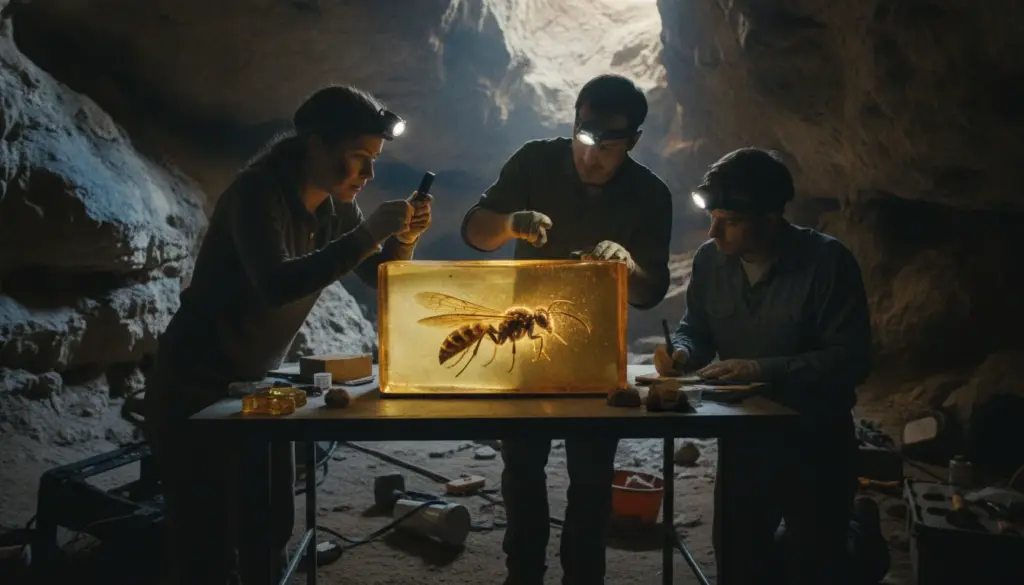
A remarkable piece of fossilized tree resin from Spain’s El Soplao cave is completely rewriting our understanding of the Cretaceous period. An international research team recently identified a completely unknown species of ancient wasp, perfectly encased in amber for a staggering 105 million years.
Documented in the journal Palaeoentomology, this specimen is far more than a simple prehistoric bug. It serves as a critical evolutionary missing link. The newly discovered insect, formally named Cretevania orgonomecorum, possesses unique anatomical traits unseen in any previously studied species. Its highly distinct features are actually forcing scientists to overhaul how this entire genus is classified.
El Soplao’s Liquid Gold Defies the Limits of Traditional Fossils
The El Soplao cave has earned a global reputation for yielding amber of breathtaking quality. While conventional fossils usually leave behind only rigid bones or crushed exoskeletons, fossilized resin acts as an unparalleled biological time capsule. It literally halts time, impeccably preserving soft tissues, ancient pigments, and even the microscopic venation patterns on delicate insect wings.
To study this specific wasp without destroying its amber tomb, researchers deployed cutting-edge imaging technology. By utilizing confocal microscopy alongside high-resolution 3D scanning, they captured visuals precise down to the millimeter. This non-invasive approach allowed them to meticulously count antennal segments and closely examine the intricate structure of the thorax and legs.
While members of the Cretevania genus are typically unearthed in regions like China or Myanmar, this Spanish specimen is remarkably larger. Its entirely unique set of physical characteristics simply doesn’t align with prior discoveries, prompting evolutionary biologists to essentially redraw the family tree. The comprehensive study was backed by several heavyweight institutions:
- Geological and Mining Institute of Spain (IGME-CSIC)
- Universities of Barcelona and Valencia
- Chinese Academy of Sciences
- Oxford University Museum of Natural History
A Tiny Time Machine Challenging European Paleontology
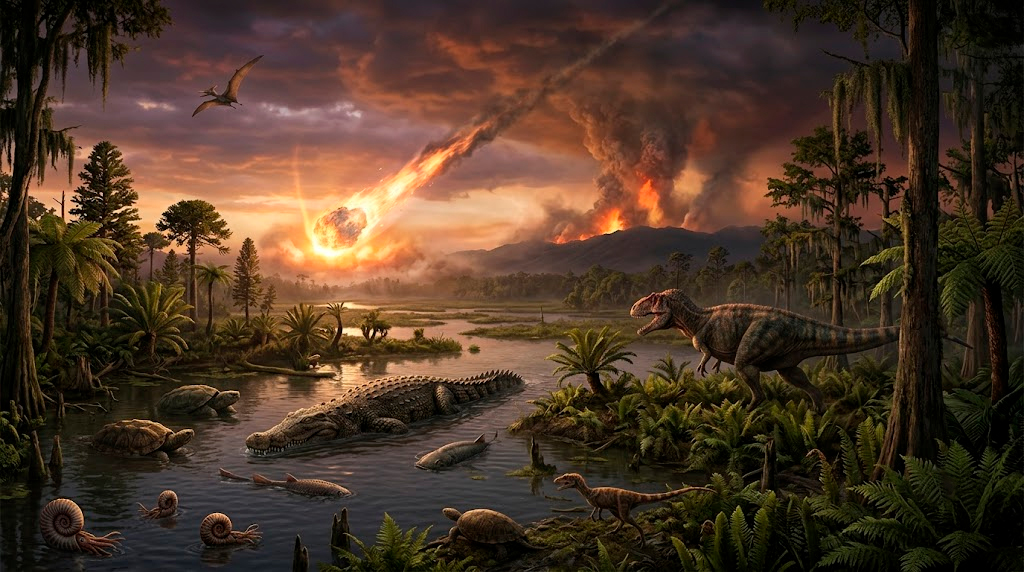
Back in the middle Cretaceous period when this ancient wasp thrived, a massive portion of Europe was completely submerged beneath tropical oceans. The Iberian Peninsula existed as a lush island archipelago, hosting primitive reptiles, the earliest flowering plants, and dense swarms of prehistoric insects.
From a scientific standpoint, these evaniid wasps are incredibly valuable. Because they were so globally widespread and display such distinct structural variations over time, paleontologists use them as index fossils. Finding them in a specific geological layer allows experts to almost instantly pinpoint the exact age of the surrounding sediments.
From a Mining Accident to a Subterranean Biological Archive
Interestingly, the El Soplao cave was stumbled upon by sheer accident during early 20th-century mining operations. The site’s name actually originates from traditional miner slang, describing a strong gust of air felt when two underground galleries suddenly intersect. Today, it stands as an absolute treasure trove of prehistoric data.
Researchers have already cataloged over 1,500 fossil inclusions within this cave system. The site has yielded not just insects, but ancient fungi, botanical remains, and even tiny vertebrate fragments, leading to the official scientific description of more than 30 new species. The unique environmental conditions of this ancient coastal zone—where terrestrial and marine ecosystems blended under highly humid, tropical temperatures—caused tree resin to flow in massive quantities.
Ultimately, the true scientific worth of Cretevania orgonomecorum goes far beyond a single taxonomic description. The amber from El Soplao acts as a high-definition prehistoric photograph, capturing dynamic, everyday moments like insect interactions, microscopic pollen grains clinging to tiny legs, and fungal growths on leaves. It provides a vivid, three-dimensional glimpse into a vibrant world that vanished millions of years ago.
Have you ever had the chance to examine a real amber inclusion up close, or is your experience mostly limited to watching Jurassic Park?