Say goodbye to cluttered windowsills filled with an endless parade of mismatched jars and glasses. A true plant propagation game-changer is likely waiting for you right under a nearby pine tree. Far beyond a simple woodland decoration, this is a brilliant, natural mechanism capable of holding your delicate cuttings perfectly upright without costing a dime.
While most of us merely view pine cones as charming autumn decor, they actually possess incredible hydraulic properties. If your indoor jungle is running out of space and you need a reliable way to root new stems, this gathered treasure serves as the ultimate stylish and practical display.
A pine cone isn’t just decor; it’s a precision vise designed by nature
It is truly fascinating how organic materials can respond to moisture levels without any modern technology. When the surrounding air is dry, the cone’s scales naturally fan wide open. However, the moment you introduce water, the wooden tissue absorbs the moisture, causing the entire structure to close tightly. By harnessing this biological reflex, you create an effective, living vise that securely grips fragile plant shoots.
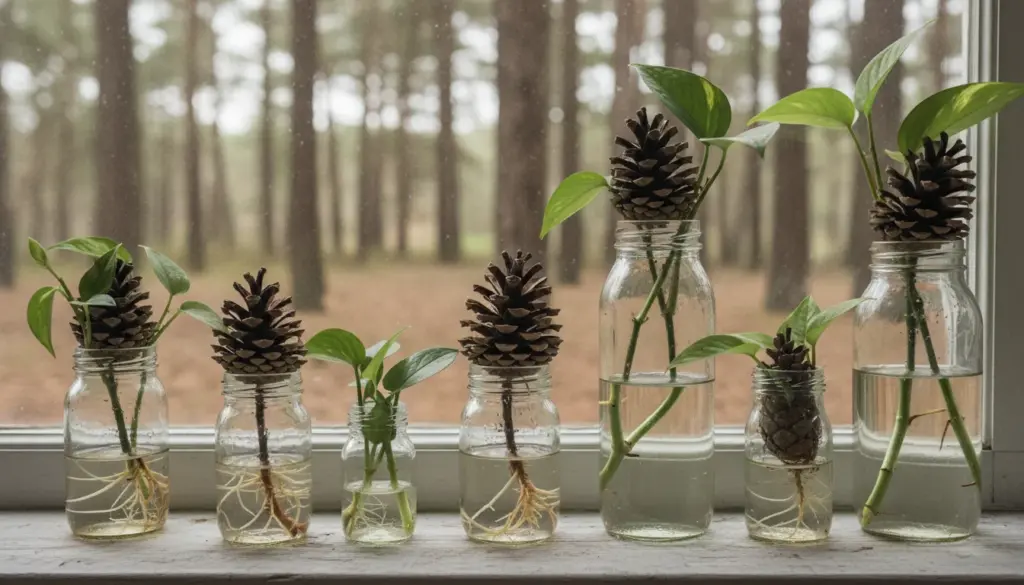
The genius of this method lies in sliding your stems into the fully opened, dry scales. Once you place the arrangement in a shallow dish of water, the cone clamps down around the stems within just a few hours. Compared to wobbly test tubes or top-heavy glasses, this DIY stand is significantly safer and more compact. (Honestly, this trick would have saved me from breaking several glass vases while trying to root heavy monstera cuttings!)
Do it for pennies: a list of items you probably already have
You can skip the trip to the garden center for this project, as the required supplies are likely already in your kitchen cupboards or scattered along your favorite walking trail. The secret to success is selecting the right cone—you want one that is large, perfectly healthy, and completely expanded.
- A completely dry and clean pine or spruce cone
- A small bowl or deep saucer to hold the water
- A few small pebbles or fine gravel to weigh down the base
- A sharp pair of pruning shears
- Four to eight plant cuttings, each about 15 centimeters long
When selecting your propagation candidates, focus on moisture-loving varieties that drink water as eagerly as we consume our morning coffee. Classic houseplants like golden pothos, philodendrons, and spider plants perform exceptionally well here, as does fresh supermarket mint. Their pliable stems and distinct root nodes make it incredibly easy to tuck them securely between the rigid wooden scales.
The magic happens in the water: step-by-step instructions
Kick off the process by lightly brushing away any dirt from your gathered cone. Next, give it a brief soak in a vinegar-water solution to evict any unwanted forest pests. Once it has thoroughly dried and the scales have fanned back open, prepare your plant clippings. Snip the stems just below a node and strip away any lower foliage so no leaves are left to rot in the water. Carefully slide each stem between the wooden layers, spacing them evenly around the circumference.
Now for the exciting part: settle your loaded cone into the water dish, ensuring only the very bottom of the structure and the cut ends of the stems are submerged. Wait about two hours, and you will watch the wood seemingly come to life as it tightens its grip on your plants, instantly forming a stable, verdant bouquet. Just be sure to swap out the water whenever it gets cloudy and position the setup in an area with plenty of bright, indirect sunlight.
Once your new root systems are robust enough to transition into pots, be careful not to let the potting mix dry out immediately. Roots developed in an aquatic environment are accustomed to constant hydration. Those first two weeks in fresh soil represent a critical adaptation period, so keeping the moisture levels consistent is vital for your plant’s survival. Have you discovered any other brilliant, cost-free methods for building a DIY plant nursery at home?