
What the Traffic Laws Actually Dictate
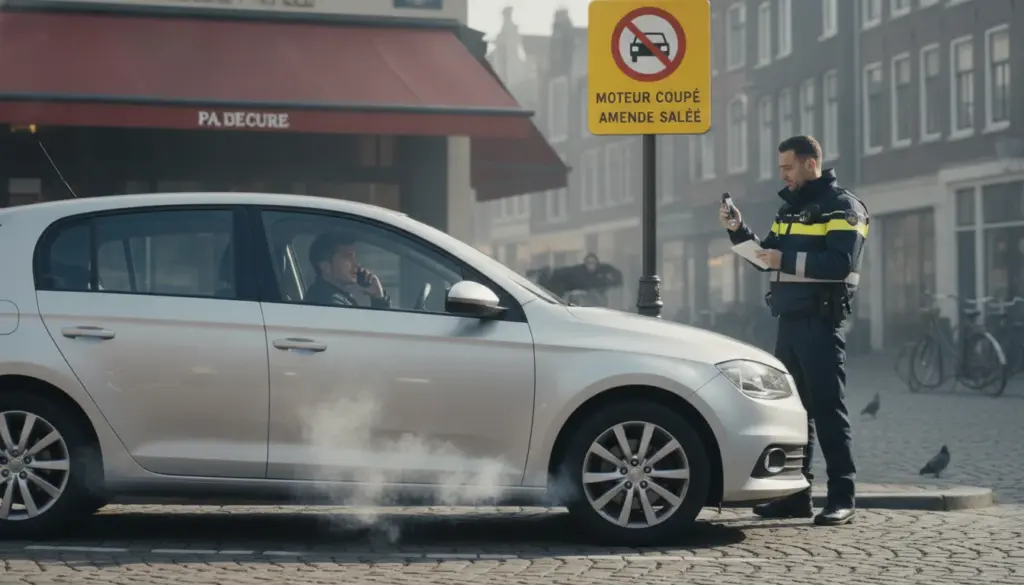
Many motorists keep their vehicles running while stationary, blissfully unaware that this habit drains their wallet, impacts local air quality, and invites steep penalties. Whether you are waiting at the school gates, dashing into a bakery, or taking a quick phone call, letting the engine purr “just for a minute” is increasingly scrutinized. Across Europe, particularly in nations like France and the Netherlands, authorities enforce strict regulations against this practice. Ignoring these rules not only skyrockets your fuel consumption but also significantly increases your risk of an unexpected citation.
A common misconception among drivers is that as long as the vehicle is parked or pulled over, they are operating within the law. The reality paints a very different picture. In neighboring countries like France, the legislation is crystal clear: any stationary vehicle must have its engine switched off, barring a provable emergency.
Similarly, the Netherlands actively prohibits “unnecessarily running the engine” through general provisions in the Road Traffic Act, backed by local municipal ordinances. City councils leverage these foundational rules to crack down on offenders in residential neighborhoods, school zones, and low-emission areas. It is not your location that determines the offense, but rather the basic fact that your engine is running when it could easily be turned off.
When is Keeping the Engine Running Allowed?
While practical application allows for some leeway, the accepted exemptions are much narrower than most realize. Authorities generally only recognize a few specific scenarios:
- Heavy traffic or gridlock where you might need to accelerate at a moment’s notice.
- Severe weather conditions requiring immediate window defogging, heating, or air conditioning for basic visibility and safety.
- Specialized utility vehicles that rely on motor power to perform essential tasks, such as emergency services or heavy machinery.
Quick convenience stops almost never fall under these protected categories. If you are keeping the motor running purely for personal comfort, you are exposing yourself to a very real penalty.
How a Simple Turn of the Key Costs €135
French traffic enforcement operates on a highly straightforward premise. Leaving a stationary car idling unnecessarily is classified as a 4th-category offense, carrying a standard penalty of €135. Law enforcement officers do not need to identify any additional infractions; a parked car emitting exhaust is sufficient grounds for a ticket.
The enforcement process is incredibly swift. Imagine waiting outside a shop with the engine humming. A patrolling officer spots you, jots down your license plate, and the interaction is over. This single momentary lapse can result in a tiered penalty system:
- €90 for prompt, early payment.
- €135 as the standard default fine.
- Significantly higher fees for delayed payments or unsuccessful appeals.
While the exact monetary figures differ in the Netherlands, the underlying enforcement strategy remains identical. Municipalities determined to boost urban air quality are utilizing the General Local Bylaws (APV) to actively penalize unnecessary idling.
Primary Target Areas for Enforcement
Traffic wardens deliberately concentrate their efforts on locations where idling vehicles create the most disruption and pollution:
- Outside educational institutions, where parents frequently wait for extended periods.
- Narrow residential streets lacking adequate airflow and ventilation.
- City centers and designated environmental zones, especially during heatwaves or smog alerts.
- “Kiss & ride” drop-off lanes where brief pauses escalate into long waits.
The Hidden Costs of “Just a Few Minutes”
The standard defense of “it will only take five minutes” masks a much larger issue. When compiled over weeks and months, these brief moments accumulate into massive environmental and financial burdens.
Fuel Waste and Invisible Emissions
Depending on the model, an average petrol or diesel engine burns between half a liter and a full liter of fuel for every hour it idles. While that might sound minimal in isolation, daily idling habits quickly add up to dozens of wasted liters annually. Translating that into carbon output, a few minutes of daily idling equals the emissions of numerous extra trips you never actually drove.
Air Quality at Street Level
Idling presents an acute health hazard primarily for those in the immediate vicinity of the exhaust pipe. These toxic gases pool close to the ground, directly impacting:
- Children congregating outside school gates.
- Pedestrians and cyclists navigating past parked cars.
- Homeowners whose ground-floor windows face congested streets.
Prolonged exposure to particulate matter and nitrogen oxides is known to exacerbate asthma, respiratory conditions, and cardiovascular issues, with seniors and children being particularly vulnerable. Prioritizing cabin comfort over turning the key effectively forces others to breathe in concentrated pollutants.
Does Frequent Restarting Damage Your Engine?
Many drivers stubbornly refuse to switch off their engines, citing fears of wearing out the starter motor or draining the battery. As automotive professionals frequently note, this concern is largely a relic of older vehicle generations. Contemporary engines and their associated electrical systems are engineered specifically to handle continuous restart cycles.
For the vast majority of cars on the road today, the negligible wear from starting the engine is completely offset by the substantial savings in fuel and reduced emission output. Stop-start technology was developed precisely around this mechanical reality. Automotive manufacturers utilize heavy-duty starters and reinforced batteries capable of engaging dozens of times during a single commute. Extreme freezing temperatures or driving a vintage classic are the rare exceptions where caution is warranted.
Maximizing Stop-Start Systems
If your vehicle features integrated stop-start technology, it automatically manages the idling rules for you. Yet, many motorists manually disable this feature due to unfamiliarity. To get the most out of your vehicle’s mechanics, consider these professional insights:
- Review the manufacturer’s logic: Every brand programs its stop-start engagement differently, so consult your manual.
- Monitor battery health: Frequent, very short trips can age a battery faster, making proactive replacement essential.
- Winter driving: During severe cold snaps, temporarily disabling the system can ease the immediate strain on cold-starting.
Even without automated systems, manually turning the key or pressing the start button achieves the exact same results. It merely requires a slight adjustment in routine.
Breaking the Habit: Why We Keep the Engine Running
When questioned, most motorists offer predictable explanations: the kids are freezing, the windows will fog up, or they will be moving again shortly. This behavior rarely stems from malice; rather, it is a potent mix of modern convenience, underestimating the consequences, and a lack of awareness regarding local ordinances.
Rewiring Driver Reflexes
A widespread habit involves starting the ignition the second the driver sits down, letting the motor run while they buckle up children, program the GPS, or fire off a text message. Adopting one straightforward behavioral shift—only starting the engine when you are physically ready to accelerate—yields immediate benefits.
Traffic psychology shows that this transitions into a subconscious habit within mere weeks. International awareness campaigns prove that once drivers understand the financial risks and the direct impact on local children’s lungs, behavior modification happens remarkably fast.
Community Action and Social Dynamics
Local authorities are increasingly installing direct signage near schools urging drivers to cut their engines. Parent-teacher associations actively advocate for these measures, armed with data showing drastic drops in air quality during peak drop-off hours. A clear message displayed on a school banner leverages positive social pressure; when parents observe others shutting off their vehicles, they instinctively mirror that responsible behavior.
Practical Strategies to Avoid Fines
Protecting yourself from unexpected citations while simultaneously lowering your fuel budget requires only minimal effort. Integrating a few smart habits transforms your daily drive:
- Adopt the 30-second rule: Switch off the ignition anytime you anticipate waiting longer than half a minute (excluding active traffic jams).
- Prepare before you ignite: Ensure seatbelts are fastened and navigation routes are set before touching the engine start button.
- Check local bylaws: Stay informed about specific idling crackdowns in your municipality, particularly if you frequent historic city centers.
- Manage cabin climate smartly: On chilly mornings, rely on lower fan speeds or drive gently to warm the car faster, rather than idling in the driveway.
For commercial drivers and delivery professionals, intentionally scheduling “engine off” breaks into a route not only trims operational fuel costs but also provides a much-needed physical reprieve from constant engine vibrations.
Advanced Insights for Modern Motorists
Today’s smart vehicles often track idling metrics without the driver even realizing it. Certain dashboard displays will highlight exactly how many minutes were wasted stationary, translating that directly into lost fuel economy. Furthermore, fleet management companies monitor these statistics rigorously, as reduced idling directly correlates with lower maintenance overhead and extended vehicle lifespans.
As urban planning shifts toward stricter environmental zones, reduced speed limits, and elevated parking fees, every drop of fuel conserved while parked becomes incredibly valuable. Drivers who normalize shutting off their engines today will seamlessly adapt to the inevitable tightening of tomorrow’s traffic regulations.