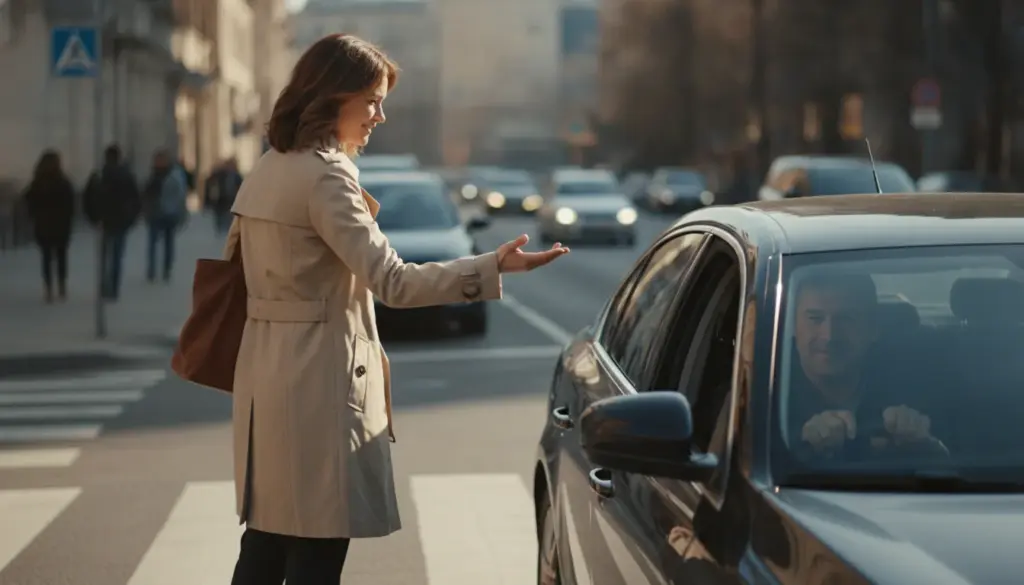
That fleeting wave of thanks might seem trivial, but behavioral experts notice a striking pattern hidden within it. Pedestrians who make a conscious effort to acknowledge a driver stopping for them usually navigate life quite differently than those who just walk by in silence.
What a quick wave reveals about your personality
Traffic psychologists and behavioral analysts connect these seemingly insignificant motions to a much broader life outlook. When analyzing everyday acts of kindness and appreciation, a fascinating picture emerges. Individuals who acknowledge others on the road tend to view the world through a more optimistic lens and generally find their lives more fulfilling.
People practicing these tiny rituals frequently report that they:
- Have a deeper sense of trust in other people
- Feel significantly less threatened in chaotic environments
- Reflect on their day with a much more positive attitude
- Are noticeably quicker to step up and help someone else in need
Ultimately, it goes far beyond a brief interaction at a crosswalk. This subtle movement reflects a deeply ingrained tendency to recognize the good in others and intentionally show appreciation for it.
Lowering stress through a split-second of focus
The concept of gratitude has gained massive traction within modern psychology. Researchers consistently tie it to improved sleep quality, stronger resilience during tough times, and significantly lower stress levels. While this usually involves evening journaling or structured habits, the exact same mechanism applies to our daily commutes.
When a person walking across the street lifts their hand, a remarkable cognitive shift happens. They literally pause to process the present moment: “This person slowed down for me, and I am acknowledging that.” This mental micro-pause successfully disrupts the autopilot mode that dictates how most of us rush through our schedules.
Taking a deliberate moment to register a friendly act physically reduces bodily tension, instantly making the immediate environment feel less frantic. Those who do this consistently point out in behavioral surveys that they:
- Maintain their composure much better during rush hour traffic
- Experience less hostility from fellow commuters
- Bounce back much faster after an exhausting day at work
Cultivating empathy both on and off the sidewalk
Reacting appreciatively in traffic is strongly intertwined with empathy, which is simply your capacity to understand someone else’s perspective. The vast majority of pedestrians who signal their thanks are frequently drivers themselves. They intimately understand the frustration of yielding right-of-way only to be met with zero eye contact or basic acknowledgment.
Because they have been in that exact position, they realize that braking, shifting gears, and staying alert requires active effort. A simple wave validates that exact exertion. It is not some grand theatrical display, but rather a subtle communication conveying that you see the effort made for you. These miniature moments of validation are the fundamental glue that keeps society functioning smoothly.
Experts refer to this specific dynamic as “pro-social behavior.” These are voluntary actions intended to foster a more pleasant community atmosphere, completely devoid of any expectation of an immediate reward. Offering a quick thanks at the zebra crossing remains a textbook illustration of this concept.
Practicing patience in a chronically rushed world
Another character trait strongly associated with individuals who make these gestures is patience. Choosing to raise your hand signifies that you are carving out a tiny fragment of your time for someone else, rather than remaining entirely consumed by your own rushed pace.
By consciously showing appreciation, you briefly break out of a hurried mindset and create a little room for basic humanity, even while the clock keeps ticking. Behavioral data indicates that individuals with these habits are far less likely to honk their horns, rarely shout in traffic, and are much less easily agitated by red lights or unexpected delays. They aren’t flawless saints; they have simply trained themselves not to overreact to every single external trigger.
How this simple gesture impacts the driver
The positive impact of a friendly wave certainly isn’t limited to the person walking. The driver on the receiving end often feels an equally powerful psychological boost. Traffic behavior studies highlight that motorists drive much more courteously and responsibly when their polite actions are met with positive reinforcement.
For instance, a driver who receives a friendly nod is far more likely to:
- Willingly stop for the very next person waiting to cross
- Maintain a much safer distance when passing cyclists
- Keep their cool if another road user makes a careless mistake
Simply put, one fleeting instance of gratitude can ignite a small chain reaction of considerate driving. Suddenly, a basic crosswalk transforms into an unexpected training ground for positive social interaction.
Not a waver? What this actually means for you
If you never raise your hand to say thanks, it absolutely does not automatically mean you are a selfish or cold person. How we act on the road heavily depends on our upbringing, the role models we observed during childhood, and our overall sense of personal safety while navigating the streets.
A lot of individuals are simply shy. Making direct eye contact with a complete stranger behind the wheel can feel incredibly awkward for them. Others have grown so accustomed to cars yielding at designated crossings that the action feels completely standard, triggering no conscious urge to express gratitude.
Nevertheless, psychological professionals suggest that consciously practicing these tiny gestures can still offer great mental benefits, even for those who feel hesitant. You shouldn’t do it out of a sense of obligation, but rather because it can genuinely elevate your own daily mood.
Building a brand new habit from scratch
If you are curious about these benefits and want to give it a try, the secret is to start incredibly small. Just try offering a slight nod or raising a single finger from the steering wheel next time.
After just a few weeks of deliberate practice, this action typically evolves into an automatic reflex. You will eventually stop overthinking it entirely, yet you will continue reaping the subtle emotional rewards.
The proven science behind micro-gratitude rituals
Formal research into thankfulness usually focuses on larger practices, such as meticulously writing down three positive events every single evening. However, everyday hand gestures fit perfectly into that exact same cognitive framework. They do not demand deep introspective reflection, yet they successfully shift your brain into a state of appreciation.
Because these minor actions require almost zero time, they are significantly more sustainable for the average person than massive lifestyle overhauls. You do not need to book an expensive mindfulness retreat or take up daily meditation; you merely need to make a tiny physical movement at the appropriate moment.
A ripple effect beyond basic traffic etiquette
Those who regularly practice gratitude on the morning commute usually notice this positive energy bleeding into other areas of life. It might manifest as a polite nod to a delivery driver, a quick verbal thanks to a grocery clerk, or a thumbs-up to a neighbor holding a door. The underlying pattern remains identical: you notice a helpful action, you validate it, and you respond accordingly.
Mental health experts define this specific cognitive pattern as a “gratitude mindset.” It is essentially a perceptual filter where you actively scan your environment for small, positive interactions. While it requires a little bit of conscious effort at first, it quickly becomes second nature. As a result, happy memories begin to stack up in your brain much faster than frustrating ones.
When life feels overwhelmingly busy and full of friction, this incredibly basic habit can make a world of difference. A quick wave at a crosswalk won’t magically turn the streets into a perfect utopia, but it certainly smooths out the roughest edges of our daily interactions. For both the pedestrian and the driver behind the wheel, it often creates just enough mental breathing room to navigate the rest of the day feeling a little more relaxed.