When the Sahara Resembled a Lush Savanna
Deep within the dunes of Niger lies the ancient shoreline of a long-vanished lake. Thousands of years ago, human communities thrived here, mourning their loved ones and carefully laying them to rest. What emerged from these shifting sands forces researchers to completely rethink the traditional view of the Sahara as an endless, lifeless wasteland.
Today, this region appears as a barren expanse of rock and sand. However, the landscape looked drastically different roughly 12,000 years ago. A subtle shift in the Earth’s orbit pushed tropical rain belts further north, intensifying monsoons that fed sprawling rivers, swamps, and lakes across the modern desert.
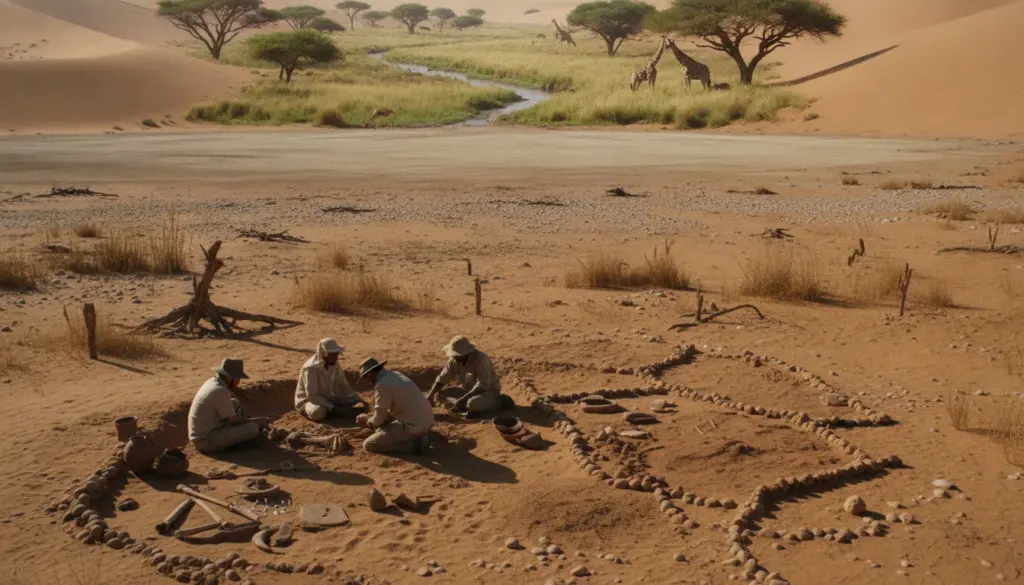
Satellite imagery still displays ancient riverbeds carving scar-like patterns through the arid ground. Geological evidence points to an ancestral version of Lake Chad that dwarfed its contemporary counterpart. Furthermore, prehistoric rock carvings found in local caves depict elephants, hippos, and giraffes. Such vibrant wildlife art implies a thriving ecosystem supported by permanent water sources, trees, and abundant grasses.
During this vibrant epoch, the territory functioned as a verdant savanna where human populations, wildlife, and freshwater created a perfectly balanced environment.
Gobero: A Prehistoric Graveyard Beneath the Dunes
Communities naturally gravitated toward these flourishing riverbanks and lake shores. One specific settlement, later named Gobero, eventually expanded into the largest Stone Age burial ground ever discovered on the African continent.
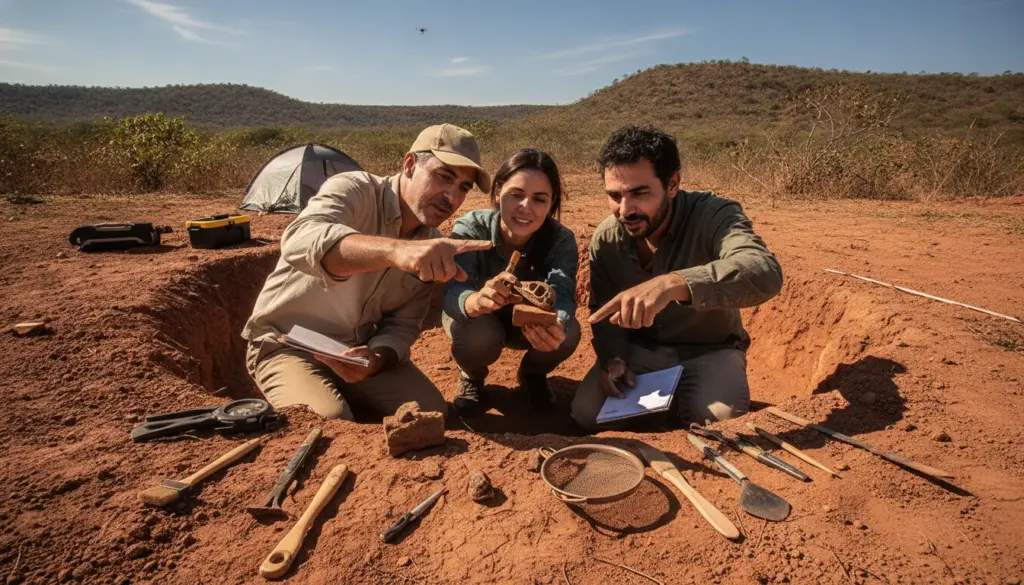
The unearthing of this site in 2000 happened by sheer coincidence. American paleontologist Paul Sereno was originally scouting the Niger dunes for dinosaur fossils when he noticed stone tools and human remains scattered across the surface. Beneath the loose topsoil hid something far more profound than ancient reptile bones.
Systematic excavations gradually revealed around 200 skeletons distributed across several low-lying sand mounds. Radiocarbon dating indicates the earliest burials occurred around 8000 BC, a period when massive glaciers still covered substantial parts of Europe.
These ancient individuals were not haphazardly left in the dirt. Many bodies were positioned with distinct care and specific postures. One particularly poignant grave features a mother and two children locked in a close embrace, resting undisturbed for millennia. Such deliberate funerary practices prove these groups were not mere wanderers, but deeply rooted societies with established rituals.
Artifacts Reflecting a Water-Dependent Lifestyle
Archaeologists recovered an impressive array of artifacts nestled among the remains. These carefully placed grave goods included:
- Bone hooks and heavy harpoons designed for extensive fishing
- Ostrich eggshell beads meticulously threaded into garments or jewelry
- Delicate pendants carved from ivory and hippopotamus teeth
- Discarded bones from turtles, crocodiles, and large fish left over from meals
These possessions paint a vivid picture of daily routines along the shores of an immense lake. The locals actively hunted aquatic prey, gathered shoreline resources, and fished for sustenance. Beyond showcasing material wealth, these burial items carried significant social weight. Placing a prized harpoon next to the deceased likely signified their respected status as a master hunter or fisher within the community.
Two Distinct Cultures Sharing One Shoreline
Osteological analysis reveals that a single unbroken lineage did not occupy Gobero. Instead, two distinct populations utilized the cemetery, separated by several centuries. Anthropologists have identified two culturally and physically separate phases of habitation.
The Robust Pioneers of the Wet Phase
The earliest inhabitants are identified as the Kiffians. They flourished during the most humid era, coinciding with the lake’s maximum water levels. Their skeletal structures reflect tall, heavily muscled physiques, which aligns perfectly with the strenuous physical demands of hunting large aquatic beasts. Burials from this specific soil layer contain massive harpoons alongside the remains of substantial lake creatures.
Around 6200 BC, the climate experienced a severe temporary shift. A prolonged drought caused ecosystems to collapse and water levels to plummet. Stripped of their primary life source, the Kiffian pioneers were forced to abandon the region.
The Slender Successors
Centuries later, the seasonal rains returned, inviting a new civilization known as the Tenerians to settle the exact same coordinates. These successors possessed a noticeably lighter, more slender skeletal build. Their lifestyle appeared more diversified, blending hunting and fishing with early plant-processing techniques.
Fascinatingly, the Tenerians buried their dead in the very same mounds as the Kiffians, yet largely avoided disturbing the older resting places. This lack of widespread grave disruption suggests they either actively recognized and respected the ancient burials or inherently viewed the landscape as sacred ground.
Chemical Clues Hidden in Dental Enamel
Beyond analyzing physical bones and tools, specialists examined the chemical signatures locked inside human teeth. The specific ratio of isotopes found in dental enamel provides critical data regarding geographic mobility and dietary habits.
Tests conducted on the Gobero populations yielded incredibly consistent isotopic values. This consistency confirms these communities did not migrate across vast territories, choosing instead to remain anchored near their dependable lake. The localized environment clearly offered enough sustained hydration and nutrition to support a highly stable existence.
Equally telling is the striking absence of skeletal trauma. Compared to many contemporaneous prehistoric sites across Europe and Africa, researchers noted very few fractures or weapon injuries indicative of warfare. Such peaceful conditions logically arise in lush habitats where resource scarcity is minimal, reducing the need for tribal conflict.
When the Water Finally Retreated
The gradual transformation into the hyper-arid Sahara we recognize today began roughly around 5000 BC. As the tropical rain belts permanently retreated southward, the majestic lakes slowly evaporated. River currents stalled, and the dense green vegetation incrementally died off.
This drastic environmental shift spelled the end for the lakeside dwellers. Stripped of reliable freshwater, their aquatic-based society could no longer function. The surviving families migrated toward wetter climates, leaving the sprawling cemetery behind to the elements. Shifting dunes eventually blanketed the site, preserving it in darkness for thousands of years.
There is a profound irony in the fact that the hostile conditions of the modern Ténéré desert ultimately safeguarded this archaeological treasure. The sheer inhospitability that kept modern humans away allowed the ancient landscape to survive as an undisturbed time capsule beneath the desert floor.
Modern Lessons from a Forgotten Oasis
The intricate history of Gobero highlights incredible human adaptability in the face of erratic climate cycles. It demonstrates that wherever freshwater exists, complex cultures, deep emotional bonds, and elaborate rituals will inevitably follow, even in spaces now synonymous with extreme desolation.
This site also provides crucial insights into the rapid tipping points of terrestrial landscapes. A territory that appears fundamentally uninhabitable today served as a thriving refuge in a different geological era. For ongoing conversations regarding desertification and global climate shifts, Gobero offers a stark warning: environments that currently feel permanent can radically transform within just a few generations.
Walking across the contemporary dunes, it is staggering to realize that children once splashed along a vibrant shoreline exactly where the sand now burns. It is a powerful reminder of the mourning families who gently placed their loved ones into the earth, fully believing that shimmering oasis would remain their eternal home.